I have waited a long time to post on this book. In part because I didn't want to simply give voice to my anger and disappointment that a purposely (seemingly) vacuous person has a position with the company that publishes – and seems to have great joy in rescuing and destroying – Dungeons & Dragons while having no real personal attachment to the game. Shelly Mazzanoble writes about the lessons she has learned from D&D the way I could try to detail the length and breadth of humanity from having to aid them with finding the products that are right in front of them at the store. Hey, I'll straight out admit that I used to visit the comparative stores in other markets when I was on vacation, meaning that I must have had some attachment and involvement with that job that went beyond taking home money every Thursday. It would be extremely hypocritical of me to suggest that Mazzanoble could not have developed an attachment to D&D through her workplace association with it. But I will insist that her connection is inferior to mine because mine is from my formative years. Like it or not – and I came to terms with it over a decade ago – I am a Dungeons & Dragons guy. Just not the kind that could get on board with 4E or be bothered to read any of the Forgotten Realms novels.
Mazzanoble, on the other hand, is the kind of person that I think my brother aspired to be for about a minute in 1993. By that I mean that I'm sure he would have loved to have interned at SubPop Records around that time, and he lasted a whole semester out in the Pacific Northwest at the Evergreen State College in Olympia, Washington. Mazzanoble comes off as a cross between a self-doubting/self-obsessed ditz and a functional, conscientious person who has a clue on how to get through life without needing to relate it to a game where the goal is often to murder and rob others. She seems to have to work backwards, giving information about her life and how her understanding is truly formed by her mother, and then inserting how Dungeons & Dragons doesn't countermand those important lessons.
Like her other book, it would seem that Everything I Need to Know I Learned from Dungeons and Dragons (2011) was written in an effort to redeem D&D of its image from...well, I honestly don't know when D&D had an image problem in my circles. I know there was some uproar about it when AD&D was breaking big in the late 1970s. I also know that bad press continued into the mid-1980s. But there were D&D boxsets at Toys 'Я' Us and Kay•Bee Toys, the AD&D books fully stocked at the tiny Palos Park Public Library, and a successful cartoon show during the 1980s. Hell, the worst thing I can think of associated with D&D – other than how some of the players really did look like greasy trolls who shun meaningful human contact, but since many of them were teens or in their early 20s, it is entirely possible they just hadn't mastered good hygiene yet – is the Dungeons & Dragons (2000) movie.
For all of my bitching, and there could be much more than what I'll show here, Mazzanoble isn't a bad writer. She is just (in my estimation) writing for the wrong audience. I have a feeling that the people who think that reality television on the opposite side of the spectrum from Mythbusters (2003-present) or Deadliest Catch (2005-present) aren't likely to be drawn to Dungeons & Dragons. There isn't a huge Say Yes to the Dress (2007-present) vibe to most D&D sessions. I'm not trying to knock shows that clearly appeal more to the ladies, but Dungeons & Dragons – even in its more introspective, personal moments – is usually not running short on testosterone. Every character has a means to go about killing, and most games expect it to happen on a regular basis. Hell, the original formula for advancing characters was largely predicated on how tough or dangerous the monsters were which the PCs were killing.
Mazzanoble seems to see D&D as a cooperative game – which it is – but doesn't seem to grasp that it is quite different from a sedentary team sport. There is almost no mention of character development, by which I mean how the player comes to know and understand his or her PC as a separate being (more than just an alter-ego). Instead, she seems to think that character creation is the time to understand the character; after that, it is a figure to be moved around on the combat grid and a sheet on which abilities and powers are recorded. She doesn't come across as cognizant of how D&D may be different from other roleplaying games. Why could she not learn everything she needed to know from Rifts or Deadlands – except for the fact that she isn't employed by Palladium Books or Pinnacle Entertainment Group?
She also largely ignores the role that having something that could draw a diverse group of outcasts together, as D&D did before the world became one that accepted and celebrated things like World of Warcraft or Skyrim, would have on the players. Coming to the game as an adult, where one can play it at work (on the clock), I am sure that she didn't give it much thought. Her one example of introducing it to children showed her to have little concept of how it might bring people with nothing else in common together.
This wasn't a bad book. But it certainly wasn't written with people like me in mind. Then again, several WoTC employees had no problem telling me that they had no qualms if all the longtime D&D players walked away when 4E was launched (because they had a plan to get a new generation of players). They also told me that they weren't interested in listening to feedback outside of organized play (because home campaigns can always change the rules as they see fit). I really wish I had written down those guys names way back when, because I know that one of them ended up being a prominent player in 4E; more than that, I would like to be able to back up my statements by saying something more than the WoTC employees at the GenCon booth told me those things.
Mazzanoble seems to have to make up for some of that damage, but she still isn't trying to appeal to longtime players. And I would be forever baffled as to why anyone who wasn't playing D&D would buy or read the book. It is a fake self-help book that is really an excuse for Mazzanoble to write about herself. I won't begrudge her that. I think a lot of us would do that if we were given the opportunity, and I know that I wouldn't be able to make myself as sympathetic as her. I just don't think that her efforts to wedge D&D into her personal story served her, her story, or the property.
Original fiction, opinions, and reviews that are decidedly not related to work. Also, apparently where people go to read about Steven Pfiel.
Showing posts with label Roleplaying Game. Show all posts
Friday, June 1, 2012
Thursday, May 17, 2012
There is a difference between "challenging" and "frustrating"
I first ran into people not quite understanding how to properly challenge their charges while I was in elementary school. There were two teachers who ran the program for gifted (in the good way, not in the Midvale School way) children, NOVA. Aside from the issues with gender inequality – they believed that girls were disadvantaged by traditional education methods, so their solution was to actively and purposely disadvantage the boys in their classes – they really had one major screw up. While making the material covered more challenging was the right thing to do, they also decided to be much harsher in their grading.
Not that there is anything wrong with tougher standards. It is not irresponsible to tell children that they shouldn't be aiming for the 70% mark to get by. Never mind that a C average would get a student booted out of the program, and even flirting with a low B led to some encouragement to migrate back to an existence with the normals. Those were the standards, and even though we didn't know what they were going in, they were pretty regular.
The problem was what it took to get that solid B average. Many of us are used to the soft and easy break down of 90/80/70/60 percent for the floors of A/B/C/D grades. It allows for an easy concept of how one is expected to perform. In NOVA, the break down was a little different. The As ranged from 100-96, Bs from 95-88, Cs from 87-78, and Ds from 77-70. Now those aren't equal spreads, but I guess there is nothing that says they have to be.
So, NOVA had tougher material and higher expectations in terms of performance in regards to grading. That just makes for a challenging experience; you can make your own decisions as to whether or not that is a good thing for 8 year olds. But these teachers also decided that they needed to be hypercritical when it came to grading and testing. The multiple choice tests had between 8 and 10 possible answers, and the students received credit only if they picked the answer that best fit the expectations of the teachers (usually 5 of the choices were correct to some degree). The essay tests (starting in third grade) demanded that the imposed format of topic sentence, supporting sentences, conclusion be used in every paragraph. If a sentence were deemed to not be on point within the paragraph, that was 5% off right there. Same for every spelling or punctuation error.
Throw in the fact that neither of these women liked me (and said so to both me as a child and to my mother while they were trying to get my brother and I kicked out of the program despite our good performance), and I never really felt like I was being challenged by NOVA. It was challenging, but I was just frustrated. I was punished for my inability to spell – something with which I still struggle – and not allowed any degree of creativity in building my written arguments. I wasn't rewarded for having a better understanding – as I saw it – than the teachers when I selected the answers that didn't need unstated qualifications (that they thought were implied in the questions). It was a fight, all the time, and it did much to ruin any fun I had in school.
And that lasted until about 2001. Well, if I am going to be honest it will endure in some degree forever. I have a general mistrust of teachers because of these women – the worse of the two has been reduced to teaching computer savvy students how to use outdated school computers at St. Christina School (3333 W 110th Street, Chicago, IL) – and, I would guess, that my similar distrust of women in general springs from the same source. (So, for those who were so eager to blame someone I didn't meet until the fall of 1991, I suggest that you may be wrong. Ask her. I'm sure she'd agree that she is blameless.)
Anyway...
One should never have a goal of frustrating people unless the desired result is to drive them away. Challenging them is different. In the endeavors we willingly take on, most of us like a challenge. If it all comes too easy, we tend to get bored and move on to something else. If it doesn't come at all, we'll just quit. And we are right when we do so.
I see a fair amount of RPG scenarios where the writers can't seem to make the distinction between frustrating players and challenging their characters. Sometimes this is because they just don't understand the mechanics of the game. Henry Lopez was a textbook offender of this when he put together a non-combat encounter for his Living Arcanis mod "Sibling Rivalry" where every PC needed to be able to scale a 200 foot tall cliff. Not in a, if we take a lot of time when can mitigate the difficulty for characters that don't do a great job of climbing. No, it was a every character needs to make this check that needs to challenge good climbers. Run as written, this encounter should kill PCs. It should leave entire groups sitting at the base, unable to go on. While that may be somewhat realistic, it isn't what players are looking for.
More recently, I and my fellow players suffered through Kyle Baird's Pathfinder Society Organized Play scenario The Rats of Round Mountain—Part I: The Sundered Path (#3-20). The author had a completely different understanding of the rules than those who have played the scenario; this is never a good sign. The result in a combat encounter which essentially runs as all of the players can make some guesses and maybe not be able to hit while the NPCs can do lots of damage to the PCs. Not fun. Not even for the GM running it.
This is not the first time that PFS has embraced the frustrating over challenging mindset. Sometimes it is because the GM isn't running it correctly (those little creatures aren't supposed to be invisible throughout the encounter, DG), but more often it was because somebody couldn't tell the difference between challenging and frustrating. Having to defeat a really tough bad guy? Challenging. Having to make more than 10 Fort saves in a scenario or pick up the plague? Frustrating. Needing to find a way to accomplish some tasks without resorting to combat? Challenging? Having all of the roleplaying elements of a sessions mean nothing because the investigation cannot reveal anything? Frustrating.
We want challenges. But we expect to succeed in them. We want to think that there is a chance of failure, a real chance, because it is that perceived risk that makes the success matter. Now, I don't think any of us wanted failure to be an actual option in elementary school (and that is not something we really willingly enter). And we would probably like for work to have a much greater chance of reward than real risk, since without it we may go hungry and be without shelter.
When it comes to hobbies, we want our successes to mean something. We want the frustrations to be minor, ones than can be overcome by a better understanding of the technique or situation at hand. It is why we don't stick with playing miniature golf or wiffle ball as adult hobbies. It is why – if we are being serious – we don't try to learn to play a musical instrument without some form of assistance or aid.
I guess I am one of those people who frustrates far many more than I simply challenge. I would apologize, but that seems like a lot of work; I'd have to track down people who I would just assume have forgotten about me. So, I have something to work on. But nobody is really adopting me as a hobby, so they all have the option of just walking away. I like my time spent playing RPGs. I just wish that the people who took the time to write the material had a better understanding of the difference between challenging and frustrating.
Not that there is anything wrong with tougher standards. It is not irresponsible to tell children that they shouldn't be aiming for the 70% mark to get by. Never mind that a C average would get a student booted out of the program, and even flirting with a low B led to some encouragement to migrate back to an existence with the normals. Those were the standards, and even though we didn't know what they were going in, they were pretty regular.
The problem was what it took to get that solid B average. Many of us are used to the soft and easy break down of 90/80/70/60 percent for the floors of A/B/C/D grades. It allows for an easy concept of how one is expected to perform. In NOVA, the break down was a little different. The As ranged from 100-96, Bs from 95-88, Cs from 87-78, and Ds from 77-70. Now those aren't equal spreads, but I guess there is nothing that says they have to be.
So, NOVA had tougher material and higher expectations in terms of performance in regards to grading. That just makes for a challenging experience; you can make your own decisions as to whether or not that is a good thing for 8 year olds. But these teachers also decided that they needed to be hypercritical when it came to grading and testing. The multiple choice tests had between 8 and 10 possible answers, and the students received credit only if they picked the answer that best fit the expectations of the teachers (usually 5 of the choices were correct to some degree). The essay tests (starting in third grade) demanded that the imposed format of topic sentence, supporting sentences, conclusion be used in every paragraph. If a sentence were deemed to not be on point within the paragraph, that was 5% off right there. Same for every spelling or punctuation error.
Throw in the fact that neither of these women liked me (and said so to both me as a child and to my mother while they were trying to get my brother and I kicked out of the program despite our good performance), and I never really felt like I was being challenged by NOVA. It was challenging, but I was just frustrated. I was punished for my inability to spell – something with which I still struggle – and not allowed any degree of creativity in building my written arguments. I wasn't rewarded for having a better understanding – as I saw it – than the teachers when I selected the answers that didn't need unstated qualifications (that they thought were implied in the questions). It was a fight, all the time, and it did much to ruin any fun I had in school.
And that lasted until about 2001. Well, if I am going to be honest it will endure in some degree forever. I have a general mistrust of teachers because of these women – the worse of the two has been reduced to teaching computer savvy students how to use outdated school computers at St. Christina School (3333 W 110th Street, Chicago, IL) – and, I would guess, that my similar distrust of women in general springs from the same source. (So, for those who were so eager to blame someone I didn't meet until the fall of 1991, I suggest that you may be wrong. Ask her. I'm sure she'd agree that she is blameless.)
Anyway...
One should never have a goal of frustrating people unless the desired result is to drive them away. Challenging them is different. In the endeavors we willingly take on, most of us like a challenge. If it all comes too easy, we tend to get bored and move on to something else. If it doesn't come at all, we'll just quit. And we are right when we do so.
I see a fair amount of RPG scenarios where the writers can't seem to make the distinction between frustrating players and challenging their characters. Sometimes this is because they just don't understand the mechanics of the game. Henry Lopez was a textbook offender of this when he put together a non-combat encounter for his Living Arcanis mod "Sibling Rivalry" where every PC needed to be able to scale a 200 foot tall cliff. Not in a, if we take a lot of time when can mitigate the difficulty for characters that don't do a great job of climbing. No, it was a every character needs to make this check that needs to challenge good climbers. Run as written, this encounter should kill PCs. It should leave entire groups sitting at the base, unable to go on. While that may be somewhat realistic, it isn't what players are looking for.
More recently, I and my fellow players suffered through Kyle Baird's Pathfinder Society Organized Play scenario The Rats of Round Mountain—Part I: The Sundered Path (#3-20). The author had a completely different understanding of the rules than those who have played the scenario; this is never a good sign. The result in a combat encounter which essentially runs as all of the players can make some guesses and maybe not be able to hit while the NPCs can do lots of damage to the PCs. Not fun. Not even for the GM running it.
This is not the first time that PFS has embraced the frustrating over challenging mindset. Sometimes it is because the GM isn't running it correctly (those little creatures aren't supposed to be invisible throughout the encounter, DG), but more often it was because somebody couldn't tell the difference between challenging and frustrating. Having to defeat a really tough bad guy? Challenging. Having to make more than 10 Fort saves in a scenario or pick up the plague? Frustrating. Needing to find a way to accomplish some tasks without resorting to combat? Challenging? Having all of the roleplaying elements of a sessions mean nothing because the investigation cannot reveal anything? Frustrating.
We want challenges. But we expect to succeed in them. We want to think that there is a chance of failure, a real chance, because it is that perceived risk that makes the success matter. Now, I don't think any of us wanted failure to be an actual option in elementary school (and that is not something we really willingly enter). And we would probably like for work to have a much greater chance of reward than real risk, since without it we may go hungry and be without shelter.
When it comes to hobbies, we want our successes to mean something. We want the frustrations to be minor, ones than can be overcome by a better understanding of the technique or situation at hand. It is why we don't stick with playing miniature golf or wiffle ball as adult hobbies. It is why – if we are being serious – we don't try to learn to play a musical instrument without some form of assistance or aid.
I guess I am one of those people who frustrates far many more than I simply challenge. I would apologize, but that seems like a lot of work; I'd have to track down people who I would just assume have forgotten about me. So, I have something to work on. But nobody is really adopting me as a hobby, so they all have the option of just walking away. I like my time spent playing RPGs. I just wish that the people who took the time to write the material had a better understanding of the difference between challenging and frustrating.
Tuesday, April 24, 2012
How Not to Abuse the Rules as a GM
Now, the game I played and judged (was the GM of) this past weekend was Pathfinder. It is, like it or not, the true heir to the legacy of Dungeons & Dragons that WoTC threw away when they introduced 4th Edition. I have been playing RPGs – starting with the Basic Rules set of D&D – for almost 30 years; longer if I consider playing with no understanding of the rules. But rules are actually important. They shouldn't be paramount, because there are the concerns of story and character and player investment, but in an Organized Play (OP) environment, rules are damn near the top of the list.
Not that everybody needs to know every rule. Not that anybody need to know every rule. There is a reason we carry the books around. Actually, these days most of the referencing is done on tablets (for access of the pdfs of the rulebooks) or on smart phones (for the website that has almost all of the rules material). We need access to those rules. Some of us are gracious in our ignorance, and others are fat pieces of shit who I will sooner see die then ever realize that their partially informed opinions – the same way most of the rest of us formulate opinions – are not universal truths.
As a player, I know not to cheat. Hell, I don't want to. I do want to avoid having bad things happen to my characters. I don't want them to be killed, or robbed, or imprisoned, or raped, or any of the other unsavory things that can happen to real people (and the chances for the aforementioned possible consequences drastically increase if the PCs are adventurers). But I see the easiest way to put the odds in my PCs' favor is to minimize the risk as much as I can, and that is just play style. I also try to make sure that my PCs have utility, that they can do several different things (though not as well as any character that chose to specialize in them). It means that I don't spend a lot of time wondering when the fight is going to happen so I can finally do something. I prefer the stuff that isn't combat. Not everybody is like that.
The aforementioned fat piece of shit (and I'm sure in about a week's time I'll regret repeatedly referring to him as a fat piece of shit, but at least I'm not calling him or her out by name as a fat piece of shit) decided that the adventure he was running for us, the players, was too easy. Fine. Those of us who GM in an OP setting have been there. Lots of players want to crack their PCs out, usually for combat. Hell, combat is the only true measure of success in OP, so those of us who don't so it are just harming ourselves (or looking for some degree of challenge to be left in the combat encounters). But he increased the difficulties of the encounters to counteract the combat ability of two PCs in such a way that those PCs were the only ones who could meaningfully contribute to the battles.
That is how to be a bad GM. It is a prime example of how not to abuse the rules. All GMs want to feel that what they are doing matters to the players. Players want to think that the actions of their PCs matter (though this isn't all that likely in OP sessions). Often, players aggravate the GMs by not paying attention and having silly table talk, bullshitting with each other until it is time to roll dice. And we should feel bad about that. But the GM doesn't just want attention because he or she is there. The GM wants attention because the actions of the beings he controls (the NPCs and monsters and such) present some degree of risk and challenge to the PCs.
The FPoS decided that one encounter had to be against a monster with an AC 41, SR 27 (maybe...we never surpassed it to know for sure, but the mechanics of it would be right), over 300 HP (all of that is meaningful if you know the system; the short version is that the monster was tough). Our party consisted of 10th and 11th level PCs. To put this in perspective, none of the PCs had an AC over 40 (my Arcane Monk did get her's up to 38 for this combat), none of us had SR (spell resistance), and none of us had more than 120 HP. The monster could deliver over 70 points of damage in a single hit, and since it was attacking with better than +30 to hit (meaning that it would hit my Arcane Monk with a 60% frequency and come close to killing her on the first attack, with five more to follow that same round). The only PCs who could fight it were the ones who were making a joke of all the other combats – the giant Robot and the dainty Archer (with his suspect dice that consistently rolled in the 17-20 range all weekend).
Everyone else was fucked. And we knew it. It didn't make the combat more exciting (the chance of losing does that to some degree, but knowing there is nothing a PC can do means that there is less reason to pay attention....like politics in Chicago). But FPoS sat in his chair chuckling like he had found the way to bring balance to the game.
As someone who frequently cheats as a GM, I can assure him that he did it incorrectly. When the PCs who are built to break the game are doing just that, the GM needs to introduce elements that slow down and hamper the (usually combat) successes of those PCs. Someone's archer is killing everything on the battlefield? What if all the bad guys could deflect those arrows (by ability or spell), at least for a short while? The other PCs now get to step up and help out. The raging barbarian/ultimate fighter/giant robot is killing every NPC with a single hit? Why not have the bad guys steal his or her (or its) weapon (even if the bad guys normally wouldn't have a chance in hell of succeeding)? The the battle beast of a PC has to come up with a new tactic and the rest of the party gets involved.
Maybe it is just laziness, but I think it points to a fundamental misunderstanding of how to break the rules for the good of everyone. I first encountered people doing it the wrong way when Carl Hewelt decided to make a Living Arcanis module more difficult for us because my Barbarian/Fighter was killing everything. The end result was the only PC who could do anything meaningful in combat was my Barbarian/Fighter. He pissed off the other players because he was trying to show me that my PC could be made less effective, and he didn't even do that. I think that there has to be a misreading of the situation where these GMs think that since they have to increase the difficulty of the scenario, they should only let the PCs who made that necessary (?) succeed from that point forward.
I don't know if the players I GM for know when I am cheating. I think they have a notion, sometimes, but they often seem surprised by the fact afterwards. With experiences like the one the FPoS put together, everyone at the table knew right away. And I think we all would have been fine with it had the FPoS found a way to make it a more equitable experience. But if you are too single minded to see anyone else's opinion on anything, I guess you are not likely to consider whether or not they see the general experience the same way as you. And the FPoS is of the belief that he can make the most effective combat builds out there, so his attempts to frustrate those who are combat monsters may have been a qualified success, but it also shows how little he understands the game.
Monday, April 23, 2012
CodCon 2012
| I do not get Cosplay. Not at all. |
![]() |
| Three of the miniatures I got for free. I can't believe other people expect me to pay to get things like this. |
Wednesday, February 1, 2012
Big Eyes, Small Mouth (1998 revised) & Big Robots, Cool Starships (1999)
Once upon a time, roleplaying games didn't feel the need to define everything and use the rules to constrict ideas and possibilities. It wasn't that long ago, actually. But looking back at one of the better experiments in an 'open system' – one that lets the players and GM (gamerese for Game Master, or the person who adjudicates the rules and plays "the world" instead of one character) craft their tales of adventure, intrigue, and so on without the need for everything to be detailed in the game mechanics – that came out of the late 1990s, I was surprised at how much roleplaying games have seemed to change. At least for me.
Now, Big Eyes, Small Mouth (1998 revised printing) wasn't interested in setting up a system that would define anything; that was up to each individual group. No, what Mark C. MacKinnon appears to have been after was just a simple set of rules to allow for some balancing of the imaginative playground for those who wanted to play anime or manga styled stories out as a roleplaying game. At the time, he still hadn't dubbed it the Tri-Stat system (a move I'm convinced was motivated by concerns for marketing the licensed products that would later be published by Guardians of Order).
The idea behind it is insanely simple. The core mechanic is just rolling 2d6 (or two six-sided dice, for those who don't read gamerese fluently) and trying to get a low total. That is somewhat counterintuitive, but it makes sense within the framework of the rules. What there are that amount to rules, at any rate.
There is a system for building a character, distributing points among the three stats – Body, Mind, and Spirit – and how some values derive from how those points are spent. There are suggestions as to what the levels purchased might mean in a given setting or game, but nothing is hard and fast. Because BESM was designed to be used in any conceivable setting, it doesn't have chapters on skills (instead, a character can do most things that they should be able to do, and can make a check against the stat that best fits the situation. Combat is handled slightly differently, invoking a couple of derived values and characters can vary widely in ability. Again, because it is written to accommodate any setting or story, there are allowances for giant robots and spaceships as well as magic and strange mental powers. That last one is the only part where the rules get somewhat concrete, as mental combat is handled differently than normal, physical combat.
By itself, the BESM doesn't feel like an RPG rule book. Instead, it seems like the guidelines to allow players to break free from the restrictive chains that lock characters into a game-defined type or class or O.C.C. (instead of an anime defined type, which players are somewhat encouraged to adopt as it should help them immerse themselves in a different style of play that still mimics their favorite source material) while still rolling dice and having a fair amount of random influence on the outcome of the story. As far as that goes, it holds up quite well – in spirit. I certainly wouldn't pay $13.95 for the same thin book now (how reckless was I with my RPG spending...I easily spent about 1/4 of my income on gaming shit over a three year period in the late '90s and I'd like to have most of that money back), but that also has something to do with how my experience with gaming has changed.
More on that later.
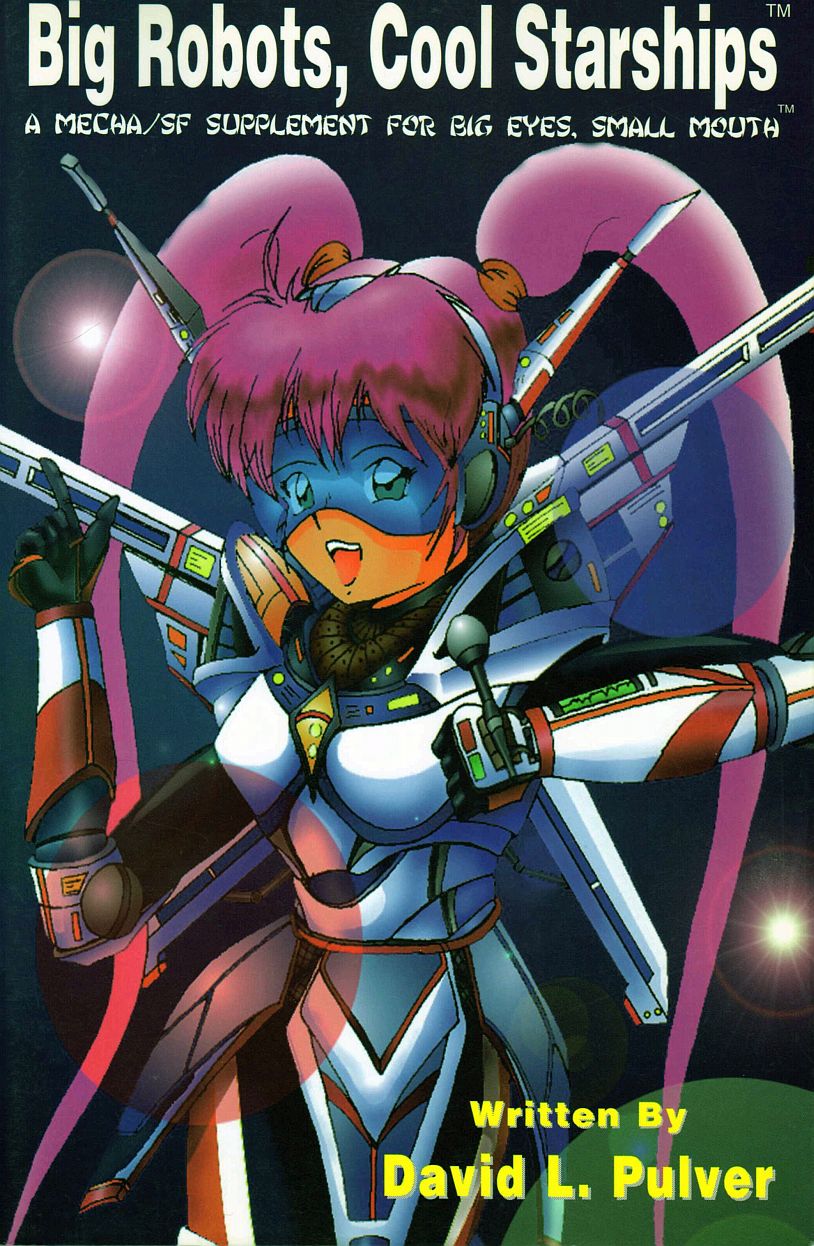
The only supplement I purchased for BESM was Big Robots, Cool Starships (1999). It functions much like the original, giving ideas for how to build mecha (or giant robots), cyborgs, androids, spaceships, or even magical armor with the same level of vagueness. BESM was focused on the idea that the players and GM could operate in a cooperative manner and agree upon how the rules should be interpreted. Because of the level of sparsity in regards to all-around detail, I think it works. There isn't much of a way to win at BESM (though the Extra Attacks attribute introduced in BESM becomes abusive when combined with Multiple Mecha Attacks in BRCS, because the amount of attacks multiply with each other...and that means that one character may have one attack action each round and another could have 20) because the game is clearly meant to focus on story.
In that regard, neither MacKinnon nor David L. Pulver (author of BRCS) manage to create a sense that they have a launching pad to steer players and GMs in what they assume to be the right direction. This may be because MacKinnon originally had no intention of getting in the way of the players' good time. There is also the issue that Pulver's suggested adventure is too bare bones to help a new RPG player, but too scripted in its expected outcomes to make experienced GMs and players happy.
Still, I was pretty shocked that it has only been 14 years (almost 15) since MacKinnon first wrote BESM. He wrote in a pre-3E D&D world, where game companies did not have the luxury of writing for an OGL (Open Game License) system and making your own system almost always meant having a distinctive setting. Sure, Fudge showed up in 1995, but it required a lot of work in terms of figuring out how much of the rules were needed for a setting or story, and in my extremely limited experience, players and GM often had difficulty deciding on how to play with the less than concrete Fudge rules. GURPs had been around much longer, debuting in 1986, but it relied on concrete rules that were specific in terms of what applied to what setting. There was room for GM fiat in decided for exceptions, but the supplemental material became canon unto the type of setting people played (not always, of course, but far more often than I would have expected).
There is a danger when it comes to mixing hard defined rules with whatever the group agrees upon. Indeed, I never had a good experience running (GMing) or playing White Wolf's Mage: The Ascension (I played with groups that used the 1996 2nd Edition) because it did exactly this. There is no easy way to define how magic is supposed to work unless one resorts to a set of spells, and Mage didn't want to do that. The problem became that players would attempt to do insanely powerful things (like create a living creature out of the aether) while having very little power as defined by the game mechanics. It invariably turned into an argument and at least one player would pout because they couldn't do whatever they wanted to do. BESM seemingly overcomes this because everyone has to agree as to what the rules mean, because the book doesn't define them to any kind of absolute or concrete terms. Everyone would know what the rules allow for because they are the people who set the limits, and that seems both audacious and inspired. It should even work.
However, if my past decade of gaming has taught me anything, it is that players seem to crave system. Story has become much less important. Maybe it is the MMO effect, where how one makes a character has more impact than the story for him or her. D&D 3E was a huge offender in terms on needing to have everything fit the rule. Gone was the simplicity of giving the baddies an AC (Armor Class, or what level of skill+luck is needed to hit the creature or character) and HP (Hit Points, gamerese for how much damage a creature or character can take before it dies) and running a combat on the fly. Gone was giving certain creatures the abilities necessary for the scene to look and feel right. Everything became defined, and people who played the d20 system (RPGs that ran under the OGL system) got sucked into this trap. I know because I am one of them.
I don't know if I could take people whose experience came from that d20 mindset and expect them to get the much more free-form BESM. I am certain that there are old-school gamers who prefer the fits the rules mindset that has fallen upon us. I miss the story being king. I miss the rules always being made to fit the story, and not vice versa. BESM requires a certain level of maturity that may be best suited for the RPG player who has learned how to play but not yet settled into a rut of comfortable systems. I do know that it would be a disaster for an Organized Play campaign, and that is where I see most my RP action these days. OP play is an entirely different animal from home play, the kind of RPG experience that used to be the norm. It is as different as being friendly with the people with whom one plays and playing a game with well-established friends. OP requires a commitment to the rules because that is the consistent element. It is rules over story, even when the story is very good.
Song of Ice and Fire setting, since they had the rights before collapsing because of debt. What could have been.
Now, Big Eyes, Small Mouth (1998 revised printing) wasn't interested in setting up a system that would define anything; that was up to each individual group. No, what Mark C. MacKinnon appears to have been after was just a simple set of rules to allow for some balancing of the imaginative playground for those who wanted to play anime or manga styled stories out as a roleplaying game. At the time, he still hadn't dubbed it the Tri-Stat system (a move I'm convinced was motivated by concerns for marketing the licensed products that would later be published by Guardians of Order).
The idea behind it is insanely simple. The core mechanic is just rolling 2d6 (or two six-sided dice, for those who don't read gamerese fluently) and trying to get a low total. That is somewhat counterintuitive, but it makes sense within the framework of the rules. What there are that amount to rules, at any rate.
There is a system for building a character, distributing points among the three stats – Body, Mind, and Spirit – and how some values derive from how those points are spent. There are suggestions as to what the levels purchased might mean in a given setting or game, but nothing is hard and fast. Because BESM was designed to be used in any conceivable setting, it doesn't have chapters on skills (instead, a character can do most things that they should be able to do, and can make a check against the stat that best fits the situation. Combat is handled slightly differently, invoking a couple of derived values and characters can vary widely in ability. Again, because it is written to accommodate any setting or story, there are allowances for giant robots and spaceships as well as magic and strange mental powers. That last one is the only part where the rules get somewhat concrete, as mental combat is handled differently than normal, physical combat.By itself, the BESM doesn't feel like an RPG rule book. Instead, it seems like the guidelines to allow players to break free from the restrictive chains that lock characters into a game-defined type or class or O.C.C. (instead of an anime defined type, which players are somewhat encouraged to adopt as it should help them immerse themselves in a different style of play that still mimics their favorite source material) while still rolling dice and having a fair amount of random influence on the outcome of the story. As far as that goes, it holds up quite well – in spirit. I certainly wouldn't pay $13.95 for the same thin book now (how reckless was I with my RPG spending...I easily spent about 1/4 of my income on gaming shit over a three year period in the late '90s and I'd like to have most of that money back), but that also has something to do with how my experience with gaming has changed.
More on that later.
The only supplement I purchased for BESM was Big Robots, Cool Starships (1999). It functions much like the original, giving ideas for how to build mecha (or giant robots), cyborgs, androids, spaceships, or even magical armor with the same level of vagueness. BESM was focused on the idea that the players and GM could operate in a cooperative manner and agree upon how the rules should be interpreted. Because of the level of sparsity in regards to all-around detail, I think it works. There isn't much of a way to win at BESM (though the Extra Attacks attribute introduced in BESM becomes abusive when combined with Multiple Mecha Attacks in BRCS, because the amount of attacks multiply with each other...and that means that one character may have one attack action each round and another could have 20) because the game is clearly meant to focus on story.
In that regard, neither MacKinnon nor David L. Pulver (author of BRCS) manage to create a sense that they have a launching pad to steer players and GMs in what they assume to be the right direction. This may be because MacKinnon originally had no intention of getting in the way of the players' good time. There is also the issue that Pulver's suggested adventure is too bare bones to help a new RPG player, but too scripted in its expected outcomes to make experienced GMs and players happy.
Still, I was pretty shocked that it has only been 14 years (almost 15) since MacKinnon first wrote BESM. He wrote in a pre-3E D&D world, where game companies did not have the luxury of writing for an OGL (Open Game License) system and making your own system almost always meant having a distinctive setting. Sure, Fudge showed up in 1995, but it required a lot of work in terms of figuring out how much of the rules were needed for a setting or story, and in my extremely limited experience, players and GM often had difficulty deciding on how to play with the less than concrete Fudge rules. GURPs had been around much longer, debuting in 1986, but it relied on concrete rules that were specific in terms of what applied to what setting. There was room for GM fiat in decided for exceptions, but the supplemental material became canon unto the type of setting people played (not always, of course, but far more often than I would have expected).
There is a danger when it comes to mixing hard defined rules with whatever the group agrees upon. Indeed, I never had a good experience running (GMing) or playing White Wolf's Mage: The Ascension (I played with groups that used the 1996 2nd Edition) because it did exactly this. There is no easy way to define how magic is supposed to work unless one resorts to a set of spells, and Mage didn't want to do that. The problem became that players would attempt to do insanely powerful things (like create a living creature out of the aether) while having very little power as defined by the game mechanics. It invariably turned into an argument and at least one player would pout because they couldn't do whatever they wanted to do. BESM seemingly overcomes this because everyone has to agree as to what the rules mean, because the book doesn't define them to any kind of absolute or concrete terms. Everyone would know what the rules allow for because they are the people who set the limits, and that seems both audacious and inspired. It should even work.
However, if my past decade of gaming has taught me anything, it is that players seem to crave system. Story has become much less important. Maybe it is the MMO effect, where how one makes a character has more impact than the story for him or her. D&D 3E was a huge offender in terms on needing to have everything fit the rule. Gone was the simplicity of giving the baddies an AC (Armor Class, or what level of skill+luck is needed to hit the creature or character) and HP (Hit Points, gamerese for how much damage a creature or character can take before it dies) and running a combat on the fly. Gone was giving certain creatures the abilities necessary for the scene to look and feel right. Everything became defined, and people who played the d20 system (RPGs that ran under the OGL system) got sucked into this trap. I know because I am one of them.
I don't know if I could take people whose experience came from that d20 mindset and expect them to get the much more free-form BESM. I am certain that there are old-school gamers who prefer the fits the rules mindset that has fallen upon us. I miss the story being king. I miss the rules always being made to fit the story, and not vice versa. BESM requires a certain level of maturity that may be best suited for the RPG player who has learned how to play but not yet settled into a rut of comfortable systems. I do know that it would be a disaster for an Organized Play campaign, and that is where I see most my RP action these days. OP play is an entirely different animal from home play, the kind of RPG experience that used to be the norm. It is as different as being friendly with the people with whom one plays and playing a game with well-established friends. OP requires a commitment to the rules because that is the consistent element. It is rules over story, even when the story is very good.
Song of Ice and Fire setting, since they had the rights before collapsing because of debt. What could have been.
Friday, January 27, 2012
Learn the Rules
Most of the players had 4th level characters (with one having a 5th level), so nobody was new to the campaign or the system. In fact, I am nearly positive that all the players at the table had been to the Monday night games at Chicagoland Games before. As such, I was not expecting any kind of problem.
Now, I have gotten a little lazy in my attitude towards Pathfinder Society play. I don't always update my records right away, I don't closely follow the ongoing story, and I don't dig through the rules to find all of the combinations the players are sure to want to abuse so they can play the most powerful version of their characters as possible. But where I have truly gotten lazy is in how I handle the players before the session starts, probably because after eight years of judging organized play I have begun to think that experienced players should be responsible enough to play the game without cheating. Or, if they feel the need to cheat, they will at least cheat on dice rolls and not the basics of the rules.
Then there was the player with the 4th level Cleric.
I had judged him before, a couple of months ago. I remember him not really knowing the rules, which was okay at the time. We are trying to get new players to show up – both because we want more people to help grow the campaign and because we want them to buy stuff from the store that lets us use the space – and that means that some people will start playing without really looking at the rulebook. Fine. He had problems with some of the core things about his character, but they were corrected as we played the scenario. At the end, I very politely suggested that he go over the few areas about which he seemed to be completely unfamiliar.
I didn't think that would necessarily solve the problem, but I thought it would be a step in the right direction. Lo and behold, he shows up for the Monday session with the same character and proceeds to make even more egregious mistakes in regards to his character. And I want to be clear I am not slamming somebody's play style. Sure, it bothered me that he wanted no roleplaying, just roll playing (meaning that he just wanted to roll the dice for everything his character did), but because he seems to have come to Pathfinder through online play, I kind of expected that. No, this player consistently misunderstood nearly every rule in regards to his character.
He didn't want to memorize his character's spells ('I can just cast anything on my spell list, right?'). He wanted to add his character level to his channeling. He wanted to roll the wrong dice for his channeling. He would stop the action to look up a spell description on his phone (which does happen, but he waited until it was his turn to even start the search and that would stop the game dead for at least a minute), but he only did that a few times. Not carrying around a rulebook (or a printed copy of his spells), he seems to have opted to keep his spellcasting to a minimum. Again, that can be a fine play choice but he could have helped his fellow players by actually being familiar with what his character could do.
And I don't mean as a 4th level Cleric. I mean as any type of Cleric. Or spellcaster in PFS.
I corrected him on his belief that he could spontaneously cast his spells (which I had done before), but he continued in his belief that he did not need to prepare his spells or make a spell list. He got a little frustrated that he couldn't do whatever he wanted (I think this had as much to do with him wanting a more combat focused experience and I was trying to gives as much RP time as possible, so he may have had some legitimate frustration with my style). But he has a 4th level character. That means he must have played him – because I'm pretty sure he hasn't been judging – at least nine times. To be fair, that is about five times too many to have any uncertainties on the basics of the rules, and at least three sessions too many to not know the basics of what his character can do (you know, by the actual rules).
It pissed me off. I was already in a bad mood because I forgot to pack a book for my train rides to and from the game (meaning I missed out on over two hours of reading I could have accomplished), but that anger was directed at myself. I was hoping that the players would be able to give me as good an experience as I was planning on giving them. I like to think at least three of the five players honestly enjoyed the session. I enjoyed a lot of it. But not the guy who shows up to play the game without any regards to playing by the rules.
I can stand a small amount of cheating. I don't view it as all that different from the people who try to min-max the hell out their PCs to get the best advantages they can find. But cheating usually means having an understanding of the rules one wants to find a way to get around. I respect that a whole hell of a lot more than showing up without knowing what one is doing in what is essentially a session not for beginners. I see that as wasting my time and being discourteous to the other players.
Just learn the rules, man.
| Okay, I know it is in the Star Wars alphabet, but I think it conveys the thought just as well. |
Monday, December 5, 2011
Gaming in Different Systems (to break up routine and keep the game fresh)
As far as this applies to me, I guess that part of the reason is that I have no desire to master a system. I am not, nor do I think have ever been, looking for a way to game the system. I don't want to get bogged down in the minutiae of the rules, the deep crunch that some enclaves of gamers dive right into, looking for a way to win at character creation or power combinations. I want to be able to play, and in most instances to be capable of running the game (if needed). But I still think the second rule should be to enjoy myself (behind the first rule – don't ruin anyone else's good time – and slightly ahead of the third rule – don't cheat unless you are the GM), and I usually don't happily read more into the rules than what I need to accomplish that.
There is a danger of sticking too long to a single system, though. Eventually, those little facets of the rules that I could avoid start springing up. Worse – and this is the situation in which I find myself – characters start to seem less like organic beings who grow and evolve over the course of play (yes, I am generally that reckless when it comes to anticipating character progression – a topic I have briefly covered before) and things to be optimized or trickerated (read: made to have many minor tricks that, in combination, amount to increased utility and abilities beyond standard or optimized builds). The characters stop having personality and become little more than the information on the sheet. And that is just boring to me.
I kicked around the MechWarrior RPG 2nd Edition (1991) and some GURPs (1986). I tried Fudge (1992) but found it too abstract for my purposes. My cousin tried to get me interested in RoleMaster but I prefer the rules-light, setting specific Middle-Earth Roleplaying Game (1984) and gave it a few months of play. Eventually I fell back into AD&D 2nd Ed., but that was short lived as we – as a group – came to discover Vampire: The Masquerade (2nd Edition) (1992). Vampire led to the other White Wolf games and it wasn't a little more than two years before the entire enterprise was back to looking like a bunch of dots on the page. The characters who started these campaigns – Demius Bloodclaw in the Dragonlance AD&D campaign and Richard Talisman in the Vampire chronicle, both run by Jeff Bergman – shone so much brighter as beings with whom I shared time and gave voice than those toward the end.
However, I find myself playing only Pathfinder these days (and only the Organized Play scenarios and modules). I have six character that I have played – Daenaris, Hymibi Jymbo, Kiara, Bellarius D'Nassi, Jenissa Halvarek, and Hedda Gørsyn – and one yet to be played (Aeoki Hyrushi, the character who is supposed to go with the picture at the beginning of the post). I find myself having a hard time being invested when a character may only be played two or three times a year, but it is even worse when the rules seem to take over the experience.
I don't feel any strong need to get involved in different games, but I know that throwing different systems into the mix helps break up the desire to look at the roleplaying experience as something that can be won by making a better, more powerful, more resource-laden character. In previous experiences, one of the things that changing systems did was expose me to new and different people. I already get a steady stream – perhaps too much – of that with PFS.
I know people who purposely plan short campaigns as a way to keep things fresh. One of the things this allows is to let the duties of GMing be shared (OP accomplishes this much differently), but it also means that the players will likely move on to a new game before anyone has felt the need to figure out how to make the best character they can. It keeps the focus on the roleplaying and the characters have to be found and defined quickly because they won't be around forever [Talisman was played for almost three years, Mistocles Sardis (Living Arcanis) was played for six years, and Daenaris was first played on 11/27/09]. I don't think that is what I want to do, but changing things up with different systems – on occasion – is usually a good idea.
Monday, November 28, 2011
Stuffed COWS '11
I find it hard to motivate myself to write a full post about anything in the wake of spending 34 hours running and playing Pathfinder Society Organized Play at Stuffed COWS – a local gaming convention hosted at the College of DuPage for (I believe) 13 years now. That is much longer than my involvement with it, but I have been a regular for a few years now. I started as a die-hard Arcanis player, but when that world changed rules systems, I was more interested in sticking with something similar to v3.5 than the (mostly) well developed world of Onara.
So I am just posting this as a kind of filler. It also seemed to make sense to write about this as soon as possible – The Descendants (2011) can wait a day or two. Sorry if anyone was expecting something insightful today.
I had a good time at the convention. Two players told me that I ran the best table at which they played – at least up to the point they told me – and I felt good because I went out of my way to make sure I could manage the challenge for the PCs without risking it being a death trap. None of the players who blitzed through an earlier scenario (under two and a half hours) seemed upset about having a lot of extra time on their hands; I did everything I could to make the experience memorable because of what they had their characters choose to do to overcome minor obstacles. Yes, I felt very self-conscious running a scenario with a player who had already run it for me (he knows where I'm changing the mod or breaking rules on-the-fly), but I think the table enjoyed it and nobody told me I was doing it wrong.
The RPG Table Tent at Work and Play and The Problem Player at the Con posts). My weredragon got to assert that she is the Sewer Dragon of Absalom. I got to play a sadistic, but not unintelligent, goblin sneak-thief. And I got to break out a new character – and had to choose a faction at the table – who was so far out of her element that it was scary. Actually, that table didn't sit particularly well with me. There was a teenager who brought real immaturity to the table (not the adult immaturity to which I have become accustomed), and I really don't care for that. There was a revisit of the theme of a player demanding that all of the spotlight falls on him and not playing well with others (still not me), and of leaving my underpowered PC to fend for herself.
I got to see some of the table tents I designed in use with other players. I got to take some pictures of other tents in use. I was told I won over one player to the use of the table tent, and another commented on how he had shared my laments with a certain bad player with some friends. I was just really stoked to know that they had ever read anything on the blog.
I actually didn't hear much in the way of complaining this year. But the attendance was well beneath where I would have liked to see it. I think the high water mark was running 10 tables in a slot. Four years ago it would have been around 18, which means another 40-50 players. It worked out for making it easier to organize, but I missed the bustle a little. I did get to see people I have not seen in quite some time (including a pair of brothers who I just assumed weren't gaming any more), and that was cool.
Here are some pictures I took. I know that nothing about them conveys the fun or the action we experience while playing PFS. Sorry about that.
So I am just posting this as a kind of filler. It also seemed to make sense to write about this as soon as possible – The Descendants (2011) can wait a day or two. Sorry if anyone was expecting something insightful today.
I had a good time at the convention. Two players told me that I ran the best table at which they played – at least up to the point they told me – and I felt good because I went out of my way to make sure I could manage the challenge for the PCs without risking it being a death trap. None of the players who blitzed through an earlier scenario (under two and a half hours) seemed upset about having a lot of extra time on their hands; I did everything I could to make the experience memorable because of what they had their characters choose to do to overcome minor obstacles. Yes, I felt very self-conscious running a scenario with a player who had already run it for me (he knows where I'm changing the mod or breaking rules on-the-fly), but I think the table enjoyed it and nobody told me I was doing it wrong.
The RPG Table Tent at Work and Play and The Problem Player at the Con posts). My weredragon got to assert that she is the Sewer Dragon of Absalom. I got to play a sadistic, but not unintelligent, goblin sneak-thief. And I got to break out a new character – and had to choose a faction at the table – who was so far out of her element that it was scary. Actually, that table didn't sit particularly well with me. There was a teenager who brought real immaturity to the table (not the adult immaturity to which I have become accustomed), and I really don't care for that. There was a revisit of the theme of a player demanding that all of the spotlight falls on him and not playing well with others (still not me), and of leaving my underpowered PC to fend for herself.
![]() |
| This is a modified piece by Adam Majka with the Pathfinder logo under it. I used a different version in one of the table tents I brought for players. I like how this image came out so much, but I wasn't going to drain the ink on the color printer to print it out. |
I actually didn't hear much in the way of complaining this year. But the attendance was well beneath where I would have liked to see it. I think the high water mark was running 10 tables in a slot. Four years ago it would have been around 18, which means another 40-50 players. It worked out for making it easier to organize, but I missed the bustle a little. I did get to see people I have not seen in quite some time (including a pair of brothers who I just assumed weren't gaming any more), and that was cool.
Here are some pictures I took. I know that nothing about them conveys the fun or the action we experience while playing PFS. Sorry about that.
| Timothy Bailey's tent for Dr. Wogglebug. I saw him in action multiple times. |
| Timothy Bailey's tent for Huang-Fu Zheng. I did not see him in action. |
| Hawthorne Candlewood, Jenissa Halvarek (the weredragon), and Dr. Wogglebug after defeating an opponent in Sewer Dragons of Absalom. Tim Tjarks did an awesome job judging us. |
| Two witches, a barbarian/oracle, and my magus/bard escorting some goblins (the Snapple lid represents the cage that one of the goblins was put in). |
Thursday, November 3, 2011
Pathfinder Tents
Just threw a couple of tents together to stand in for the standard fill-it-in-yourself (which these still require) table tents for PFS (or most any FRPG) play. I have a 33 page pdf file (3 tent faces to a page, top face is the same throughout) with 67 different looks. Now, should I acknowledge that I'm not going to print out the full file for the upcoming convention – and not just because I don't want to drain the color from the printer – and that they are not going to replace the more basic tents that have been in service for over a decade?
If you have never been to this blog before, I have a few previous posts on the table tent (The RGG Table Tent and Me, The RGG Table Tent at Work and Play, and The Non-RPG Table Tent), and am hoping that this will be my last regarding them in a long while.
![]() |
| This one was done specially for COWS conventions. Hence the COWS logo and dancing cows. Also managed to throw a Pathfinder Society logo in there. |
| At no point does any of the text change (though I had to reposition it for a few of the ones I did). Figured this does as good a job of advertising PFS play as the downloadable tents from Paizo. |
| I did one for each of the factions (secrecy be damned, I guess). For some reason, when I look at a bunch of these one after another, they look like bank deposit forms to me. |
| The alternate version of the Osirion tent. For some reason I really like this graphic more than the standard one. My great thanks to whoever made it. |
| No, I can't think of a situation in PFS play where a PC is going to look like this. But it is a cool looking picture and I wanted to use it. |
| Playing a pregen? Or maybe you just really like the artwork for the iconics (they are recognizable enough that their images promote the game)? Then have I got the table tent for you. |
| Another image that just screamed out to have a character made to match it. If I were making this into a PC, it would have to be a Chelaxian (proto Hell Knight). |
| Along the same lines, this would be that Silver Crusade character I'm probably not going to make. I get a paladin vibe from this. |
| Maybe you have the mini that goes with this picture (I've seen it in play). At least it shows that I made some tents for male PCs. |
| Ever wonder how all of the bad guys can immediately recognize your PC as a Pathfinder? Maybe it is because you went and put a Wayfinder on your table tent. |
| Want a tent that you can color yourself? Or maybe you just need something that says guy with a sword because you haven't fleshed out the rest of the concept. Well, here you go. |
| What if your ninja is male? Or you just want a more dynamic shot for a ninja-type character? That is why I put this one together (on the same page with just the regular ninja). |
Wednesday, November 2, 2011
The Non-RPG Table Tent
Really brief today.
I have put up a bunch of my table tents – and a few others – that are game related. However, I have had occasion to have a table tent (a desk tent, if you will) for school. I had a professor – for three classes – who had a devil of a time remembering names and asked everyone to put the tent out before them so she could better associate the name to the face. By the time I actually made this one, it was somewhat unnecessary (there have to be people out there wondering if I ever had a teacher at any level who didn't quickly learn who I was), but not having one would have been quite conspicuous. So this is what I made for that class.
Yes, the picture is cropped from my sit down with Robert Englund, but it was the most up to date picture I had of myself at the time. I guess if I had it to do over again, I would have added some other details, but I thought this got the point across. Oddly, nobody ever called me Timothy. Its written right on the tent. It is how my name is listed on all my papers. But people have no problem shortening it to Tim (which is fine), and it really is a special kind of pretentiousness to make people refer to me as Timothy (I'm not about to force the issue).
So, there you go. Pretty much the same layout I always use (picture on the left, text on the right, framed to take up one-third of the page – in this case the middle). Yes, people did comment on me going through the trouble of making it (rather than just scrawling out my name on a folded piece of lined paper), but we had these things up for the first five weeks of class and I have to think that it couldn't hurt to put some effort into the project.
I have put up a bunch of my table tents – and a few others – that are game related. However, I have had occasion to have a table tent (a desk tent, if you will) for school. I had a professor – for three classes – who had a devil of a time remembering names and asked everyone to put the tent out before them so she could better associate the name to the face. By the time I actually made this one, it was somewhat unnecessary (there have to be people out there wondering if I ever had a teacher at any level who didn't quickly learn who I was), but not having one would have been quite conspicuous. So this is what I made for that class.
Yes, the picture is cropped from my sit down with Robert Englund, but it was the most up to date picture I had of myself at the time. I guess if I had it to do over again, I would have added some other details, but I thought this got the point across. Oddly, nobody ever called me Timothy. Its written right on the tent. It is how my name is listed on all my papers. But people have no problem shortening it to Tim (which is fine), and it really is a special kind of pretentiousness to make people refer to me as Timothy (I'm not about to force the issue).
So, there you go. Pretty much the same layout I always use (picture on the left, text on the right, framed to take up one-third of the page – in this case the middle). Yes, people did comment on me going through the trouble of making it (rather than just scrawling out my name on a folded piece of lined paper), but we had these things up for the first five weeks of class and I have to think that it couldn't hurt to put some effort into the project.
Subscribe to:
Posts (Atom)