I remember the first – and to that point, only – time I read Mrs. Frisby and the Rats of NIMH (1971). It was well after Don Bluth's animated adaptation, The Secret of NIMH (1982), at least as how time is seen to a child. To my knowledge, I was the last of my friends to actually read the book; I distinctly remember asking Joel Tysiak for the title of the book so that I didn't end up reading something nobody else had. I can't explain why that last part was important because I still don't know.
As a child, I don't know if I got beyond the simple narrative of the story. It certainly was more tame than the movie. No magic. There isn't some sinister force working against the good rats. It certainly didn't seem all that heroic. The best thing going for it – it seemed – was that it had talking animals.
Giving it another pass as an adult, I was struck by O'Brien's economy of language. He doesn't draw this tale out to preposterous lengths, choosing instead to keep the story continuously moving forward with only the necessary descriptive adjectives and adverbs. He certainly challenges the vocabulary of the average 10 year old with it (I don't know the target audience, but it feels like it is pre-tween), but not in an aggressive or impolite manner. Indeed, I can imagine children gleaning most of the meaning from context and happily turning to the (online) dictionary for any words beyond them.
It has at its core an interesting concept for a children's book. It is about the everyday heroics of parenting made manifest in the quest to keep a child safe. The good relationship the late Jonathan Frisby built with the Rats (and how well he was regarded by other various creatures) allow for Mrs. Frisby to seek out allies and do right for her children. She cannot do it alone, but she is not so obstinate as to even try to forgo seeking help. She is also a good enough soul to offer help to others when she is in position to do as much.
In an animal world where most of those she encounters are smarter than she is, Mrs. Frisby isn't rejected or looked down upon. She is different, but she is still valued. Largely treated as an equal by the Rats (who know she is not), she becomes a keeper of their history for their time on the Fitzgibbon farm and the informant who keeps them from being exterminated. That O'Brien could do all of this with a gentle yet engaging tone, one that has certainly made many a young reader strive to find out what comes next without fretting about the lack of control the mouse has in a world of Rats, men, owls, and Dragon (the cat).
Mrs. Frisby is the ultimate mother-as-hero, but she is presented also as how a child would be among adults. Her actions have merit. She matters. O'Brien makes it happen through the story, not as some tagged on lines to reassure the little ones that she is like them and they like her.
I certainly don't read much in the way of books aimed a children. Hell, until recently, I could be said to not be doing much in the way of reading. But I glad I gave this book another look. It is a great example of how to write – and do so exceptionally well – for children.
Original fiction, opinions, and reviews that are decidedly not related to work. Also, apparently where people go to read about Steven Pfiel.
Showing posts with label Children's. Show all posts
Monday, May 21, 2012
Friday, April 20, 2012
The Lion, the Witch, and the Wardrobe (1950)
I am just going to assume that everyone over the age of ten – those who were raised in the USA or the UK, at least – has more than a passing awareness of C.S. Lewis' The Lion, the Witch, and the Wardrobe (1950). The copy of the book that I read showed up in the house some time around the mid-1980s (itself published in 1970, so I assume it was a hand-me-down from my cousins), which was well after I had been traumatized by the animated version of the story (the vision of a shaved, sickly Aslan still haunts me...well, on the exceedingly rare occasion that I have cause to think of it). I know that the second book in the series, Prince Caspian (1951) was also a lurker among the books my brother and I never read, but it apparently did not survive the 10 moves since leaving Palos Park, IL.
My motivation for reading this now was two-fold. One, I had never read it (and it is a staple of fantasy literature, even if it is aimed for younger readers). Two, I figured I could finish it rather quickly. As a matter of fact, it got picked up when it did because I needed something to read while having new tires put on the car. I judged – rightly so – that it would not be so demanding that the noise of the adjoining garage would preclude any progress. In the 45 minutes I was there, I got 71 pages into the story and filled out three pieces of paperwork for the work order.
Now, having seen the big budget live action film version (2005), I was on the look out for differences. I enjoyed the Disney/Walden Media version, but I really only took the time to see it because they had the presence of mind to include the shot of the charging minotaur in the previews. I had no idea if there were minotaurs in Lewis' book (there are), but I want them in most of my fantasy films. Whether they belong or not, I want axe-wielding minotaurs. To get back on track, I was impressed at how well the film teased out the bits of the book and made the world seem more whole. It also softened how harsh the story seems to be on Edmund (who does not have much of any redeeming characteristics in the novel).
Yes, it is weird that Father Christmas exists in the fantasy world of Narnia. But not as much as I thought when watching the movie. Lewis tells the entire tale in a conspiratorial – yet grandfatherly – manner. It is clear that it is meant for younger children, full of wonder and willing to give magical qualities to the world in which they live (in this case, it is another land accessible through some magic furniture). In that regards, it really works. The Christian overtones may be too obvious to adults, but they would most likely be reassuring to children (that what they are taught in church, and presumably by parents who take them to church, has meaning in the fantasy world of Narnia).
I wouldn't put The Lion, The Witch, and The Wardrobe up there with The Lord of the Rings (1954-55) in terms of quality of story or writing, but it is much more accessible. It is the kind of a story that a younger reader can understand (I remember friends who read The Lord of the Rings in 5th grade, and I hold to this day that they would not be able to get much out of it at that age). It doesn't have much to say other than that those whose need to exercise control are born out of greed and fear are the tyrants we cannot allow to remain in power (apply that lesson to current politics as you will).
My motivation for reading this now was two-fold. One, I had never read it (and it is a staple of fantasy literature, even if it is aimed for younger readers). Two, I figured I could finish it rather quickly. As a matter of fact, it got picked up when it did because I needed something to read while having new tires put on the car. I judged – rightly so – that it would not be so demanding that the noise of the adjoining garage would preclude any progress. In the 45 minutes I was there, I got 71 pages into the story and filled out three pieces of paperwork for the work order.
Now, having seen the big budget live action film version (2005), I was on the look out for differences. I enjoyed the Disney/Walden Media version, but I really only took the time to see it because they had the presence of mind to include the shot of the charging minotaur in the previews. I had no idea if there were minotaurs in Lewis' book (there are), but I want them in most of my fantasy films. Whether they belong or not, I want axe-wielding minotaurs. To get back on track, I was impressed at how well the film teased out the bits of the book and made the world seem more whole. It also softened how harsh the story seems to be on Edmund (who does not have much of any redeeming characteristics in the novel).
Yes, it is weird that Father Christmas exists in the fantasy world of Narnia. But not as much as I thought when watching the movie. Lewis tells the entire tale in a conspiratorial – yet grandfatherly – manner. It is clear that it is meant for younger children, full of wonder and willing to give magical qualities to the world in which they live (in this case, it is another land accessible through some magic furniture). In that regards, it really works. The Christian overtones may be too obvious to adults, but they would most likely be reassuring to children (that what they are taught in church, and presumably by parents who take them to church, has meaning in the fantasy world of Narnia).
I wouldn't put The Lion, The Witch, and The Wardrobe up there with The Lord of the Rings (1954-55) in terms of quality of story or writing, but it is much more accessible. It is the kind of a story that a younger reader can understand (I remember friends who read The Lord of the Rings in 5th grade, and I hold to this day that they would not be able to get much out of it at that age). It doesn't have much to say other than that those whose need to exercise control are born out of greed and fear are the tyrants we cannot allow to remain in power (apply that lesson to current politics as you will).
Friday, September 2, 2011
Legend of the Guardians: The Owls of Ga'Hoole (2010)
Maybe the problem I had with Legend of the Guardians: The Owls of Ga'Hoole (2010), other than its lengthy title, is that it is a truly unsatisfying children's movie. Maybe the source material is much better – I have no means of judging since I didn't even know there was a Guardians of Ga'Hoole book series until the movie came out – but in the movie, the story is a little all over the place, occasionally sweet, sometimes bitter, and often very violent. Much of this seems to be a little too intense for children (especially young children), but the dialog and relationships is too simple for adults. The characters are often too cute, and many of the lesser characters are not developed at all. The most damning thing may be that the characters are owls – and a snake – and several of these owls are just not built to be very expressive or to carry to mantle of anthropomorphism the story implies.
The movie looks great, though. It has some of the crispest animation I have ever seen. Even in watching it in 2D, it is clear how well suited for 3D. Director Zach Snyder once again indulges in the use of slow motion during the action sequences, but here it does not look forced – as it did in Watchmen (2009) – or ridiculous – as it did in 300 (2007) – and not doubt served the 3D effects well. He does not, however, get overly graphic in the combat sequences (probably good for the children, but ultimately unsatisfying for the adult viewer) as he did in previous efforts. Still, the combat looks good. It makes me think that if there ever were a hard-R, ultra-violent Teenage Mutant Ninja Turtles animated movie, then Snyder and this team would be the ones to handle the technical aspects.
There is a good story in there, somewhere. There is hero worship, betrayal, more betrayal, dangerous beasties, dangerous journeys, and standing up for what is right. It has the elements that should appeal to children and adults alike. But the voice acting is a little flat (which is surprising given the cast) and the characters don't have enough depth. Soren (voiced by Jim Sturgess) seems perpetually lightweight and lacking in resolve – even when he is following his gizzard. Gylfie (voiced by Emily Barclay) seems to do nothing other than to give Soren another owl with whom to speak. Nyra (voiced by Helen Mirren) should make for a compelling villain, giving voice to the righteousness of bigotry and domination.; instead she comes off as a slightly mean surrogate mother and little different from the Guardians when they finally appear.
The movie looks good enough to give it a look, especially if you have the 3D set-up at home. Just don't expect much in the way of an engaging story. I kind of wish this kind of technical expertise had been applied to a more faithful remake of Mrs. Frisby and the Rats of NIMH (1971).
![]() |
| Protagonist Soren learning to fly in a storm. |
![]() |
| Evil pure one Nyra and some minions. |
The movie looks good enough to give it a look, especially if you have the 3D set-up at home. Just don't expect much in the way of an engaging story. I kind of wish this kind of technical expertise had been applied to a more faithful remake of Mrs. Frisby and the Rats of NIMH (1971).
Thursday, July 21, 2011
My Time with Netflix - Part Five: The Good Streaming Content
Now I finally get around to the movies and television shows available to Watch Instantly I found rewarding. No big preamble to this one.
This is another cheat. I saw The Crazies in the theater, but I wasn't sure if I liked it as much as I was glad Breck Eisner handled the tone with the right mix of tension and absurdity. Given a second viewing, I might like it a little less, but I am more convinced that it works as a movie. I'll give Radha Mitchell a chance in nearly everything, but it is Timothy Olyphant who is most successful in hitting the right notes and meeting the intensity level required throughout the calamity. The Crazies satisfies nearly everything I look for in a disaster movie – it introduces the audience to the characters, then to the disaster, and the audience gets to watch (in this instance) the disaster kick those characters asses. There is no uniformity in how the people are afflicted in The Crazies, which plays as both more realistic and more terrifying. Even with a somewhat limited budget, it doesn't feel constrained. Given how much I enjoyed it, I thought it would only be fair to give the original 1973 version a watch. I couldn't make it through the first half hour. Where Romero appeared more concerned with selling conspiracy theories and orchestrated inefficiency, Eisner opts for a more focused approach showing the deterioration of a town through the eyes of a select few residents. Maybe it doesn't work as commentary, but I'm convinced it was not intended to. It is an almost horror, mostly suspense, disaster movie where people behave in decidedly less than civil ways.
Labels:
Animated,
Children's,
Documentary,
Drama,
Feature Film,
Horror,
Netflix,
Review,
Suspense,
Television
Tuesday, July 19, 2011
My Time with Netflix - Part Four: The DVD Gems
Something I never did when renting from RedBox, Blockbuster,Oak Park Video, or Orland Video was rent foreign language films. I kind of viewed my renting dollars as too valuable to risk checking out a movie I didn't know much about and would have to read all the way through. This was a foolish outlook, and not just because I've learned to watch movies with the subtitles on even when they are in English. Netflix, however, made me feel a little more free to add the movies I had heard good things about to the queue (I was already filling it up with absolute crap), and this included two fantastic foreign language films.
As these are – on the balance very – good movies, I know that my reviews of them will not do them justice. I will make an attempt to explain what I saw in them that made them more than worthwhile, but I recommend taking a look at real reviews of them or (better yet) giving them a chance yourself. I will also note that there are only a few titles that made this list, and that is one of the reasons why I feel that – even if Netflix is a good deal for the price – I wasn't using it correctly.
The DVD Gems
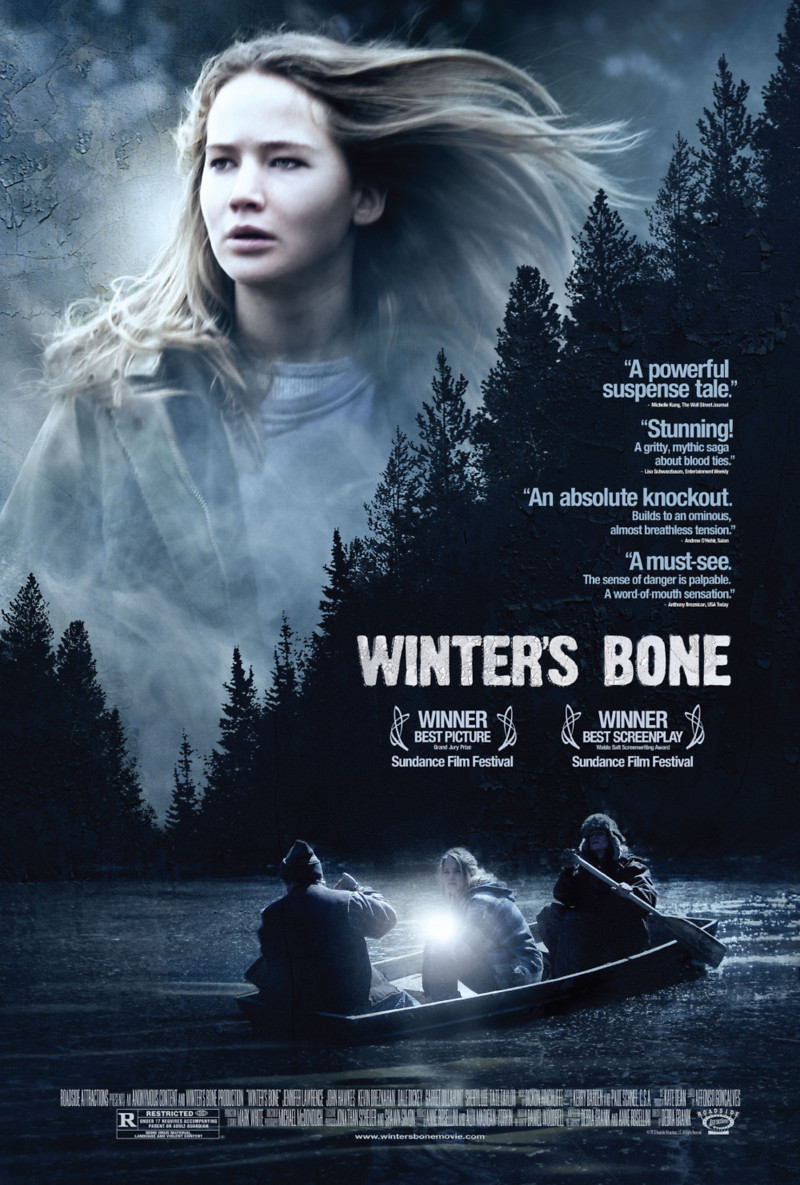
Winter's Bone (2010)
Writer-director Debra Granik adapts Daniel Woodrell's 2006 novel of the same name into a tight, intense look at the determination of Ree Dolly (Jennifer Lawrence) to do right by her family in the wake of her father's disappearance. There is no romanticism here; Granik presents the present day Ozarks as a criminalistic feudal society living on the fringe and sharing some trappings with mainstream America culture. Family and lineage, no matter how worthless they may seem, mean everything in this land, and the sins of the father can and will be rained down upon the children if Ree cannot find a way to satisfy the forces on both sides of the law who are working against the Dollys. While Jennifer Lawrence gives an Academy Award nominated performance, the true soul of the movie is presented in the powerful portray of Teardrop Dolly by John Hawkes. While Ree undergoes a more geographic hero's journey, it is Teardrop who takes the emotional journey from one brand of darkness to another, sadder brand of darkness. To audiences born and raised in affluent suburbia, Winter's Bone may seem slightly overwrought in its portrayal of rural desolation and criminal activity as the norm. It isn't. And it story being told could easily fit into nearly any time period in American history.
As these are – on the balance very – good movies, I know that my reviews of them will not do them justice. I will make an attempt to explain what I saw in them that made them more than worthwhile, but I recommend taking a look at real reviews of them or (better yet) giving them a chance yourself. I will also note that there are only a few titles that made this list, and that is one of the reasons why I feel that – even if Netflix is a good deal for the price – I wasn't using it correctly.
The DVD Gems
Winter's Bone (2010)
Writer-director Debra Granik adapts Daniel Woodrell's 2006 novel of the same name into a tight, intense look at the determination of Ree Dolly (Jennifer Lawrence) to do right by her family in the wake of her father's disappearance. There is no romanticism here; Granik presents the present day Ozarks as a criminalistic feudal society living on the fringe and sharing some trappings with mainstream America culture. Family and lineage, no matter how worthless they may seem, mean everything in this land, and the sins of the father can and will be rained down upon the children if Ree cannot find a way to satisfy the forces on both sides of the law who are working against the Dollys. While Jennifer Lawrence gives an Academy Award nominated performance, the true soul of the movie is presented in the powerful portray of Teardrop Dolly by John Hawkes. While Ree undergoes a more geographic hero's journey, it is Teardrop who takes the emotional journey from one brand of darkness to another, sadder brand of darkness. To audiences born and raised in affluent suburbia, Winter's Bone may seem slightly overwrought in its portrayal of rural desolation and criminal activity as the norm. It isn't. And it story being told could easily fit into nearly any time period in American history.
Labels:
Children's,
Drama,
Feature Film,
Foreign,
Netflix,
Review
Subscribe to:
Posts (Atom)