Showing posts with label Crime. Show all posts

Wednesday, May 9, 2012

Heat Rises (2011)

     Why am I reading these books?  Isn't it enough that I watch – usually on tape or via ABC.com – Castle (2009-present)?  Is there really a need for me to support the franchise by reading the supplemental material?  I look upon this as my ongoing struggle with a need to achieve some acceptable level of fandom, even though I am aware that this unobtainable (because there is no real meaning in how one is viewed as a fan of something in the eyes of others).
     Heat Rises (2011) is the third novel credited to Richard Castle, a television character who spends his time getting coffee for a squad of homicide detectives (apparently writing mostly off-screen).  It follows the formula of the earlier books and television show in that it is filled with needless misdirection and revisiting of suspect characters (because the detectives can't seem to do the legwork before dragging them in to be interviewed or confronting them at their homes or places of business).  In book form, this feels quite tedious.  Why not let the characters seem a little more on the ball?
     What the book does offer that is lacking in the TV show is frequent (and not well described) sex between the lead detective, Nikki Heat (Nikki doesn't seem to have a less ridiculous first name, but that's okay because every frequently refers to her, when speaking to her, by her full name...just like all of us do in our regular lives with our family, friends, lovers, coworkers, and enemies) and supposedly gifted journalist Jameson Rook.  That would be fine if it were handled by a more adept author, but "Richard Castle" handles the placement of the sex scenes with all the gentleness of a child stomping an ill-fitting shoe to make it fit.
     That is not the real problem with the book.  No, it suffers from an inability to have most of the disparate elements have any real relationship to what the plot is supposed to be. I don't know how this is the draft that the editors decided was good enough.  It could have absolutely used more direction from the editor, but it isn't a book that is going to make it on its literary chops – see Shatner's TekWar (1989) for a book that only needed to be good enough for die-hard Shatner fans to find satisfactory before it went to press – so all it needs to do is be written in coherent sentences. 
     Maddeningly, the Castle books never do anything to try to develop the characters.  "Richard Castle" is happy to just ape the show, albeit with less charm and little wit.  Again and again it strikes me that Castle must not be a very good writer.  We kind of know this on the show when he considers a contract to write James Bond novels (no offense, Eric Van Lustbader), but to be constantly reminded of it in the books supposedly written by the character feels like an insult.  Why doesn't investigative reporter Rook know how to do research or investigate?  Because "Richard Castle" doesn't want to do the research to show what that entails, because it would grow the character beyond a stand-in for Castle-on-TV, and because it would make the guess work the police do look very stupid in comparison.
     Why can't this series get someone who will do the Castle books some level of justice?  I have enjoyed some books that should be in the same vein of Castle's books.  Surely there are authors on par with Stephen Woodworth or Philip Hawley, Jr. who would be willing to ghost write a Castle novel (there's a paycheck, right?).  I don't know who actually writes these Castle books – I don't care enough to even search to see if that is readily available information – but it feels like it is a junior member of the show's writing staff who would not have a chance to get a book published otherwise.
     Heat Rises felt like work for much of the book.  It gets much better towards the end, where it starts to build some momentum and the characters stop being inconsistent.  Then that falls apart and most of the elements are exposed as being unrelated to the central story and so they are just dropped.  Not a good book, but if you feel the need to prove your fandom, go ahead and read it.  Or read it again, because that means you are an even more serious fan.

Friday, April 6, 2012

Echelon Conspiracy (2009) vs. Eagle Eye (2008)

     Right or wrong, I am solidly of the opinion that everyone but Shane West signed on to Echelon Conspiracy (2009) because they liked the idea of being able to see Prague and Moscow on somebody else's dime.  Shane West clearly just needs the work – unless he saved all of his money from ER (1994-2009).  Between this and Red Sands (2009), he clearly showed that life after major network television wasn't full of open doors and opportunities in shown in theaters movies.  Then again, Ving Rhames may just live in Sophia, Bulgaria waiting for opportunities to make top-end low budget unofficial zombie sequels.  And Ed Burns, well, I may be the only fan of him as an actor.  I keep wondering why he hasn't landed in some kind of franchise film or as the lead in a premium cable channel show. 
     Echelon Conspiracy has a lot in common with a major motion picture that was released at about the same time, that being Eagle Eye (2009).  However, its real roots stretch back to War Games (1983), with West having all the machismo of a nerdy, near shut-in Seattle teenager.  But there is at least some degree of internal consistency and thought put into Echelon Conspiracy.  It may all be ridiculous, but there is a sense that everyone involved – excepting, perhaps, Martin Sheen – knows that the premise of the movie is beyond any rational belief, and that allows for the action to be fun without imposing any threat of real consequence.
     There is the oddity that everyone in Prague, at least those we see, speaks English (and most seem to be American).  One would think that Czech, Slovak, Russian, and German would be more common, but that wouldn't allow for our American technician, FBI agent, former FBI agent, and combat-trained agent girl to just go around like they were in some kind of not America that accepted English as the default language and the Americans as the guardians of order.  Actually, there is some nice, if overstated, commentary on that last bit to close the film. 
     Without a huge budget, Echelon Conspiracy does not rely heavily on special effects to move the action along.  There are a fair amount of practical effects, most of them in that range between oh my god, this is as bad as those Sci-Fi original movies and the Jason Bourne films.  Yes, using a shotgun blast to blow up a gas tank and thus send the car twenty feat in the air is stupid, but it is the fun kind of stupid.  It takes the false toughness of the 1980s and manages to treat it with nostalgia while admitting that there is no way to take it seriously.  Watching someone implore a computer – or rather a complex set of programs that allows for a Skynet-like diffusion over all connected computers – to learn how its stated programming is
    
     Somehow much worse – to the point of not even being that entertaining – is Eagle Eye (2008).  Operating along the same lines of a computer or super complicated set of integrated programs that has found a way to access each and every computer, cell phone, and remote-operated giant scrap metal scooping crane-claw with zero lag time, Eagle Eye manages to be leaden and boring at almost each step of the way.  Maybe that has something to do with casting Shai LaBeouf.  This is the guy who was uncompelling in Holes (2003) and managed to take his general deficit in charisma in new heights in (at least the first two) Transformers (2007; 2009; 2001) movies.  At least he is comfortable in special effects dominated films.
     The same cannot be said for the rest of the cast.  They seem universally confused as to why they are not allowed to do more than spend long sequences reacting to things that will be added in post-production.  If there were more continuity to the story, maybe the scenes where Billy Bob Thornton and Rosario Dawson are together wouldn't feel so damn awkward to watch. 
     Where Echelon Conspiracy may have some destructive chase sequences, they are limited to cars operated by actual people, Eagle Eye decides that wholesale destruction from mysterious sources should rule the day.  So mass transit trains can get thrown in reverse like it is nothing (which shocked me, because as a regular rider of the CTA, I know that this cannot be done via remote access), construction booms can be swung around with exact timing (and we should ignore the fact that they cannot generate the force to rip through half a floor of a steel building), and the aforementioned scrap metal claw cranes operate like some demented form of the coin operated grab-a-toy crane games. 
     There is also a complete and total lack of internal consistency.  The overriding program is supposed to be in some sort of a lock down stopping it from going through with its dastardly plan.  Mind you, this isn't a plan that is essentially what it has been programmed to do – which is how Echelon Conspiracy handles it – but rather something it has extrapolated to being a good and necessary step towards being able to perform its stated function.  However, it takes all of its steps during this lockdown.  There is no need to get Jerry (LaBeouf) or Rachel (Michelle Monaghan) at all, and no computer would go through the trouble of picking people from a thousand miles away from the objective.  They are selected so the audience can watch them have adventures while trying to survive the various dangers.
      Eagle Eye doesn't even look that much more polished than its lower budget counterpart.  It looks hurried and ill-considered.  It doesn't seem to be at all aware of just how stupid it is, which makes me think that the people involved thought it was a serious type of thriller.  It isn't.  I'm sure there are people who would enjoy it, but I can't imagine why.  At least Echelon Conspiracy had a better grasp on balancing the plot with the improbability of it all. 

Monday, April 2, 2012

The DVDs I haven't reviewed

     Apparently, I don't give an opinion on everything.  Here's what I haven't posted about, either because I was too lazy or didn't care enough.

AUGUST


Blessed (2006) — So, this was pretty awful.  It is slow, overly low-key, and Heather Graham puts close to nothing into her performance.

Heartland: The Complete Second Season (2008-09) — I only watched one episode, out of devotion to Katharine Isabelle.  But it looked like a decent, mostly wholesome show.  Better than most of the other Canadian offerings as of late.

Snow Angels (2007) — It is hard to make a movie that doesn't note just how unbelievably attractive Kate Beckinsale is.  But there is too much going on in this one, to the detriment of the two major stories at play.  Not a bad movie, but not as focused as it should have been.


SEPTEMBER

Rec (2007) — Good, but I still prefer Quarantine (2008).  There is certainly a different central element at play here.  Much more horror in concept than its American cousin.

The Resident (2011) — This was horrible.  Plodding.  Predictable.  Completely lacking in tension.  I have a hard time believing that both stars wanted to do this movie, but it is hard to criticize working actors when it comes to taking jobs.

Fanboys (2009) — There is a good concept at work here, but the delivery is lacking.  Maybe it would have been better if the movie hadn't be reworked and scenes re-done in an effort to make it more mainstream.  But my main problem was the idea that more Seth Rogen is ever better.

The Special Relationship (2010) — This was a disappointment.  It essentially shows how necessary, but not always friendly, the relationships between Great Britain's Prime Minister and the American President.  Too much time was spent on tidbits and too little on the meat of the relationship.  Really felt more like an old-school Network TV movie.

Limitless (2011) — Not bad, but I found myself eager for this one to end.  If Cooper weren't so charismatic, I don't know if it would have gotten a release.

Thor (2011) — I hated this movie.  Just hated it.

X-Men: First Class (2011) — I liked this prequel, but will continue to wonder why starting the X-Men as the comics started is an impossibility.


OCTOBER

Definitely, Maybe (2008) — I have a man-crush on Ryan Reynolds.  He is great in this, as is Isla Fisher.  This could have been tighter, but it is one of the better rom-coms I've seen in a while.

Scream of the Banshee (2011) — Ugh. 

Mirrors (2008) — Too much early action, not enough of a slow build for my tastes.  I also couldn't understand why prime real estate was just sitting there waiting to claim victims with its haunting.

Ann Rule Presents The Stranger Beside Me (2003) — Yeah, this was a TV movie that did nothing to give a better idea of how the people close to Ted Bundy had no idea he was a serial killer.

NOVEMBER

Feast (2005) — Hey, Krista Allen keeps her top on.  I actually like Feast, but it is a flawed horror film.  One of the better creature features I've seen from the modern era, but too casual with how the characters are disposed of.

Gene Roddenberry's Andromeda: Season One (2000-01) — Much worse than I remember.  Hard to see how this ran for five seasons.

Killshot (2008) — Mickey Rourke as a Native American hitman.  If the film had centered on him, I think it would have appealed to me more.  The victim characters are underdeveloped (but played by likeable actors), and that means that there isn't any investment in terms of what happens to them.

DECEMBER

Bond of Silence (2010) — TV movie that wastes the talents of Kim Raver and Greg Grunberg.

Red (2010) — A little too over-the-top for me, but at least Red was entertaining.

Gene Roddenberry's Earth Final Conflict: Season One (1997-98) — Wow.  There was actually a good show here in the first season.  Sure, it had too many campy moments, but it really looked like it was laying the groundwork for a great humans vs. aliens, cloak and dagger series.

Attack the Block (2011) — I was rooting for the aliens for most of this.  Just couldn't root for the wanna-be thugs.


JANUARY

Adventureland (2009) — Hey, its Ryan Reynolds having sex with Kristen Stewart.  I kind of expect that to happen in real life.

Pirates of the Caribbean: On Stranger Tides (2011) — Somehow, this was worse than the original trilogy.  And they managed to add a bunch of characters I couldn't be bothered to care about.  Note to Disney: these movies can all be an hour shorter.

Gene Roddenberry's Earth Final Conflict: Season Two (1998-99) — Robert Leeshock (not pictured above) takes over as the lead and the show goes to hell.  Coincidence?  Maybe.  But killing off the main character and removing the subtlety made this show go from good to awful in about two episodes.

Thursday, March 8, 2012

Faster (2010)

     I no longer need to wonder what an urban Western would look like, but I can continue to search for such a blend that believes in character development.  Clearly, Faster (2010) isn't interested in this.  It wants iconic character archetypes, fast cars, and loud – but largely bloodless – shoot-outs between different types of criminals.  This isn't necessarily problematic; Faster isn't concerned with what may make a thinking man's modernized Western.  It wants to be about as easy as it can be, delving into something deeper only to find a way to graft the familiar wages of sin concept into a film that doesn't believe that dialogue is essential.
     There isn't much of a reason for this to be a Dwayne Johnson vehicle.  His burly bulk – often accentuated by his flexing his chest and shoulder muscles – does not speak to a man who is a driver and does his fighting with a gun.  But those seem to be there because Johnson's unnamed character (he is credited as Driver, I guess because Blondie wouldn't work) is a darker version of an old Eastwood cowboy shootist.  He even uses a stylish, snub-nosed large caliber revolver in an age when action films seem to have forgotten that there are non-automatic weapons, and pursues his enemies with a zeal that makes Three Hours to Kill (1954) look like a man on his way to a friendly church social.
     The rest of the cast seems a little lost, or maybe director George Tillman, Jr. just didn't have the same level of focus with them as he did with Johnson.  Oliver Jackson-Cohen (another unnamed character known only by a moniker, in this case Killer) is part hired gun – familiar to the Western genre – and part conflicted hit-man, drawn straight out of Grosse Pointe Blank (1997).  Other than his character allowing for the audience to see girlfriend Lily's (Maggie Grace) naked hip, not much is added with him.  If I were smarter, maybe I would think that writers Tony Gayton and Joe Gayton were trying to show how to men set to killing, but coming from different motivations, deal with their drives.  I didn't get that from Faster, seeing only some padding to the running time by putting an attractive English guy with an attractive American girl and showing the audience how ridiculous the idea of expecting a significant other to be okay with the career trajectory of professional killer.
     Billy Bob Thorton is fine, but plays his role a little too slightly.  For as much as should be going on inside his detective (keeping up with men with no names, he is simply Cop), he seems to be an unconflicted open book.  In fact, it is a little too easy to see where the story arc with Cop and his wife (or ex-wife) Marina is headed, a fact that makes Cicero (Carl Gugino) nothing more than a device to give information to the audience.  No of the police officers appear to act like real police officers, but for stand-ins for ineffective lawmen of typical Westerns, they do a fine job.
     My only real complaint with Faster is that it has the worst car chase scene ever committed to film.  No?  Okay, it does have a supremely disappointing one that creates no tension (because it is repetitive in the shots used) and hides both the cool looking cars and supposed danger with over-saturated darkness.  I can live with the simple revenge plot, underdeveloped characters (with no explanation of how the team of bad guys would have ever worked together, never mind the why being laughable), and heavy reliance on the desert terrain between Bakersfield and Nevada to hammer home the fact that Faster is a Western.  But if you are going to put cool cars in a movie car chase, don't hide the cars or the action.  And have the action matter.
     This isn't high art.  It really isn't art at all.  But it is an interesting reworking of the Western in a more modern setting,  I think it would have worked much better if it were set in the late 1970s, but that is a personal preference.  In terms of action, Faster isn't saturated with it, but it does try to make the sequences meaningful – at least as far as they would have analogues in a Western.  But it could have relied on more than Johnson's big, soulful eyes to convey its emotional content.  Maybe the next modern, urbanized Western will be better, but this one is okay.

Friday, December 30, 2011

The 2011-2012 Reading Project to Date (August - December)

     I thought I would give a visual recap of titles covered to date as part of the 2011-2012 Reading Project.  Sure, it is much less loaded with serious titles than the 2010-2011 Reading Project, but it already has more non-fiction titles in the first five months so I have not abandoned hope.  There are quite a few types of fiction covered, too, so I don't feel as though I have locked into just reading types of books.  Sure, there are five Dover Thrift Edition titles in the mix (one quarter of the books read), but they are just so damned affordable.
     Anyway, feel free to comment on any of the titles you may have read and enjoyed (or hated). I feel rather confident that most people will have read at least three of these books.  Or just take note that this would only be six rows of books if I yanked the comic books and graphic novels out.  I would like to say that fourteen of the titles pictured were courtesy of the Forest Park Public Library and another four were borrowed from family members, so the 2011-2012 Reading Project has been quite economical to date.

The Imperial Cruise by James Bradley, Walking the Tightrope of Reason by Robert Foegelin, Great Short Short Stories edited by Paul Negri, and What Jesus Meant by Garry Wills

Conan the Barbarian Michael A. Stackpole, Seinfeld and Philosophy edited by William Irwin, The Memoirs of Sherlock Holmes by Sir Arthur Conan Doyle, and Naked Heat by Richard Castle

Kremin issues 1-4 by Charles Moissant

A Study in Scarlet by Sir Arthur Conan Doyle, Ian Edginton, and I.J.N. Culbard, The Beast of Chicago by Rick Geary, and School issues 1-4 by Brian Defferding

Wrath issues 1-7, written by Mike W. Barr, mostly drawn by David Ammerman (Malibu Comics)

The Night Man issues 1-15 (Malibu Comics)

Rousseau's Dog by David Edmonds and John Eidinow, "Cat Calls" by Cynthia Leitich Smith, The Adventures of Tom Sawyer by Mark Twain, "Rogue Hunter #1 – Gaia: Into the Abyss" by Kevis Hendrickson, and Herland by Charlotte Perkins Gilman

Arcadia by Tom Stoppard, The Power and the Glory by Graham Greene, Richard Castle's Deadly Storm by Brian Bendis, Kelly Sue Deconnick, and Lan Medina, Lord of the Flies by William Golding, and The Penguin Historical Atlas of Ancient Greece by Robert Morkot

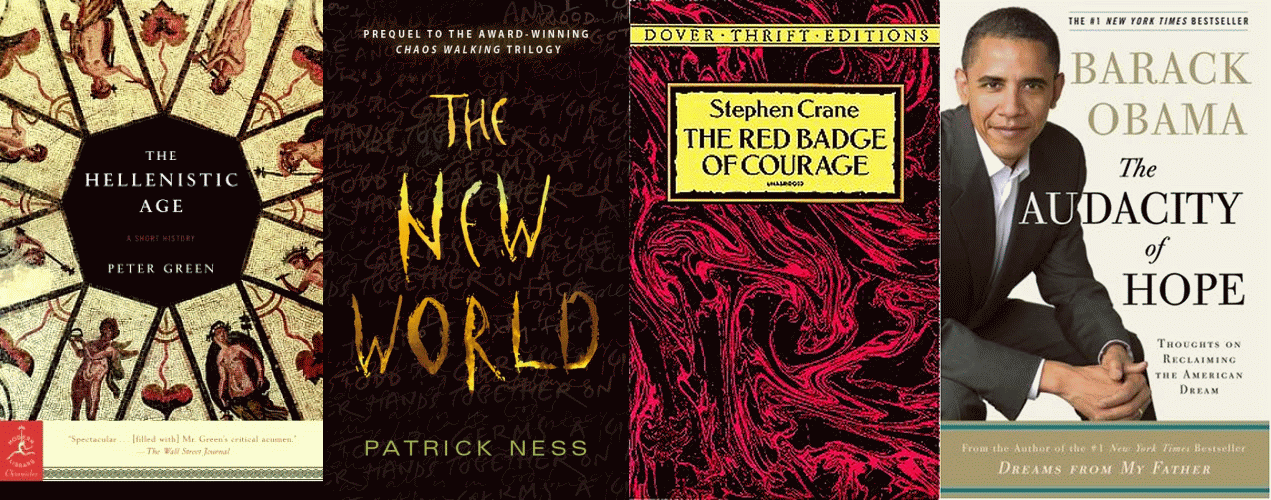
The Hellenistic Age by Peter Green, "The New World" by Patrick Ness, The Red Badge of Courage by Stephen Crane, and The Audacity of Hope by Barack Obama

The Dead that Walk edited by Stephen Jones, "They" by Vincent Hobbes, The Time Machine by H.G. Wells, The Zombie Survival Guide: Recorded Attacks by Max Brooks, and Blockade Billy by Steven King

Tuesday, December 20, 2011

Cop Out (2010)

     Tracy Morgan is poison.  Lethal poison.  Tracy Morgan kills funny.  He is what causes tremors, convulsions, and eventual death to almost all of the scenes he is in, and he is in over 80% of them.  Sure, there is a bit part – a pistol-packing momma who is both unsubtle and unfunny in her odd materialism – that rivals the lack of timing and tone that is necessary in comedy.  Actually, that character would have been out of place in any kind of professional project.  But watching Cop Out (2010), director-for-hire Kevin Smith's wan take on the buddy cop action-comedy, all I could think was that almost any other actor of note would have done a much better job.  Perhaps that is because they would have acted and not just relied on the same lazy persona manufactured for appearances on Saturday Night Live (1975-present).
     The problem isn't so much with the direction – Smith still has some obvious limitations, many related to his ambition in shooting a scene – but with the characters.  Bruce Willis is essentially playing a role one would expect Bruce Willis to play, but other than he apparently has a vindictive ex-wife and a daughter who doesn't understand the value of a dollar (please, ask your middle middle-class father to pay for a $48,000 wedding, 90% of which must have been spent on the reception if we are to judge by what the ceremony looks like).  The other characters don't fair any better when it comes to development, and this is a problem as they shuffle along in this overlong project.  Then again, Smith apparently decided to do most of this project while high on marijuana – because he was inspired by Seth Rogen to do so.  I will mark this in my book as another reason to not like Rogen.  If the accusations that Smith interacted minimally with the cast – a la Stephen King with  Maximum Overdrive (1986) – then this explains how Morgan was allowed to kill every scene and a lack of consistent tone.
     Seann William Scott (looking a little chubby in the sweatshirt) is a parkour master and occasional thief who has the best energy and lines in the film.  Unfortunately, it seems he largely borrowed the shtick used by one-time co-star James Roday uses on Psych (2006-present), albeit with a little more R-rated nastiness.  This is counterbalanced by the scene with the enormously unfunny 11 year old car thief (played by Marcus Morton).  There has been a trend to introduce the foul-mouthed, criminal (or nearly criminal), violent pre-teen black boy [see Seann William Scott's film Role Models (2008) for the most obvious example] as a comical figure.  I want to go on the record as saying that it does nothing positive for me when I see that.. Scott isn't in much of the movie, but neither are Kevin Pollack (giving an awesome but too brief Robert DeNiro impression) and Adam Brody as the other detectives in the story.
     What Cop Out does get right, to some extent, is the music.  Borrowing from 1980s films such as Fletch (1985) for Stephanie Mills' "Bit by Bit" and now ubiquitous Ram Jam cover of "Black Betty", Cop Out sounds like it wants to be an homage to the action comedies of Smith's childhood/adolescence.  Unfortunately, Smith, or more likely writers Robb Cullen and Mark Cullen, did not feel the need to form a complete story into which comedic elements could be sprinkled.  Instead, there are often crass set-ups for unfunny bits (mostly because Morgan is poison) that strain to have anything to do with the three separate plots at play.
     Cop Out isn't a bad looking movie; clearly it had a budget.  It doesn't feel like a Smith project – at least it isn't as angry or upsetting as Rogen's The Green Hornet (2011) – in that it isn't concerned with witty dialogue or the dynamics of friendship.  I don't know if Smith has earned the right to keep working as a director-for-hire.  If this is the effort he thinks is acceptable, maybe he would be better off hosting a talk show.  I know that I have not been enthusiastic about any of his projects since Clerks II (2006), and did not find that movie to be very rewarding.
     But Cop Out isn't really about Smith's deficiencies.  It is about Tracy Morgan.  How he isn't funny and  probably never has been outside of brief appearances on SNL close to a decade ago (and SNL should have a much stronger history of finding talented African American actors than it does).  It is about how a seemingly by-the-numbers script needs the actors to do something with it other than just show up.  But if you had to watch your performance get killed by Morgan every day, 10-15 takes at a time, I'm betting that just showing up would start to look like a victory.

Tuesday, December 6, 2011

The Hostage Crisis (as it appeared to "us" on the Red Line)

3 surrender after nearly six-hour Uptown standoff shuts part of Red Line

     I had planned to devote this post to something tied into the previous post, covering the topic of how when certain gamers find new and cool "crunch" they want to exploit the basic dynamics and expectations of play can suffer as a result.  Seemed like a good idea at the time.  Still about gaming (and maybe I write both too often and too shallowly on that subject) and about where some of my frustrations lie.
     Instead, I would like to share my experiences on being diverted while on my regular trip up to the Dice Dojo (5550 N. Broadway, Chicago, IL).  To get there, I take public transportation.  I have a five minute walk to the Blue Line stop at Circle Ave. (the western entrance to the southern Harlem stop) and the Red Line lets out less than a block away from the store at Bryn Mawr.  The trip usually takes just under an hour to get there and up to an hour and a half to return (the wait for the Blue Line at Jackson is usually lengthy after 11:30pm).  Knowing this, I make sure to leave the house with enough time to have to wait the full interval for two trains and still make it to the store before the 7:00 pm start time.
Okay, I've never taken a photo of  that would really sell what the Dice Dojo is.  So please accept this picture pilfered from Flickr.
     On Monday, I was a little rushed.  I was adding some audio files to the iPod – there may eventually be a post about authors who don't feel the need to stick to the script when reading their own book – and packing unnecessary crap into the messenger bag.  While I didn't do something incredibly stupid like forget my wallet (wouldn't be able to get on the train without the fare card) or keys, I did leave my phone sitting on the table in the TV room.  Not a huge deal.  I had a book to read (with the author reading along with me) and couldn't imagine the circumstances where not having the phone would be little more than an inconvenience or means to let someone know I may be up to ten minutes late.  Sure, I wouldn't get whatever emails or Facebook information pinged through on the phone, but I could definitely do without that.
     I was making good time on the Blue Line.  Only one sluggish drift between stops instead of the regular two or three.  No lengthy waits at any stop.  Just zipped right down to Jackson. Off the train, down the steps, through the tunnel, back up some steps and the Red Line train was in sight.  It was as if it were too good to be true.
Put the train back about 75 feet and it would be a good representation of where the train was for several minutes while "we" patiently waited for it to pull into the station.
     That train sat there – in sight – for about seven minutes.  Odd, sure.  But there weren't any announcements, the southbound trains were still running, and most surprisingly, the musicians performing at the stop (a kind of jazz-blues-rock trio – with the drummer working with just one drum, one symbol, and a cowbell) were good.  It was just a simple matter of waiting for the train to actually pull into the station.  Besides, trains get delayed all the time.
     As a group, we passengers politely filed into the train and took seats or found places to stand.  Because of the wait, space was at a premium.  I managed to get a seat and opened the book back up.  Might as well get some reading done.  After a handful of minutes the conductor announced that we would be standing for a short while.  Maybe two minutes later we received some information.  There was a police situation ahead and trains were backed up.
     I think most of us had ridden the CTA long enough to have – at least peripherally – encountered the train hits citizen event, usually when citizen leaps into the path of moving train.  Sometimes when the police make an arrest at a stop the trains get delayed for a short while; I sat at Kedzie one time for ten minutes while the criminal who stole a woman's phone – in the same car I was in – was arrested and waiting to be picked up for a patrol car.  We were told twice more than we would be waiting for clearance to move ahead before the conductor suggested that some people may be better served by just walking to the next stop (if that is where they needed to go).  Some five minutes after that we were off, but skipped the Monroe stop.
     For whatever reason, none of us seemed that concerned.  We had to wait again for several minutes, but we were now told that there was some problem by the Berwyn stop (this of course was not an accurate representation of what was happening).  Most passengers are off the train well before that.  Hey, I thought, just get us to Belmont or Addison and most these people will be happy.  Yes, I knew I was going to be pretty late now.  I now cursed not bringing the phone along; not an emergency, but it would be nice to let the other players know I would be late.  There still wasn't much discussion amongst the passengers.
     Eventually the police cordon was announced to be further south than Berwyn.  This was followed immediately by the announcement that all of us hard to deboard at Addison.  That got us talking.  What the hell? was the common sentiment from the other white people near me, though these were the kind of folks who take the CTA in (relatively) cold weather dressed only in black dress pants and thin shirts that may be accepted wear for an office, but are certainly not preferred.  Two older black men started to wonder aloud as to what was happening.  One of them had been on the train for over an hour now (apparently the delays started before I saw the train waiting just outside the Jackson stop). 
I have to think that Viggo – and not just Lord of the Rings 'I don't notice that Peter Jackson has been calling me Aragorn for the last hour' Viggo – would have done a good job at finding a way to keep the Red Line in service.
     We wandered down to street level where we were told shuttle buses would be waiting to take us...somewhere.  Much like the underseen Sylvester Stallone vehicle Daylight (1996), the city seems to have no planned response for situations that could easily happen.  No, I'm not arguing that one should anticipate that a truck carrying toxic waste is going to be hit by robbers fleeing arrest and cause an explosion that destroys the tunnel between Manhattan and New Jersey.  But something could happen to cause serious damage to the Holland Tunnel.  And some idiot could take hostages (the story that eventually spread among us) and threaten that there were explosives that could be set off and damage the L tracks.  Have a plan, right? 
     We get down to the street and the only plan that seems to be in place is to shout that we need to form to single file lines – good luck with that since none of us want to wander to the end of a line that is going to make us not get on the first bus possible – and leave space for the regular bus to come and pick people up.  Great, the five people who got on were well served.  Now there was some talk between us passengers, but it was mostly about whether or not the shuttle bus was just going to go to the ultimate destination – Berwyn, one stop short of where I needed to be – or if it would make the in-betweens.  It was several minutes and one CTA worker shouting at us (I appreciate his frustration, and as I remember it none of us were disrespectful to him) to line up.  A bus came and we piled in, undoubtedly overloading it but all eager to get where we were going.
     Now there were discussions.  One woman was going to be late for work, but as she put it, what the fuck was [she] supposed to do?, and just wanted to be able to get there eventually; missing work would have meant she would not get her regular paycheck until her next pay period (this is what she said...I don't know that it is true, but it would seem like a pretty shitty thing to implement to make wage slaves show up for work).  One of the two older black men from the train was seated next to where I was standing.  He couldn't get a hold of anyone at home and was a little disappointed that nobody seemed to be missing him yet.  The woman in front of me asked if anyone had checked to see what the police were doing.  The other white people buried their heads in their chests or heard only the music from their iPhones, but I had my iPod turned off.  And I didn't have my phone to check and see what was going on.
     Suddenly there was a small community of us reliant on two women who were using their much less than premium smart phones to find information.  The rest of us were patient and waited while they gave us information one droplet at a time.  The police were out in force.  We could see the barricade and flashing lights.  One black woman announced that the Chicago Police Department didn't need an excuse to shoot people.  They would just shoot you for walking down the street.  Clearly she lived in the city during the late 1980s when my limited experience supported that belief (or rather that people really believed it).  Another black woman chimed in with agreement.  Somebody said there was a hostage situation and that is why they stopped the Red Line.
     My first thought was, who would take hostages on a CTA train?, because it seems like there is no way out of that situation.  That is as trapped as trapped seems to get.  People started to wonder where exactly the hostage-taker or takers were.  Was it close to home? The older black man next to me grunted.  I looked over at him and he smiled.  "We're just takin' a bus back to the train.  We got nothin' to complain about."
     Fair enough.  Not that more than one or two people had complained by that point.  In this moment of micro-crisis, at least as it impacted us, we sure seemed capable of working together, of respecting one another while still maintaining whatever fears and prejudices would normally be used to keep us distrustful of one another.  He didn't say anything else until one woman was frantic about getting off the bus shortly after we left people off at Wilson.  "You have to push on the door," he calmly said to her.  She continued to shout up to the driver that she needed off.  "The green light is on.  You have to push."  She eventually listened to him and got off.  He nudged me, smiled, and said, "I guess you can't make it easy enough for some folks."
     And that is when it struck me that none of these conversations, none of this experience would have happened if we were just having a normal trip on the Red Line.  The crisis – to us – had no immediate threat.  It would be interesting and some people might be at real risk, but we were almost entirely concerned with getting wherever we were originally going.  We were people that wouldn't normally strike up friendly conversations or share asides with one another but found it to be quite natural as we slowly made our way to the Berwyn stop via bus.  The damnedest thing was that we took four right turns and one left turn but seemed to be consistently moving north from Addison to reach Berwyn. 
     I took the train at Berwyn one stop – it was waiting for us and I figured it would be faster than walking – and made it to my game just over an hour late.  I wasn't happy about that but mostly because I missed out on the play experience.  Sure, what I experienced during the delay would prove to be more valuable than marching my pseudo-Bard through a dungeon – hey other Pathfinder players, my PC actually has the best to-hit and second best damage of the melee fighting characters so you shouldn't auto-place her at the back of the party – but it wasn't what I had planned for the evening.
     When we finished playing, Mike Tomczak and I walked over to the Red Line station and asked if the drama had been resolved.  We were given a very hyperbolic statement about snipers being put in position and that the shuttle buses were still running.  Mike needed to go to Wilson, so he would be chancing it on whether he would get let off there or not.  I didn't want to have to play hopscotch from train to bus to train.  We walked back to the Dice Dojo and asked for rides.  Jim Fortsas gave me a ride to a Blue Line stop – it would have been a long haul to walk to was apparently only a few blocks from his home – and Mike got a ride from Brad Ruby.  I got to go back to reading my book and made it home in time to see the repeat of The Daily Show with Jon Stewart.
     Still, I have to imagine this experience as a brief glimpse into how people can find their civility even when the common ground is no more remarkable than going home, or to work, or to a game.  I thought back to the images of the mass foot exodus of Manhattan on 11 September, 2011 and how those involved appeared – from the television news presentations – to have that subtle involvement that we seek to lose as we travel among others.  I wondered what the homefront experience of World War II had been like for that generation and what we were missing in not sacrificing, in not sharing in the decade long struggle in foreign lands that have become so much noise for us as citizens.  I experienced this odd moment when the selfishness that has become endemic to the American character was nowhere to be found – at least not on the surface – and advertised selfishness has become a brand of cool.
     The trip became memorable not because there was a delay, or because the cause of the delay was so far from the ordinary, but because of how we found a way to become a group that was quietly supportive.  Well, most of us. Seriously, the (other) white people largely kept to themselves, insulated or isolated by their electronics.  I know that my thoughts on the matter are heavily influenced by Peter Green writing about the turn from public works and service of Classical Greece to the more self-focused, private goals of the Hellenistic Age coupled with Barrack Obama's musings on the nature of the role of the citizen in government (sure, I'm getting to the book a few years late but I am reading it).  But what I experienced was real.  Maybe to random and fleeting, but worth the inconvenience. 

Wednesday, November 9, 2011

The Lincoln Lawyer (2011)

     Maybe it is because there are no longer those big chain book stores in the area.  I always imagined that I could have done well in one of those companies, and on top of it all, I would be around books all day.  New books, books to be sold (and all the non-book items that got crammed in to those places).  But those stores are gone, and I get to the library far more often than The Book Table, the surviving local independent book seller.  The point is, I sure seem blissfully unaware of what people are reading, especially when it comes to fluff, the non-literature fiction that makes authors famous (well, known may be a better term) and movies made "based on the book".  I had never heard of The Lincoln Lawyer (2005) until the advertisements for the film started to pop-up during television programming.  Likewise, I had no idea who Michael Connelly was (this was his 16th book, and another of his novels had already been turned into "major motion picture").  I didn't have much interest in seeing The Lincoln Lawyer (2011) when it was in theaters (I passed up a chance to see it for free during its opening weekend), but decided to give it a go on DVD.
     Why?
     I have a theory that the people who don't hate Matthew McConaughey – I count myself in this group – have a somewhat desperate desire to see him in a role similar to the ones that helped define his career (in my limited judgment): A Time to Kill (1996) and Contact (1997).  Now, it can be noted that it is somewhat ridiculous to expect McConaughey to step 15 years into the past and reclaim that special mix of earnest and man-boyish charm.  Almost anything would be more satisfying than Surfer, Dude (2008) or How to Lose a Guy in 10 Days (2003).  The Lincoln Lawyer also has Marissa Tomei – who has a list of disappointing projects that can easily rival McConaughey's – in a more substantial role than I have seen her in for quite some time.  So I should be generally happy with this movie.
     The problem is I don't think The Lincoln Lawyer worked for me.  Ryan Phillippe (as defendent Louis Roulet) is allowed to bring his menace to full force, but even with this he gives a decent performance.  Tomei is reduced to being on screen more than giving a fully realized performance – and the relationship between ADA Maggie MacPherson (Tomei) and Mick Haller (McConaughey) is too loosely defined for it to have any emotional depth.  McConaughey has some fun with the role, but he has scenes where he is overshadowed by William H. Macy (as investigator Frank Levin) and others where Bryan Cranston (as Det. Lankford) gives him absolutely nothing to work with.  Supporting actors Bob Gunton (somebody give this guy the lead in a major studio picture, please) and Frances Fisher (forever Angie from Strange Luck to me) do much to give weight to their underwritten – at least for the screen – characters.
     The general pace of the movie is slow, which did work for me.  The action is largely off-camera, but even when it is not its slow.  There is an implication in the motive of the bad guy that is never addressed (I would like to imagine it is in the book, because it is a bold and plausible way to take the story), and that was rather unrewarding.  Haller doesn't seem to have any redeeming qualities, and he doesn't seem to be a very good lawyer.  Actually, nobody seems to be a very good (TV or movie version of a) lawyer.  The courtroom scenes has some limited payoff, but otherwise get in the way of the expanding story. 
     I wonder if I would have enjoyed this film more if I were a bigger fan of the genre of fiction from whence it came.  There seems to be a lot of non-horrible elements to the movie, but nothing really appealed to me.  I have spoken with several other who found this to be a "great" film, but they were clearly looking for something far different that I was.  Not a bad movie, and the things that bothered me were different than what usually bothers me, but this one didn't quite click for me.

Friday, October 21, 2011

Mystery Team (2009)

     I don't want to disparage Mystery Team (2009), because there are some very funny and enjoyable moments in it.  It is, however, clearly a work of collaboration and tends to lack a focus in tone, not to mention meandering away from the story for minutes on end to indulge unrewarding side stories.  The team behind it, Derrick Comedy (whose most prominent member would have to be Donald Glover or NBC's Community) are young and relatively unseasoned.  As such, that this is the result of their first attempt at a feature film is somewhat impressive.
     The set-up isn't new, with celebrated child detectives grown out of that cute phase.  Most satires and comedies that try something like this stick to the former boy detective (in my thinking, all child detectives are inspired by Encyclopedia Brown and not the Hardy Boys or Nancy Drew) and a side kick facing the reality of not having the skills to cope with real world crimes.  Mystery Team has three of them who worked in concert: Jason (Glover) – the master of disguise, Duncan (DC Pierson) – the boy genius, and Charlie (Dominic Dierkes) – the strongest boy in town.  Of course, as high school seniors, none of these titles really apply.  Jason has no aptitude for disguise (though much for sketch and/or prop comedy), Duncan only memorizes useless facts, and Charlie has done nothing to develop his strength since he was eight which leaves him as a bit of an awkward stick figure.
     The standard fare for the Mystery Team is figuring out who poked a pie resting on a windowsill to cool or finding missing kittens.  They keep handwritten (in crayon) files of their cases and regular suspects.  The standard devices of the child detective feel rightfully sad and desperate in these near-men, but they refuse to admit it.  Then a different kind of case comes along.  A little girl hires the three to find out who  murdered her parents.
     The group bumbles through their investigation, with mixed results in terms of how the humor works.  It is enjoyable to watch the boys succeed in spite of themselves at times, or to rely on what should be absolutely useless contacts to keep the investigation alive.  However, it is during the various encounters that the style and tone tend to vary wildly even within the scenes.  Even though the story is written with a clear leading man (such as the term applies), the sidekicks have nearly as much screen time until the third act.  Because this film isn't really their story, that ends up feeling like wasted time.
     The one real complaint I have with Mystery Team is that the boy detectives are all played as being kind of dumb.  This really fits one of the characters (Charlie), but Duncan should still be smart and Jason should be more earnest in his desire to solve all the cases the neighborhood children bring to him.  In the end, there is an attempt to mitigate the near constant barrage of gags letting the audience known these characters are fully arrested in childhood, but it feels forced.  It seems written into the script to make sense of the ending they envisioned. 
     Mystery Team may not be a classic, and it certainly isn't a masterpiece, but it does have some very funny moments (such as one involving a stop sign).  For anyone who has fond memories of Encyclopedia Brown and wants to see a twisted take on the boy detective, Mystery Team  should be a worthwhile experience for you.

Thursday, October 13, 2011

Steven Pfiel (A Musing on What Generates the Traffic to the Case Study)

     I wonder what draws some of the people looking for information about Steven Pfiel to this blog.  Surely most of it must be some sort of curiosity.  I can judge that alone by the people in foreign lands who were likely just putting their or a friend's name into Google and finding that there was a Steven Pfiel who committed a pair of heinous murders – and one confirmed sexual assault – currently serving out the rest of his life in a maximum security prison in Illinois.  Some of the traffic may also be due to the fact that my scholastic (not professional) case study of him, largely gathered from public sources, appears to be the most comprehensive treatment of his journey from troubled child to convicted killer that is easily available to the public.  Still, if I had to guess, I would imagine that the majority of people looking for information about Pfiel knew him or of him back when he first made headlines in 1993.
     As such, it is a little disheartening that there has been so little feedback about the case study.  Sure, it is likely much longer than anything one would want to read from a computer screen.  It also does not have the crime scene photos for which many are searching.  I want to make a point on that subject.  I do not have photos of either the Hillary Norkog or Roger Pfiel, Jr. murder.  If I had access to such images, I would not make them available to the general public nor post them on a blog.  It isn't that I do not believe that such images don't better inform the actions and underlying mindset of Pfiel and his actions.  Rather, it is my belief that the value of what can be gained from an examination of them is limited – and would truly apply to a small group of professional (of which I would not be included) – and does not exceed the disrespect it would show for the victims.
     Back to the subject of feedback.  It strikes me that there should be several hundred people who count themselves as former classmates of Steven Pfiel, and no fewer who would have similar ties to Hillary Norskog or Roger Pfiel, Jr. (indeed, I was a classmate of Roger's).  While I am aware that the case study does not do much of a service of illustrating the victims – and there is really no place in a case study to do as much – I do think that there is a place for some commentary on those who were murdered by Pfiel.  Leaving the victims as little more than names with ties to the killer does not allow for the best understanding of the tragedy of the murders.
     Likewise, I am well aware that there were people who counted themselves as friends and supporters of Pfiel.  Yet there has been no mention of the how the paper misrepresented Pfiel's behavior or actions.  Nor has there been any feedback of how easy it was to miss the signals of how damaged Pfiel was – at least not on the blog.  There was an off-hand comment while I was constructing the paper about how 'nobody could see it coming', but such a sentiment only reflects the general lack of awareness to the Macdonald Triad (which suggests that animal cruelty, fire-setting, and persistent bed wetting after five years old are strong indicators of later homicidal behavior) and how Pfiel may have scored on such a measure.
     Clearly, there were those who had more than a general sense of discomfort when dealing with a young Steven Pfiel (I count myself in this camp).  To be perfectly fair, I assume that there were probably an equal number of people who had similar sentiments about an adolescent me.  I think that whatever superficial relationship Roger and I may have had would have been informed by his noting similarities between his brother and me.  It may explain why Roger was always friendly towards me, even though we weren't really friends.  Of course, it is probably just as likely that Roger was of better character than I was willing to acknowledge at the time; he may have been cool to everybody who didn't go out of their way to piss him off.  The last time I saw Roger was the Thursday before high school graduation when he and I were part of a group of students called in to serve any and all detentions still due; I got out of this rather deftly, as I had been in possession of my disciplinary card for months at that time and had the only record of what I was due to serve (for the record, it was two regular detentions and thirteen Saturday detentions).  He and I nodded to one another and as far as I know, he spent the rest of that day in the school doing nothing, a perfect example of how punishment often overrides the need to do better by the student.
     I do not know if I would have given Roger much thought after that had his brother not murdered Hillary Norskog.  I do know that there are people much better suited to speak to the character of Roger and his relationship with Steven than my personal experience would allow me to do; I don't know if I had more than three interactions with the younger Pfiel.  The case study was undertaken in an attempt to better understand just what may have been going on, what motivated a teenager with no lack of opportunity or means to commit violent crimes against people he knew intimately.  I cannot state without equivocation that my conclusions are correct.  People who knew Hillary, Roger, and/or Steven may come away from reading the case study thinking that is completely ignores the people involved in the events, that it gave them no better insight into the mind of the killer.
     More recently, the murders of John and Maria Granat by their son, John Jr., in Palos Park has brought new attention to the Pfiel case.  Palos is still a small village, though nowhere near as intimate or isolated as when I was growing up there.  There are undoubtedly many crimes going on in the quietude of wooded suburbia, but murder is a decidedly rare one.  What ties the Granat case to Pfiel's is Stagg High School and the relatively young ages of the people involved.  However, the Granat case seems to be so mundane – adolescent rage against parental authority and ignorant greed.  It does not, to me, evoke the same sense of wonder or curiosity that the Pfiel case does.
     What I am asking here, and I am not expecting much of a response, is for some feedback about the Pfiel pieces.  What is the cause for the interest in him and his crimes to be so enduring?  Is it just the personal attachments we may have had with him or his victims?  Is it just location, that those who are from Palos are interested in this small piece of history?  Is it just a curiosity about the crimes?  If you, the reader, have any information that you would like to share, I encourage you to do so (either here at the blog or at tim.mcneil93@gmail.com).  There is much left to be said about the murders and the man behind them.
     I have met the threshold I set in order to start looking into what it would take to arrange an interview with prisoner Pfiel.  At the same time, I very much hope that he would have no interest in assenting to such a request; I am not eager to sit before a murderer and ask him what he was feeling when he killed a fifteen year old girl.  Still, I think that there is more left to the tale than what little I have contributed.  And I am hoping that the people who knew Hillary, Roger, and Steven would be willing to come forward with some of their remembrances. 
     Otherwise, I will just assume that it is curiosity that drives the traffic.  A sense of uncertainty as to what may have led a supposedly normal boy to kill those he had close relationships.  I don't have the real answers for that.

Tuesday, October 4, 2011

Naked Heat (2010)

     I like Nathan Fillion.  I liked him as Johnny Donnelly on Two Guys and a Girl (1998-2001); Fillion came on the show after the name change.  I liked him as Captain Malcolm Reynolds in the enjoyable, but deeply flawed series Firefly (2002).  But I think the role he was born to play was that of Richard Castle on ABC's Castle (2009-present), as it allows him to indulge his evident inner-geek and make the regular murders that provide the plots for individual episodes to seem interesting, or more so beyond the script.
     So, Fillion draws me to Castle – and while I'm watching it I often wonder if I would enjoy a show with with John Huertas and Seamus Deaver as scrappy detectives who never get the glory for all the work they do – and it is in the vein of fandom that I have read the first two novels written by the Richard Castle persona.  I don't know if I can really defend this.  I have a long list of books that I should read.  I have an equally long list of titles I want to read.  And I have made a real effort to make the 2011-12 reading project one that has a lot more non-fiction titles of merit.  Ignore that comic book/graphic novel week of titles that are now part of said project.
     Naked Heat (2010) follows the events of Heat Wave (2009) by a few months.  Jameson Rook (the stand-in for Richard Castle), made somewhat unpopular amongst the police he shadowed for his magazine article finds a new way to become part of the investigating team: he stumbles upon the murder of a high profile gossip columnist.  It takes some time for him to win the warm regard of the detectives, but he does.  And then he has sex with Nikki Heat (the stand-in for Kate Beckett) again. 
     The novel stresses one of the weaknesses of the television show.  In order to keep some kind of mystery going, the detectives (and writer) often have to go back to people who were originally suspects.  I mean often as in regularly and repeatedly.  In the book, it happens over and over and over again.  The story is more involved than a single episode could be, but it is also horribly contrived – such as the garbage strike.  Adding to the problem, most of the elements of Naked Heat have appeared in episodes in Seasons Two and Three.  The ending is a little weak, especially for all of the disparate elements that are brought into the tale.  The pacing also raises some concerns, but it isn't so jarring as to cause any problems.
     Whoever writes the Richard Castle novels isn't particularly concerned with creating a setting, instead simply giving the show's characters different names.  There is next to nothing in regards to physical descriptions, and just as little attention paid to clothing.  Neither Heat nor Rook are developed as characters, and if one were no familiar with the show it is unlikely that either would feel like people worth headlining a story.  However, the Richard Castle novels are a tie-in to the show.  As such, they allow for stories that are similar to the show without having to constrain themselves to the established continuity.  Maybe the selling point is that Heat and Rook get together, something denied to Beckett and Castle.
     As a diversion that is tied-in to something I already invest some time to, Naked Heat is decent.  It is better written and structured than Heat Wave.  Like most of the fluff I have read for the projects, Naked Heat was a two day read.  What I would recommend – strongly recommend – is to not watch an episode of Castle in between reading the book.  It can cause a few moments of what...wait that are the result of an easy confusion between the two.