Showing posts with label Literature. Show all posts

Wednesday, April 25, 2012

Waiting for Godot (1954)

     Tragic.  Sad.  Often funny (though I'm not much for the more physical comedy, and don't find the prostate issue funny at all).  Ultimately unknowable.  That Beckett apparently vehemently denied that Godot – a name North Americans have been mispronouncing for some time – can be understood to be God is perplexing, if only because God is just as vague and inaccessible as any knowledge of being, of why we, especially given that we are destined to not-be shortly thereafter.
     Waiting for Godot (1954) is absurd, but in the abstract.  Its primary characters are never referred to by their listed names (I don't know if that is brilliant or banal, but it is something).  It has no sense of place except that it is one incapable of giving the men what they need while simultaneously evocative of longing and change.
     I wouldn't want a steady diet of this from any playwright, but I finally understand why so many people are drawn to it.

Wednesday, April 18, 2012

Death of a Salesman (1949) and Mr. Peters' Connections (1999)

     Arthur Miller must have been writing about something endemic to, if not something so broad as human nature, the soul that can know doubt and misery found in what was supposed to be a full and rewarding life.  At least in these two plays – Death of a Salesman (1949) and Mr. Peters' Connections (1999) written half a century apart.  The earlier play is one of the great accomplishments in American theatre, and I am positive that I am not interested in investing the time to produce a meaningful musing on it.  What I am going to do instead is write about how these two plays seem to inform my understanding of my grandparents.
     If ever there were a person who was the unwholesome combination of Willy and Linda Loman, it would be my grandmother Ethel.  All of the unrealistic expectations and boundless excuse making for her children with a built-in self-support system, an unquestioning, undying belief that her beliefs were always right.  From my perspective, she never failed to blame external forces for any and all failures that befell her children and grandchildren.  I cannot say that she believed that superficial charm and the trappings of success were as important for her as they were for Willy Loman, but they certainly ranked quite high in terms of what she found important. 
     Where Biff eventually comes to terms with his shortcomings, that he remained trapped between his father's view of the world and a deep and abiding need to not fulfill those misbegotten expectations, my father remained a slave to the belief that the world was forever doing him wrong.  He came to believe the lies invented by my grandmother – that my mother had tricked him into marrying her (I vividly remember when this fiction was formed in the summer of 1986 over two nights, when it was slowly formed into a truth they could all accept), military service ruining my father's ability to start his own business, that he was not at all responsible for the fact both of his children took multi-year breaks from speaking to him – I suspect because that had been a way of life in the house in which he grew up.  Such as it was for the Lomans.
     I am sure there is something deeper going on in Death of a Salesman, but because there is something so real about it, I found it difficult to see it without comparing it to my family.  Where my grandfather managed to get something akin to Willy's dream funeral – and there was much to be made about his own grandfather's funeral, with the myth (maybe truth) that even the Governor of Michigan was in attendance – my grandmother was left with a small service, almost entirely restricted to her children, grandchildren, and people from the church where the service was held (who didn't really know her).  To be fair, both lived to be quite old, and the life-long friends they had fostered (they do have me there) were almost all dead. 
     Where Death of a Salesman felt like an examination of the danger of being raised to be a valueless narcissist (and the people who create those kind of children), Mr. Peters' Connections felt like an imagining of my grandfather's later days.  When he was scared to live in his own home, essentially confined to his bedroom (it cluttered with books and video tapes collected by my grandmother, so she could pretend to be interacting with a dead friend – and clearly looking for something, anything to justify his hanging on to his life.  Where Harry Peters was a pilot for Pan Am, my grandfather flew for United.  Both felt that retirement was forced upon them too damn soon. 
     I doubt that there was a woman for whom my grandfather forever pined – he was quite honestly in love with his wife, but there may or may not have been instances when he strayed – and he didn't have a dead brother to fret about, but so much of the rest felt true.  That Miller could continue to find the angst of the end, and for it to be as true in its emotion is quite remarkable.  While absolutely nowhere near as focused as Death of a Salesman, Mr. Peters' Connections still has something to say.  Instead of being concerned with the damage that can be inflicted on children, it examines the danger of having nothing left to identify as ones' own at the end.

Tuesday, April 3, 2012

The Glass Menagerie (1944)

     There is no play that I have read and seen more times than Tennessee William's The Glass Menagerie (1944).  I had not had any contact with the material in the last 20 years, however, and so felt that I owed it to myself and the material to revisit it.  It is entirely likely that 14-16 year old me would not be able to grasp much of what is really at the heart of the play, but that doesn't necessarily mean that much older me is going to do much better with it.
     I was most surprised – because I didn't remember – by how compressed The Glass Menagerie really is.  Williams manages to condense years of desperation to escape (outwardly or inwardly) into a few nights without it feeling false or contrived for the stage.  How the household – the cramped apartment with none of the trappings of Southern aristocracy to which Amanda Wingfield clings – is presented does feel like it was crafted for the stage, but not in such a way as to diminish any of verisimilitude of the situation.
     Tom Wingfield – a stand-in for Williams as this play largely deals with his guilt over leaving his sister to her unfortunate fate – has literary aspirations, but would just assume get away from the crushing weight of his backwards-looking mother and severely introverted sister.  As someone who has dedicated more than a small amount of energy in not following his dreams, I get where he is coming from.  But Tom is relating the play from the future, so he knows everything that is going to happen.  I would think that he would be more wistful than he is (until the very end) as he knows that nothing good will come to his mother or sister from his decision to desert them.
     But the play isn't really about Tom.  It is about Laura, Tom's older sister who is so crippled with insecurity (in part due to her belief that everyone focuses on her polio-inflicted uneven gait) that she cannot bear to deal with strangers.  She has only her collection of glass figurines and the undying dream of loving a boy from high school.  Sure, it seems obvious now that this is no way to live (at least develop a way to deal with strangers and get a job...I'm not going to make any judgments on the high school infatuation). 
     Amanda isn't so much interested in helping her children be happy or better people, preferring instead that Tom find a way to make slightly more money at his soul-crushing job and for Laura to be married-off to whatever man will take her.  At the same time, Amanda is so narcissistic that she cannot help but try to overshadow her children in the presence of the only person invited into their lives.  Now, I'm not sure how much of this is exaggerated so the audience is clear on her character or if Williams really had this kind of unfortunate mother, but she is the kind of woman that husband and children should flee.
     There is something entirely sad, much more so as an adult, in seeing Laura have to accept her unicorn being turned into something as ordinary as a horse.  It isn't just that she loses the symbol of her differrentness and her gateway into the world she has created to escape her own sadness and inability to cope, but that she has to lose it to a man who could have – in the past and even the present of the events in the play – if only she had been willing to risk an encounter with Jim and he wasn't so concerned with his social position.  Her escape is forever denied and Tom leaves her to the untender mercies of their mother.
     Still a great play, but sad even in its humor. 

Monday, February 13, 2012

The Pearl (1945)

     John Steinbeck's novella The Pearl (1945) was one of those books assigned in 6th or 7th grade (please excuse my memory; it is scarily specific on things that absolutely don't matter but failing on anything that pertains to my earlier education).  I may have read it completely back then.  I have an odd feeling that I read both The Pearl and Hemingway's The Old Man and the Sea (1952) in the same year for the same class – and finished both – but I more clearly remember almost finishing The Grapes of Wrath (1939) in 7th grade and considering that an accomplishment at the time.  Anyway, I had some familiarity with The Pearl.
     There is nothing subtle or nuanced in Steinbeck's novella.  In that regard, it is proper fare to be assigned to 12-13 year olds – especially if the teacher giving the assignment is hellbent on the students finding and analyzing the symbols and tone of the piece.  However, for an adult – and one who doesn't have to give a detailed report proving that he gets what the author is saying – it is somewhat frustrating.   
     The Pearl presents Mexico, or at least its localized region, less critically than Graham Greene's The Power and the Glory did.  Sure, Steinbeck gets points for expressing the type of internalized colonialism that sets the elites against the natives, but that point seems lost in his greater picture of self-destructive greed.  Indeed, it is lost completely when the elites lose only hired hands and potential immediate profit – nothing real to them; there will always be more money to be made and people to be hired to do the dirty work that passes for business.  Steinbeck doesn't need a proto-Communist Revolution to place the well being of his characters in danger.  The danger is as real and as present as the human condition, but it is revealed along the way in such heavy handed prose that it doesn't read as those it was intended for a sophisticated audience.
     While making that criticism, I will fully own the fact that the least of Steinbeck's fiction is undoubtedly better crafted than the best of mine.  In this instance, however, too much of his is awkward.  The description of the action scenes seems to take the reader away from the story and its meaning.  The lack of familiarity between the pearl divers and the villagers, while plausible, doesn't paint the picture of two sets of beings inhabiting the same space.  Worst, the most important scene in the book is glossed over with no reasonable explanation for how it actually happened given that the description of where characters were before the event would render it impossible. 
     The Pearl presents an insanely simple story, but it takes a long time to tell it (for it being so simple).  Yes, greed is bad; it can corrupt a person if all he or she does is want for more.  But Steinbeck tries to play some false nobility into being so poor and ignorant as to not know that one is being exploited, that surviving and being happy with squalor is better than aspiring for something more if it means that there are moments of unhappiness and it restricts the gain of others. 
     Still, it is an easy and quick read.  I started it on my train ride into the city and finished it on the train ride home, with about 15 minutes to spare.  I would recommend The Power and the Glory over The Pearl, because it is a much better book and has more mature points to be made.  I prefer my tales not be structured so black and white, but I understand why Steinbeck wrote this that way.

Monday, February 6, 2012

Heart of Darkness (1899)

     For some reason, I cannot seem to warm up to the writing style of Joseph Conrad.  It isn't just that he is obviously in love with the relationship between man and ship (or boat, if the waterway is too small to accommodate a ship), though having not been raised in the Victorian Age of the British Empire – or a contemporary witness to it – the Sea and its ways holds little mythic power over me.  It seems to be more in relation to his needing to spend too much time to make too subtle an allusion to the point he is desperately trying to make.  And like with "The Secret Sharer" (1910) – the short story that was bundled with Heart of Darkness (1899) in the Signet Classics book I purchased half a decade ago – Heart of Darkness spends too much time being about man and ship instead of the nature of man.
     That is not to say that Heart of Darkness is without point.  There is something pure in Conrad's exploration of the nature of colonialism, especially in Africa.  However, he wrote the story at the tail end of the 19th Century, before the machinery of real destruction could be brought to bear on the Dark Continent.  I read it in the 21st Century, after having taken a post-Colonial period Africa history class (taught by an honest-to-God African who was wounded in a civil war largely created by the actions of the English while lording over the locals).  The book is not going to mean the same thing to me that it would before the Colonial Period came to an end.  Add to that the fact that I have Apocalypse Now (1979) as a competing format of exploring the same concepts.
     Lets face it – the absurdity of a benevolent war is a far riper target than the criticism of treating Africans as property at the beginning of the 20th Century; I would wager most Europeans didn't regard the Africans as people, per se.  Having Colonel Kilgore herding scared villagers into an amphibious APC – a metal monster of sorts – while the announcement, in English, repeats that the US Army is there to return the people to the bosom of the government of South Vietnam.  For good measure, the Army is going to burn the village to the ground just to show how serious they are about saving the people.  That scene captures the madness of what is going on (for Apocalypse Now) better than anything Conrad could craft for Heart of Darkness.  Yes, he has Marlow describe disparate scenes that show how enterprise is not directed in a proper European fashion, but he seems to walk away from the underlying point so that he can ruminate more on boats.
     Kurtz, in Heart of Darkness, isn't even really a character.  He is an objective.  There is no reason why Marlow comes to imagine him as a voice dwelling at a native temple upriver (but it is good imagery).  What is much worse, Kurtz's famous last lines – "The horror!  The horror!" – don't have nearly the depth of meaning that they should, and that is because there is no real interaction with the man.  Kurtz's story becomes lost in the fretting over a new breed of morality that may have taken root back in Europe and Marlow is seen in country as a threat of things to come.  But nothing is ever to come.
     There is something profound in the grave concern over the letters and such of Kurtz being tied directly to gaining access to his strategy to better exploit the region.  Conrad hints at what Kurtz had been up to – certainly it would not be an easy topic of conversation amongst the men who thought of themselves as civilized – but he doesn't let the terribleness of it sink in, immediately shifting focus to the effort to leave the area, and for Marlow to get back to London.
     Oftentimes I complain about how a movie will take excellent source material and ruin it because the writer(s) and director are sure that they (or he or she) can do better.  In the case of Apocalypse Now, I think John Milius and Francis Ford Coppola exceeded the source material.  That is not to ignore some of the indulgences of the film, or how it is essentially tied to the war instead of a prevailing view towards others who live on the land you want to despoil; Heart of Darkness is more timeless, but its understanding of its own underlying economy seems wanting.  Where Conrad does not give his Kurtz his due in explaining how he fosters a cult of personality, Apocalypse Now sets the stage so that there could be no other conclusion of Kurtz being cut-off from command.
     Okay, I'm aware that I am being a special kind of ass when I purposely conflate the novella and the film.  I would prefer the reason be that Conrad simply was unable to convey the true depredations and inhumanity of European colonialism (especially in the Congo), but it is much more likely that the imprint the film had on a much younger me predisposes me toward favoring it.  The Colonel sending soldier out to surf during combat speaks more of madness to me than the aimless blasting away at the cliff face or recklessness with material supplies of the novella.  Then again, the movie is from my culture.  It should speak directly to me.
     Of the literature I've read in the year and a half of the Reading Projects, Heart of Darkness was probably my least favorite (though it is nowhere near as difficult a read as Beowulf was).  I am certainly in no hurry to read any Conrad in the near future.  Still, I have heard good things about both The Inheritors (1901) and Nostromo (1904) – the former a collaboration with Ford Madox Ford, whose The Good Soldier () is currently on the to read list – so I cannot rule out more Conrad altogether.  But I do know that there is something in the style that doesn't sit right with me.  Maybe I have been spoiled by the short, strong, masculine sentences that Hemingway helped usher into fashion.

Tuesday, January 31, 2012

Adventures of Huckleberry Finn (1885)

     I want to go on the record and state that Adventures of Huckleberry Finn (1885) is nowhere near as well crafted, compelling, or meaningful as The Adventures of Tom Sawyer (1876).  I am wholly aware that I am committing some form of literary heresy with that statement.  The latter is widely viewed as a children's story, but it contains more truth about the struggle to be an adventuresome boy while still growing into a man.  It deals with young (and honest) love, financial inequities, and life on what was essentially the frontier.
     In contrast, Huck Finn abandons its deeper truths after the first third of the story, first in favor of a comical take on Americana con-artistry, then in destroying the virtue built into the Tom Sawyer character nine years earlier.  Maybe it was how disrespectful Twain was to his own creation that soured me most on this book, but I think it also had something to do with the easy realization that there is no adequate ending to the tale.  Instead, Twain places Jim back in shackles and cannot seem to return Huck to the realization that a slave is also a person and should be respected as one.
     If the second half of Huck Finn had been as well written as the first half (or the first third, especially), it would be the American masterpiece it is celebrated to be.  Instead, the book gets bogged down with the idea that young women (especially) are creatures to be marveled at (and perhaps politely lusted after), that men are essentially creatures looking to take advantage of others, and that the injustice in slavery is largely based in the separation of families – a huge step back from the early revelations at which Huck grasps to understand.
     The absolute worst part of the story is the handling of the revelation of what happened to Huck's father (even worse than Tom's appearance).  It feels cheap, and it is quite obviously a cheat.  As a frustrated writer, I know the temptation to wrap up unattended – and sometimes forgotten – elements with a wave of the hand and a simple statement that voids any concern for them.  I was hoping for something much better from a book as well regarded as this one is.
     Now, all of this is not to say that I am not happy that I read the book.  There is enough good material to make the less than good sufferable.  But it doesn't end up being the story it starts out to be (yes, I have been insanely guilty of that myself) and seems to wander away from having a point or even a consistent point of view. 

Friday, December 30, 2011

The 2011-2012 Reading Project to Date (August - December)

     I thought I would give a visual recap of titles covered to date as part of the 2011-2012 Reading Project.  Sure, it is much less loaded with serious titles than the 2010-2011 Reading Project, but it already has more non-fiction titles in the first five months so I have not abandoned hope.  There are quite a few types of fiction covered, too, so I don't feel as though I have locked into just reading types of books.  Sure, there are five Dover Thrift Edition titles in the mix (one quarter of the books read), but they are just so damned affordable.
     Anyway, feel free to comment on any of the titles you may have read and enjoyed (or hated). I feel rather confident that most people will have read at least three of these books.  Or just take note that this would only be six rows of books if I yanked the comic books and graphic novels out.  I would like to say that fourteen of the titles pictured were courtesy of the Forest Park Public Library and another four were borrowed from family members, so the 2011-2012 Reading Project has been quite economical to date.

The Imperial Cruise by James Bradley, Walking the Tightrope of Reason by Robert Foegelin, Great Short Short Stories edited by Paul Negri, and What Jesus Meant by Garry Wills

Conan the Barbarian Michael A. Stackpole, Seinfeld and Philosophy edited by William Irwin, The Memoirs of Sherlock Holmes by Sir Arthur Conan Doyle, and Naked Heat by Richard Castle

Kremin issues 1-4 by Charles Moissant

A Study in Scarlet by Sir Arthur Conan Doyle, Ian Edginton, and I.J.N. Culbard, The Beast of Chicago by Rick Geary, and School issues 1-4 by Brian Defferding

Wrath issues 1-7, written by Mike W. Barr, mostly drawn by David Ammerman (Malibu Comics)

The Night Man issues 1-15 (Malibu Comics)

Rousseau's Dog by David Edmonds and John Eidinow, "Cat Calls" by Cynthia Leitich Smith, The Adventures of Tom Sawyer by Mark Twain, "Rogue Hunter #1 – Gaia: Into the Abyss" by Kevis Hendrickson, and Herland by Charlotte Perkins Gilman

Arcadia by Tom Stoppard, The Power and the Glory by Graham Greene, Richard Castle's Deadly Storm by Brian Bendis, Kelly Sue Deconnick, and Lan Medina, Lord of the Flies by William Golding, and The Penguin Historical Atlas of Ancient Greece by Robert Morkot

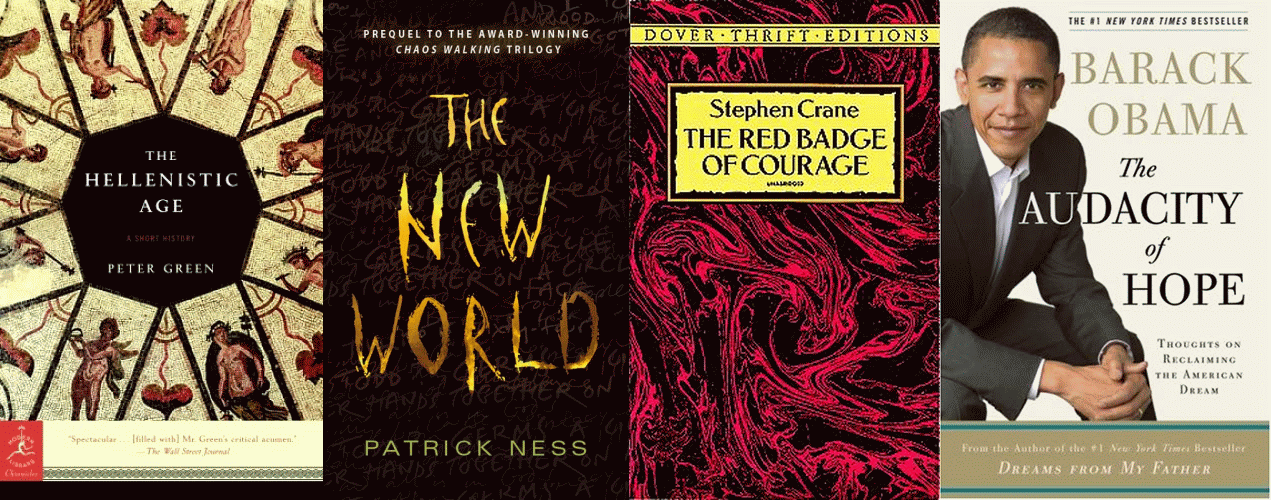
The Hellenistic Age by Peter Green, "The New World" by Patrick Ness, The Red Badge of Courage by Stephen Crane, and The Audacity of Hope by Barack Obama

The Dead that Walk edited by Stephen Jones, "They" by Vincent Hobbes, The Time Machine by H.G. Wells, The Zombie Survival Guide: Recorded Attacks by Max Brooks, and Blockade Billy by Steven King

Monday, December 12, 2011

The Red Badge of Courage (1895)

     I remember giving The Red Badge of Courage (1895) a try sometime in the fall of 1994.  This was a bad time in my life, but I thought I could make some kind of general progress if I could get to reading all of the books I had either sidestepped or outright neglected from junior high on.  I know I didn't make it past the second chapter before I put the book back on the shelf and decided that I didn't need to read it.  It didn't seem to be well written and the purposefully inarticulate dialogue grated on me.  Why would anyone think this was a worthwhile book?
     Now, much older and free of almost all of that egotistical arrogance, I found myself wanting to take up a short book between non-fiction titles (or, more correctly, as a break from the second non-fiction book I was reading).  I had purchased a Dover Thrift Editions copy of The Red Badge of Courage over a year prior, and thought I may as well just power through it.  The DTE copy has only 100 pages, so it practically invites anyone serious about reading to spend a day or two with it.  It also helped that I had long ago abandoned the idea that licensed genre fiction should be considered on par with literature.  That was a barrier that was too long to come down.
     One of the things I learned during my hated tenure as a wage slave was that there are far too many people who believe that the things we are to learn in school – including the books we should have read – are useless in a life that demands little more than remembering to smile, say thank you, and show up to work (though not necessarily on time, and with no subsequent demand to perform work while being paid).  There is a persistent belief that getting by is good enough and aspiring for me is foolish.  These are the people who could not name the capital of Missouri (they being located one state east) or convert easy fractions like 3/4 to decimals.  I detested these qualities in my co-workers, felt diminished in being associated with them in having the same basic job.  If I were to forever avoid the literature that is supposed to help inform my understanding of the human condition, I would be just like them.
     Where Stephen Crane's Henry Fleming must come to terms with what it means to be a man – what the true nature of courage is – I found myself struggling with what kind of person I wanted to be.  The are many glib answers to my question; I don't have the din of battle or the press of fellow soldiers to help me find the line.  I do know that on some level I want to feel as though I am educated, and that an education is not something that someone suffers through.  It is not something to be purchased as a means to the better career and looking like a worthwhile mate.  It is something that needs to be internalized and exercised as a person, as a citizen.
     Sure, Henry gets to discover what it means to be a man just past his youth.  Lots of people do that.  Crane presents the various men in the book who cannot come to terms with what value they have, but they are neither to be pitied or scorned.  They simply are.  That is not what any of us aspire to.  I know that I want more than to be (though let's not rule out how important existence is for everything else).  When I started my first self-imposed reading project in the August of 2010, I wanted to get in the habit of reading important books.  I think that I may have neglected the number of fun reads so far in year two (two licensed fiction novels and a handful of short stories seems light) that help balance out the more serious titles.  Unlike the battle scenes in The Red Badge of Courage, the serious and respected titles do not necessarily inspire a sense of urgency or vigor – school inspired/required reading always has an external structure to add importance to anything read.
     I think I would have been much more appreciative of Crane's novel had I read it when I was supposed to, which is to say at some point in high school.  It would have held a different personal meaning for me back then, sure, but it would have borne the benefits of a more in-depth exploration of the text.  Not that I ever enjoyed the ideal of manufacturing found symbolism in order to prove to our teachers that we really read and understood the assigned book.  There is something liberating in reading the classics that does not come with the genre fiction I once aspired to write.  Not that I have entirely given up on that dream; I have just slightly modified it to hope that I may one day write something that has a more human and truthful element.  That is where The Red Badge of Courage succeeds.

Tuesday, November 22, 2011

Lord of the Flies (1954)

     A couple of things first.  Yes, I should have read this some twenty-odd years ago.  Yes, my vision of Ralph is a young, skinny Balthazar Getty – before Young Guns II (1990) and Feast (2005) – because seeing that 1990 version of the story had been my exposure to it (and I saw it in the theater opening weekend).  Clearly one could never film the story as written, because nobody is going to make and mass market a story with scores of naked British boys running around on a tropical island.  I hope that much is true.  How did I come to read it now?  Well, I have a stack – and list – of non-fiction books I want to read as part of this year's reading project, but I wanted to get another novel in this month.  My mother has a couple of copies of this book, but the one I borrowed was her's in high school; I have a feeling that one cannot find this book with a $1.25 cover price at present.
Here is my mother's old address in central Pennsylvania (she didn't live in Spring Mills, but apparently there was no post office closer to her home).  Please take note of the phone number – EMpire 4-1537.  This is just 52 years ago, and rather than listing it as 364 -, they used EMpire 4.  Pure craziness.  Apparently only a handful of years prior they were still using five digit phone numbers in those hills.  It is realizing moments like this that make me feel as removed from her background as civilization becomes to Jack's band of hunters.
     I am not going to pretend to offer any insight to Lord of the Flies (1959).  I read it for enjoyment and on that level it is a fine, though not earthshaking, book.  Perhaps because I know the story, the impact and message feels weaker than if I were discovering it for the first time.  I did manage to get through the book in decent time – three days, doing the last 100+ pages and notes on Sunday while waiting to catch an encore presentation of The Walking Dead (2010-present).  If anyone were at all curious, Lord of the Flies is much more satisfying on all levels than the zombie show. 
     I would like to think I get what Golding was going for, even when he used relatively obscure meanings for commonplace words.  I thought the inclusion of the actual Lord of the Flies felt forced and out of place, as though Golding had his manuscript together but lacked a proper impetus/plot device to drive the big change while simultaneously giving it another level of meaning.  Maybe I'm wholly wrong on that note.  I did have some slight difficulty keeping some of the minor players straight – another result of knowing that only three of the characters really matter in the scope of the story – but that quickly resolved itself.
     What did strike me was how uncharacteristic of my experiences were Golding's expectations of these children.  While I do not want to equate Indian Guides or Cub Scouts to British schools (I imagine the latter to be much more strict and regimented, especially in the 1950s), I do know that when I was a child, we children made good account of which of us were where and who was in charge.  Moreover, we didn't seem to have any problem trying to organize (though we clearly lacked any know-how and most ability to do anything worthwhile without great direction and guidance).  Golding's boys don't know who all is on the island – and that is amongst themselves – and fell that there is still a great need to indulge in endless play.  That seems very contradictory to the human nature I've witnessed.  Then again, I grew up in a world that had already read Lord of the Flies, so perhaps we were being slightly readied for better behavior should we ever crash land on an island and have to fend for ourselves.
     Yes, the cruelty of the boys – when it is finally allowed to come out – feels true.  So does the ever returning sense of uncertainty that all of the boys experience.  There is something very real that Golding is touching on, but he seems to dance around it at times, content to have his characters dash off for a swim or talk over one another rather than delve deeper into their beings.
     Now, Lord of the Flies is not to be confused with the Cheapass Games product "Lord of the Fries", itself a disappointing follow-up to the great "Give Me the Brain".  By the way, "Give Me the Brain" is also better than The Walking Dead, but as it is an interactive that should be expected.  No, this is a good book (that I guess I can't quite accept as great) that most people read when they are closer in age to the victims of circumstance that people it.
"Give Me the Brain", in all of its original Cheapass glory.
"Lord of the Fries" goes deluxe.  There just seems something contradictory about a deluxe Cheapass Game.

Friday, November 18, 2011

The Power and the Glory (1940)


     Back in the mid-1990s I had the good fortune to have a professor who took the GenEd literature course we students took during a summer session – some because it would transfer to real schools, some because they needed credits to get back into real schools, and some because they had no means of taking courses at a real school.  He had us read the standards that the good students read in high school, The Sun Also Rises (1926) and The Great Gatsby (1925) and an insane amount of short stories (I want to say we read 50 for the eight week class).  One of the short stories was "The Destructors" (1954) by Graham Greene.  He strongly encouraged us the read The Power and the Glory (1940) – he couldn't get approval to add it to the approved curriculum.  Strangely, I made no effort to read the novel for about 15 years.
     I don't know that anything I have to say about The Power and the Glory will do it justice.  It is surprisingly good and overcomes the disinterest Greene seems to have in his own characters for the first two chapters.  Sure, I had to actually look up the word "quay" (a wharf or reinforced bank where ships are loaded or unloaded) and had to flashback to how june bugs popped off the kerosene lamps at Owasippe (a Boy Scout camp near Whitehall, MI) in order to understand all of the beetles "exploding" against the walls and lights.  Once Greene seems willing to give some depth to his characters the story becomes alive and urgent. 
     Sadly, I am more than willing to admit my ignorance of the real world situation that lead to priests being outlawed in the state of Tabasco.  Part of me wanted this entire story to be allegorical, but Greene makes (some of) the sins of man into a type of virtue and gives an eloquent voice as to what the sacraments provide.  His Whisky Priest has plenty of time to reflect on the nature of the Church and what he has to offer to them.  There is a role that God plays in their lives, but he doesn't pretend to know what it is.  Those he tends to often have a type of weakness of character, where those who tend to him – non-Catholics all, and one atheist who may be the second most important character in the novel – display the strength of character the Church has not fostered.  Greene both celebrates and condemns the Church at the same time, a remarkable feat.
     There are a few lines/ideas that stuck out for me (and in a relatively short span of pages):
✝ On page 172, Greene's Whisky Priest muses on power and dangers of Love, thinking 'Love is not wrong, but love should be happy and open - it is only wrong when it is secret, unhappy... It can be more unhappy than anything but the loss of God. It is the loss of God. You don't need a penance, my child, you have suffered quite enough,' and to this other, 'Lust is not the worst thing. It is because any day, any time, lust may turn into love that we have to avoid it. And when we love our sin then we are damned indeed.'  Later, the priest allows for Love to be the scariest thing God has to offer.  He would run away from even a glimmer of that kind of force.
✝ On page 182, Greene has one of the best lines ever.  'All the same, it's good to see a priest with a conscience.  It's a sign of evolution'.  In the novel, a schoolteacher offers this biting critique of how the priests used to take what little money the peasants had and denied the children the things they needed to survive for the services of baptism and communion.  The Whisky Priest had finally come to terms with what he needed to do as a man, but he is properly diagnosed as having evolved from a man fleeing the persecution to one who will take seriously his sacred duties (and is hoping for information about one of his benefactors).
✝ On Page 194, on the topic of what is allowable Greene offers, 'A man may want to rape a woman.  Are we to allow it because he wants to?  Suffering is wrong.'  Now this seems pretty straightforward, but the Church – and the Whisky Priest – have argued that suffering in this world may make the blessings of Heavan that much more sweet.  The Lieutenant – the man who has been charged with eliminating the last remaining priest – is presenting what he feels to be a reasonable vision of the future.  There will be law and order, and thus justice.  But there won't be any lies about how there is something to be gained – something noble – in being made to suffer.  Suffering is something that should be abhorred and its causes challenged.  That this type of world needs the priest to be executed is the contradiction that cannot be overcome.
     How good is The Power and the Glory?  I would easily put it in the top 20 books I've ever read (I didn't feel this way in the early chapters).  While I abandoned Cormac McCarthy's The Road (2006) because I felt it was going nowhere – see what happens when books aren't part of a project – I have to imagine that it cannot put humanity, suffering, and the compassion in better light than Green did 66 years earlier.  I cannot imagine this novel making much of an impression on an adolescent and how it may deeply offend Catholics, so it makes sense that it is not a staple of high school literature classes.  But I would definitely recommend that everyone read it. 

Monday, November 7, 2011

Arcadia (1993)

     I came to read Arcadia on the recommendation of Steve Carroll, a much more successful – and one would hope fulfilled – member of the 1993 class of CSHS.  I didn't know very much about Stoppard.  I was aware of Rosencrantz & Guildenstern are Dead (but only because of the film) and the he was one of the authors of the screenplay for Shakespeare in Love, but that doesn't really inform much of the style and outlook of an author.
     What does Arcadia have going for it?  It is delightfully irreverent – and in two different centuries, no less.  It has sparkling dialogue that does not come off as stilted or manufactured.  Like almost all of the recent tales I've read regarding England or the English, it is hopelessly tied to the aristocracy.  As a complete and total aside, I now firmly believe that we could solve all of America's unemployment if the 1% had as many servants and attendants as 19th Century English landowners did; Arcadia seemed light in this regard, but there were still multiple attendants mentioned.  Back to making points in favor of the play.  It has a proper respect for the amount of disrespect and discourtesy in academia, and how the legitimacy of 'discoveries' is dependent – largely – on the stature of the personality tied to it.
     However, Stoppard (like a lot of other authors) has an unhealthy attraction to Chaos Theory.  Actually, I think he gets everything in regards to physics wrong.  Sure, I'm no physicist – and it has been 18 years since
Time magazine man of the year (1960), Elliot Cresson Medal winner (1961), National Medal of Science winner (1987), Crafoord Prize winner (1989), etc., Dr. James Van Allen offered to get me started in the field – but I would like to think I have a working knowledge of the subject.  Yes, I have some problems wrapping my head around hydrodynamics (largely because I have trouble properly applying Bernoulli's principle), but Stoppard presents an academic understanding of thermodynamics that I had surpassed by high school.  What's worse, his presentation impressed some reviewers for its insight.  The disorder that Stoppard supposedly introduces felt like so much nothing to me.  It didn't distract from the wonderfully layered relationships that Stoppard put into each era, but it didn't do anything to add to it.
     Likewise, Stoppard's linkage of Chaos Theory and thermodynamics (yes, there is a lot of literature on the subject and not one the those scientists should give a damn that I think they are doing a lot of work just to muddy their own understanding of the perceptible world) to a sort of nihilism does not hold any emotional truth.  Given that there is a fair examination of conflicted emotions – tied to social class or position – that is rather disappointing.  He also has his most rewarding character, Thomasina, as the vehicle for introducing all this nonsense.  While this works (slightly) as a plot device, I would have preferred to have more time with Thomisina and her non-scientific musings because they have a much better payoff (and didn't frustrate the hell out of me).
     I can say without qualification that Arcadia is the best play I've read as part of this year's reading project (of course, it is the first play I've read for the current reading project), and probably one of the ten best I have read in my adult life.  I would imagine that it is a supremely difficult one to stage properly, especially the last scene.  There is nothing difficult in the text, though I could certainly understand not wanting to expose pre-teens to the subject matter of language (I would, but I view children differently than most people).  As Arcadia takes less than two hours to read, I would encourage everyone to at least give it a chance – I doubt you will be disappointed (or be as offended by the science as I was).

Monday, October 31, 2011

Herland (1915)

     Maybe I just don't have much of an appetite for the utopian novel (or novella).  The idea that all of the tension and dramatic action comes from a critique of the inequalities and injustices of modern – at the time of the writing, at least – society doesn't seem to one I want to see as central to the telling of the tale.  The dystopian tale seems to be a much bigger staple of the Science Fiction genre, and it would appear that it is one that works to greater effect.  Then again, this may just be a function of familiarity.  Titles like Fahrenheit 451 (1953), Brave New World (1932), and 1984 (1949) are not just staple of the American educational system but almost required reading for any Sci-Fi/gamer geek.  Factor in movies like Blade Runner (1982), Brazil (1985), Children of Men (2006), Equilibrium (2002), Logan's Run (1976), The Running Man (1987), Screamers (1995), Soylent Green (1973), They Live (1988), Robocop (1987), The Road Warrior (1981), and Escape from New York (1981), and it is unlikely that one can contemplate a world without many possible dystopian fuutres.  The same emphasis is not placed on utopian stories.  Aside from Plato's Republic (~380 BCE) – and maybe St. Augustine's City of God (413-426) for the religiously minded – there isn't a great tradition of teaching the utopian tales.
     Charlotte Perkins Gilman's Herland (1915) operates as both an imagining of a utopian society (for a little more than half of the world, at least) and a scathing critique on the state of the world.  The odd pacing of the tale – a memoir recounted by one of the three men, the most moderate and least judgmental of women in general – leaves Herland without much of a sense of urgency or tension.  There is a fair amount of building up of the three male characters (Vandyk Jennings, Jeff Margrave, and Terry O. Nicholson) and their place in the real, male-dominated world.  This section of the novel reads like a lighter, less detailed take on the typical adventure tale of the era.  The point, and one certainly not lost on the women of the time (or any readers now) is that the most masculine, domineering character is antithetical to the development of women or their role in society.  The other male characters are somewhat helpless against him while trapped in the confines of their own culture.
     One of the fundamental problems with Herland is Gilman's misunderstanding of human nature and psychology.  Because she posits that it is fundamental to the nature of women to be concerned with the welfare and well-being of children above all else – including a sense of self – Gilman crafts a society of women that has no purpose other than service to the nation and future generations.  There is no sense of individuality as we (members of a contemporary Western culture) would understand it.  There is absolutely no concept of sexual identity; their is knowledge of sexual acts (through observation of animals and an understanding of the before-time, when there were men in Herland), but as these are not needing to produce children, they are deemed unnecessary and not pursued.  I'll leave it to women to decide if sexuality is something that can be cast aside given the ability to simply wish children into existence.  My limited education on human nature (both in the fields of philosophy and psychology) would indicate otherwise – certainly Aristophanes has argued otherwise.
     Still, even with its decidedly anti-male (there was no way to be anti-establishment without being anti-male) tone, Herland is a rather fun and engaging read.  Because Gilman is so concerned with establishing the qualities she deemed to be inherently feminine are superior to the ones favored by men (and perhaps correctly lists the best qualities as neither masculine nor feminine, but human), she doesn't provide a society that is accessible to the male reader.  There are some conceits that truly help her vision – everyone in Herland is part of the same extended family, all are given equal opportunity in terms of education and vocation, and the general clannishness has worked so well that there are no real criminals (so no need for a punitive government or God).
     Herland is forced into ecological conservation by geography and population.  There are no other societies to encounter, people to conquer, or land to seize.  Part of this is a necessity for the all female society to develop and endure.  What it leaves unanswered is whether it is the nature of the women (and their dedication to life) or the isolation that led to the enlightened and utopian state.  I don't think Gilman wanted an easy answer to that question.  She allows for the fact (as she saw it) that even though men and women love differently – men love in a selfish and demanding way in Gilman's eyes (again, I'll leave it to others to judge whether this is true) – they can and do find ways to meaningful share their lives and compliment each other.  Gilman makes it as unbalanced in favor of the women as she saw it for the men in the real world, but did not view it as an inequality because of how women were not hurtful with their love.
     There is much to admire about how education and physical activity are stressed in Herland.  Sure, Gilman believes that women could be every bit as strong as men (not on the individual basis, but across the board, which is just a total misunderstanding of physiology), but her women only use force as a restraint, a means of keeping the foolish from injuring themselves and/or others.  That the denial of most rights to the men trapped in Herland is not seen as any sort of violation by Gilman gives away how much she mistrusts male authority and prerogatives.  As a man reading her nearly a century after she wrote it, I am not especially sympathetic to her desire to put men in their place.  Furthermore, her utopian society seems oddly limiting.  It is unclear who is making the decisions on one's fitness for birthing children, raising children, or the field of vocation one undertakes, but there is a controlling body.
     As for some specific points from the book that struck me:
•     When a man has nothing to give a woman, is dependent wholly on his personal attraction, his courtship is under limitations. (Chapter VIII – The Girls of Herland) 
     I think Gilman is addressing both the inequity amongst men, how those with means could easily position themselves better to woo a mate, as well as how women were indoctrinated to accede to men of such men as a manner to ensure a better chance for her children to grow up.  The idea of a woman choosing a man (and that is always the case, at least in my experience) based upon who he is and not what he can provide would be considered foolish; Gilman makes this point exactly in her short story "If I Were a Man".  In the case of Herland, Gilman is noting how the ladies man has no success among women who measure men (people, really) solely on merit, for all he has to offer are the shiny baubles he thinks women are wont to have.
•     They loved one another with a practically universal affection, rising to exquisite and unbroken friendships, and broadening to a devotion to their country and people for which our word "patriotism" is no definition at all.
       Patriotism, red hot, is compatible with the existence of a neglect of national interests, a dishonesty, a cold indifference to the suffering of millions.  Patriotism is largely pride, and very largely combativeness.  Patriotism generally has a chip on its shoulder. (Chapter VIII – The Girls of Herland)
     Gilman gives a very nice critique of nationalism, and how patriotism is often pledged in an 'us against them' manner.  She does see a sense of filial bond as a feminine quality and conquest (and self-aggrandizement) as male.  But what I like about this is how it strips down the conceit of patriotism as only applying to interests one chooses to choose as his own, ignoring the plight of his fellow citizens as though they were somehow unfit for the benefits of the society and nation which he calls his own.
•     They loved their country because it was their nursery, playground, and workshop—theirs and their children's. ...That, of course, is the keynote of the whole distinction—their children.
     Maybe their is something to the male ego that screams out for possession and domination of the land.  It is certainly true that fathers do tend to be less concerned about the lives and futures of their children then the respective mothers are (this varies with each person, but men do tend to be much less sacrificing then women when it comes to children).  The larger point being made is that Western culture tends to focus more on the present than what is being done to ensure the best situation for future generations, and it is a point that never (to date) stops being true.
•     " 'Why, you blessed child,' she said, 'you've got the wrong idea altogether.  You do not have to think that there ever was such a God—for there wasn't.  Or such a happening—for there wasn't.  Not even that this hideous false idea was believed by anybody.  But only this—that people who are utterly ignorant will believe anything—which you certainly knew before.' " (Chapter X – Their Religions and Our Marriages)
    Well, it is more than clear how Gilman felt about Christianity (and religion in general).  Here she is making the case against following the strictures of ancestors and believing in a God who exists to levy punishment and judgment against His children.  The women of Herland had no need for retribution or vengeance, and thus the concept of a deity who claims those as prime attributes is reprehensible.  I think that is a pretty good place to start in the examination of a divine being, though.  Does He/She/It have a need to judge and punish others, or can the Divine instead serve to give guidance and inspiration alone?  I don't have an answer to that, but I must imagine that such a criticism being directed at religion was just as outrageous as suggesting that all of the great accomplishments wrought by men  and competition may have simply been seen much earlier (and without individual fanfare) were societies such that they were concerned with working in concert for the general well-being of the citizenry.

Friday, October 14, 2011

Tom Sawyer (1876)

     One of the first real books I can lay claim to having read – mind you, the entire class was required to read the book and it took several months for us to finish it – was The Adventures of Tom Sawyer (1876).  I actually still own the copy from that 5th grade class, with my mother marking it as mine (apparently we bought the book in September of 1985, which is noted both by my mother and by me in different places).  When going back to reading it this time, I did not take up the weathered Scholastic edition – which I am somewhat surprised was not an abridged version – but rather went for the DTE copy that was sitting on the downstairs bookcase; the only real difference is that because of dimension and font differences, the DTE can fit the story on 184 pages instead of 319.  (Actually, if one has seen where I live, they are well aware that there are multiple bookcases downstairs, but there is one still reserved for works for the reading projects.)
The old Scholatic copy.  Not sure if it or the DTE have cover art that really fits the story.  But there is my mother's handwriting (it still looks largely the same these many years later) noting when the book came into my possession.  Lastly, there is the back cover, with my name (as T.A. McNeil) written by me – at a time when I still dotted my i's – a SEP written next to the book, and a whole made through the cover just above Scholastic (where the logo would be) that I traced out with a pen.  I actually remember doing that in class when we were supposedly discussing the book.
     I don't know what meaningful statements I can make about The Adventures of Tom Sawyer that have not been explored at depth elsewhere by people more dedicated to the study of 19th Century American Literature.  There are some points that I would like to touch on, and hopefully these will be taken in the goodhearted spirit they are intended.  The fact of the matter is that The Adventures of Huckleberry Finn (1884) is on the reading list for this year's project, and I was not going to take up the book without having refreshed myself with the story that introduced Huck Finn to the world.  As such, my intent was more to read the story for enjoyment that to deconstruct its elements.
     Having written that, I would like to note that the central theme I divined from the novel was that children are liars, and incapable of behaving in a manner that would mark them as being fit for society.  I do not feel that I am misrepresenting Twain's sentiments when I write that, and not just because he himself was not a fan of what his contemporary Americans considered "civilized".  In Tom Sawyer, children lie because they are ignorant; they simply are trying to better understand the world and have only the gossip of superstitions held by the adults to guide them.  Likewise, they lie to the adults because the adults seem to be often cruel and mercurial beings who only exist to place impediments on the experiences of youth.  The children, especially Tom, have no real conception of the larger world.  The have fantasies of the glory of piracy or banditry, something more glorious than the meager lives the adults have in the rivertown of St. Petersburg, Missouri.  Civilization seems to mean to tie oneself to an unremarkable task for life and be quickly thought of as being somewhere from middle-aged to elderly by the next generation of children.
     That message seems to be lost from the part of Tom Sawyer that seems to still exist in the zeitgeist.  Tom and Huck being friends endures, which is odd because Huck is very much a friend of convenience.  Tom is much closer with Joe Harper through most of the book.  Tom and Becky being boyfriend and girlfriend endures even though, as written, Tom is more than a little bit of a hurtful manipulator; one can assume that Tom was good looking enough for the ladyfolk to take kindly to his degree of mischief.  Likewise, Twain goes off on a tangent where he rails either against women as writers or just about writing on the subject of faith and salvation in general.  I think he actually means both.
     One of the things that a modern reader, especially a child, will find completely out of place with contemporary America is the sense of charity given to the ne'er do wells of the town.  It isn't just Huck Finn, the son of one of the local drunks – in what may have been a dry town – who receives many kindnesses in order to survive.  Muff Potter, wrongfully accused of murder (but guilty of conspiracy to commit grave robbery) also makes do on the good will of the citizens.  It is a place where most people don't have much – and some, apparently, have tons – but they do not sit content with the notion that those who are worse off are there as the result of a general defect.
     I enjoyed my re-reading of this book.  Granted, it only took three days – which makes me wonder how much we, as grade school students, were able to appreciate Twain's working the major events of the adult world into the vagaries of childish thought and pursuits.  That is the real accomplish with the novel as far as I am concerned.  Twain makes a few months time in the lives of a handful of children into a story that seems to span a lifetime, or at least the whole breadth of childhood.  This is, by nature of the style with which it is written, one of the few books that may merit a revisit every twenty years or so.  I imagine that the shrinking glow of youth can be momentarily remembered to still burn bright while within the pages, but experience gives the reader a much different understanding of the world Twain represents.
     I was also extremely happy that Twain does not dedicate himself to the bitterness and bile that dominate many of his short stories.  Not unlike his piece about his brief time as a recruit for the Confederacy, Twain has a way of imbuing his personal experiences with a fondness that comes more from telling the tale than for what the story may represent.  Even the most evil character Twain puts in the tale is far less maligned than the average citizen would be in the short stories.
     Yes, I enjoyed the book.  Who thought I was going to come out and rail against the beloved story?