Showing posts with label History. Show all posts

Tuesday, May 22, 2012

Philosophers in 90 Minutes (Part Four)

     Author Paul Strathern is largely more comfortable writing about philosophers whose contributions fall in the political realm than he is in discussing how Augustine or Aquinas integrated Ancient Greek philosophies into the Christian tradition.  He spends much of Locke in 90 Minutes (1999) not so much discussing (or even mentioning) specific contributions Locke made – using one of the more traditional cop-outs in maintaining that we would only look upon them as common sense" – but in humanizing Locke.  He also does a better than average job of covering the history of the era (considering the brevity of the book).
     At the same time, Strathern takes the time to do some quality English-bashing.  While this is usually tame, he does rise up to show what may be some contempt rather than playfulness in exploring the nature of the English.  See the following example:
           The English have always been very good at being boring,
           and several times in history have emerged for 
           considerable periods as undisputed world masters in the 
           field.  This was one of them.  Under the Puritans all 
           conspicuous signs of enjoyment were banned.  Even 
           Christmas was banned, despite what it celebrated.    
          Citizens were expected to work all day and spend the rest 
          of their time conforming.  Life was given over to Puritan 
          indoctrination, the thought police, informers (on the likes of 
          wicked Christmas pudding eaters), and long sessions spent 
          studying the principles of Markism, Lukism, and Johnism.  
          Until in the end even the English had had enough, and 
          decided to invite Charles II to take over.  They preferred to be 
          ruled by a drunkard who lived with a prostitute, that than do 
          without Christmas pudding. [p. 19-20]
     Strathern also exposes his distaste for actual philosophy (this is made clear in a different book discussed later in this post) by attacking the contributions of philosophers who dared to believe that metaphysics is a fit subject to explore.  I have no idea where this fits in with mainstream, working (in academia) philosophers; it certainly was not prominent at any of the various colleges/universities that saw fit to let me take classes in the subject.  He is more couched in his criticism here, allowing some merit at least to Kant, but only in the aesthetics of the system he created (German philosophers really do have an innate love of systems), not in value derived from the system.
           Without Descartes there might have been no modern philosophy.  
           But it was Locke who fathered its main line of development—the 
           British empiricists, who then provoked Kant to produce the 
           greatest philosophical system of them all, which in turn gave rise to 
           the elephantine folly of Hegel, and the consequent disbelief in all 
           systems by anyone except Marxists and optimistic punters. [p. 42]
     I would have preferred for Strathern to give more attention to Locke's works – he even goes a little light in quoting from them in the excerpts at the end of the book – but I cannot find a lot of fault in the book as a general overview.  It does help to be familiar with Locke's writing going in, but as a short biography of the man, his time, and his general ideas, this book is fine.


     Strathern has probably his best (certainly of those that I have read) book in the series with J.S. Mill in 90 Minutes (2002).  This isn't because Mill is the most influential philosopher he has covered – everyone after Kant has been trying to answer him, and Kant himself was just setting out to refute Hume, and Hume...well, he tried his best to establish that philosophy had no relation to the day-to-day life most of us engage in, the one that lets us hold a job, earn a living, have a good time...basically survive – but rather because Strathern finds many pointed ways to make Mill's arguments in favor of Utilitarianism and general equality easily recognizable in modern Western society.
     Not that the book has an encouraging start.  The entire introduction is dedicated to Jeremy Bentham, with Strathern seemingly eager to reduce Mill to simply repeat the ideas and take the credit.  Strathern does make the effort to show where Mill branched off on his own in regards to the philosophy, but he does so with much amateur guessing as to the psychological motives behind his work (having already exposed his distaste for psychology/psychiatry; it being a fake science, like economics, according to Strathern). 
      He does – supposing on Mill's sexual experience on resentment of his father aside – a rather elegant job of not letting the history of the man or his era overwhelm the deeper thoughts expressed in the philosophy while still doing justice to them.  Here are the various bits of the book that caught my attention:
           A few years later [after entering the civil service at the age of eighteen] 
           John Stuart Mill  also took on the task of of editing the influential 
           Westminster Review, which attracted such writers as Coleridge and
           George Eliot.  (Among this magazine's many philosophical and literary
           achievements were the introduction of Kant to general English 
           readership and a review of of the unknown Schopenhauer, which 
           overnight made him  belatedly famous in Germany. [p. 26]
     This really doesn't stress Mill's importance with the Westminster Review as it does the Review's importance all on its own.  Mill is, by extension, important early on because of his relationship to it rather than vice versa.
           Metaphysics Mill was content to dismiss, but German metaphysics was
           one of the few subjects that provoked his passionate outbursts.  He 
           even declared that being conversant with Hegel "tends to deprave one's
           intellect." [p. 27]
     This combines Strathern's general distaste for metaphysics and his outright hatred of Hegel (or at least the Hegelian philosophic system).  But at the same time it gives good insight into the otherwise proper – to the point of being a caricature of the trait – Mill having human emotions.
      Strathern points out Lobachevsky's introduction of non-Euclidean geometry, which rendered mathematics that "often had no correlate in the physical world.  Mathematical space and physical space were in no way identical: here experience and mathematics were two entirely different things." [p. 36]  This is related to how empiricism cannot explain a complete and thorough understanding of mathematics, a problem which Mill never quite overcame.
           Mill realized that the laws that govern economics are concerned with 
           production, not with distribution.  The productivity of labor, of the soil, of 
           machinery—these can all be organized more or less efficiently according 
           to certain objective laws.  These laws are affected by certain limiting 
           factors, such as nature (glut or famine), productivity (of labor, or machine),
           and so forth.  Wealth is thus produced according to laws and objective 
           factors which enable us to maximize its quantity. [p. 37]
     This is a huge breakthrough in terms of viewing economics.  It had, to date, only been concerned with looking at one half of the equation.  Mill argued that what had long been ignored was the moral component to the distribution of goods, services, and wealth.  It could not be approached with only efficiency or a desire to maximize transactions as the sole guiding principles.
           Utilitarianism remains at least the guiding principle in all labor-market 
           bargaining, union negotiations, and executive salary levels.  It may not be 
           adhered to, but it undeniably informs all such social interaction—it is the 
           one common denominator.  It remains a yard stick by which most of us 
           judge the distribution of wealth.  Ludicrously inflated earnings for senior 
           executives of large corporations are said to be "what the market dictates."  
           This is seen as a matter of production, beyond moral debate.  Objections to 
           such practice make use of Mill's original distinction and insist that it is a 
           matter of distribution.  This means that such remunerations are subject to 
           more than simply economic considerations.  They fall within the realm of 
           moral judgment.  And the most pertinent application here would seem to 
           many to be the Utilitarian idea of the common good. [p. 40-41]
     I would like to think that passage speaks for itself.
           Mill is well aware of Hume's argument and seeks to circumvent it.  He 
           does not smuggle an ought into his argument, where previously there had 
           only been an is; instead he presents a psychological fact.  At this point it is 
           worth reiterating in full Bentham's core Utilitarian principles, to which Mill 
           continued to subscribe: "Nature has placed mankind under the governance of 
           two sovereign masters, pain and pleasure.  It is for them alone to point out 
           what we ought to do, as well as to determine what we shall do....
           The standard of right and wrong [is] fastened to their throne.  They govern us 
           in all we do, in all we say, in all we think: every effort we make to throw off 
           subjection will serve but to demonstrate and confirm...[this] principle of 
           utility."  Mill concurs: "I regard utility as the ultimate appeal in all ethical 
           questions." [p. 46-47]
     Hume had a primary objection of how moral systems inserted ought to and ought not to into arguments without any real logical connection to the is and is not statements that preceded them.  While I find Utilitarianism to be a deeply flawed system for determining proper moral action, it was still an improvement over philosophies that stifled the sense of and role of self in determining moral choice.
           Bentham's concept of liberty had not been entirely theoretical.  His belief in the
           freedom of the individual had even led him to suggest that the law forbidding 
           homosexuality should be repealed: "How a voluntary act of this sort by two 
           individuals can be said to have anything to do with the safety of them or any 
          other individual whatever, is somewhat difficult to be conceived."  Such 
          advanced ideas were not widely promoted at a time when those "caught in 
          buggery" ended up on the gallows.  Betham's opinion on homosexuality, 
          especially coming from a man of high-minded principles who had no 
          sexual experience whatsoever—he remained chaste throughout his life—speaks 
          volumes for the liberalizing effect of his Utilitarianism. [p. 57-58]
     This is the kind of 1830s thinking that I would be okay with us returning to.  I'm not really sure if Bentham's sexuality, or thorough lack of sexual inclination, has any bearing on the merits of his argument; I wouldn't have presented it in a book about Mill. 
           At one point he was asked, "Did you declare that the English working 
           classes, though differing from some other countries in being ashamed of 
           lying, were yet 'generally liars'?"  Mill immediately replied, "I did."  The 
           working-class members of the audience responded with appreciative 
           applause, and Mill was duly elected. [p. 63-64]
     This is a funny story, made better because Mill's original plan for running for office was to do no campaigning, give no speeches, and engage in no debates – thinking that this freed up to voters to make informed choices without undue influence from the candidate.
           "So long as an opinion is strongly rooted in the feelings, it gains rather than 
           loses in stability by having a preponderant weight of argument against it. For 
           if it were accepted as a result of argument, the refutation of the argument 
           might shake the solidity of the conviction; but when it rests solely on feeling, 
           the worse it fares in argumentative contest, the more persuaded its adherents 
           are that their feelings must have some deeper ground, which the arguments 
           do not reach."  [p. 65]
     And that is how Mill crushes the faith-based/intuitive argument.
           "It is better to be a human being dissatisfied than a pig satisfied; better to be 
           Socrates dissatisfied than a fool satisfied.  And if the fool, or the pig, is of a 
          different opinion, it is because they only know their side of the question." 
          [p. 75, from Utilitarianism]
     Rather strong words for a man who was largely arguing in favor of pleasure (of a sort) at all times for the most people.
           "Over himself, over his own body and mind, the individual is sovereign." 
           [p. 76, from On Liberty]
     I would like to think the implications of that are easy to recognize.  And yet there is an entire political party dedicated to proving this is not the case, all the while arguing for limited government interference in the lives and over the rights of the individual.

     As strong as the book on Mill was, Hume in 90 Minutes (1999) proved to be a total disaster.  Not only does Strathern spend most of his time expressing how much he loves Hume (in that he is a Humean), he does this while failing to give an engaging (and possibility inaccurate) account of Hume's life. 

     Strathern clearly has a selective reading of Hume's philosophical works (nothing on the Clever Knave, nothing on how the mundane life is anathema to philosophical pursuits is mentioned here). Worse, he seems to have a fundamentally flawed view of it, thinking that there is something more than a general reduction to general uncertainty (on principle, not practicality, logic, reason, or experience). 
     I am not an expert on Hume.  I have read most of An Enquiry Concerning the Principles of Morals (1751) as well as most of An Enquiry Concerning Human Understanding (1748), with the support structure of a great professor and competent classmates to help me make sense of the material.  It would seem that Strathern either didn't read them or has a completely alien understanding of the general points of them. 
     If there were a book in this series to avoid, this is it.  Not because it is likely to offend, but because it really does nothing to help the reader gain a better understanding of the man or his works.

Wednesday, May 16, 2012

The Complete Maus (1991*)

     I am going to come right out and say it: I was expecting more from The Complete Maus (1991).  I was expecting a riveting telling of the personal trials and travails of Vladek Spiegelman during WWII and the Holocaust.  I also thought that the artwork would contribute to the story.  I don't think I either happened.  Art Spiegelman has trouble telling his parents' story because – and this is most explicit – he really has no affection (beyond familiarity) for his father, Vladek.  Since Anja, Art's mother, died well before he decided to take on the project, she could not be any help.
     Unfortunately, it seems that Speigelman was more than willing to settle for depicting his struggle to understand his father's struggles and life rather than actually understanding it.  As Vladek is, almost universally, depicted as a miserly asshole, it is hard to imagine why Spiegelman would turn to him for the story.  There were – we are told – many other survivors of Auschwitz in the neighborhood and amongst his fathers friends.  Surely these people would be able to give a better account of what actually happened.
     But maybe Spiegelman had no real interest in the reality of the experiences of Auschwitz or the invasion of Poland.  Maybe the entire exercise is one of trying to reconcile the shadowy understanding he had of his emotionally battered parents when he was a child with the account his father could give him as an adult.  Even so, I feel that Maus fails here as well.  Spiegelman spends much of his time wallowing in his frustrations in dealing with his father rather than showing any level of understanding.
     Now, I will admit that I am coming very late to Maus.  There has been much media about the Holocaust since Spiegelman started the project, so I am sure that I am unfairly prejudiced in expecting it to build upon material that came after it.  At the same time, there doesn't seem to be a compelling narrative to the story; Spiegelman is trading on the horrors his parents endured and survived without giving them a proper representation.
     Worst (for me), I felt that the style detracted from the story.  The choice to have the different races represented as different animals feels small minded and prejudicial rather than revealing. Polish pigs, German cats (Katzen?), French frogs, and Jewish mice may be easy to identify (actually, the cats aren't except for the fact they don't look like the other creatures).  All of the depictions are static in the extreme, even when Spiegelman tries to impart action or movement.  It looks and feels cold and impersonal, which is certainly not the intended effect (though it may be how Spiegelman felt while working through this).
     Now, this is not to say that I didn't find Maus worthwhile.  It is, but it certainly doesn't seem – 20+ years later – groundbreaking or exceptional.  It is too happily self-referential.  Ultimately, I think that it does little to illuminate anything about the survivors other than that they can be assholes or emotionally ruined in other ways as well as being survivors.

Thursday, May 3, 2012

Philosophers in 90 Minutes (Part Two)

     Paul Strathern will not be noted for being able to stay on-topic in the Philosophers in 90 Minutes series.  In the case of Socrates in 90 Minutes (1997), he manages to take quite a few pot shots at the field of psychiatry.  It is also worth noting that Strathern thinks that society in general reviles psychiatrists (I don't know if this is the case or not) while making no effort to separate psychiatry – a fake science to Strathern's mind – from psychology or even a modern way of living.
     He also has some difficulty when it comes to nailing down Socrates' particular contributions.  This is more than understandable.  Socrates never wrote anything down and what information that has survived about him is not just contradictory (the two primary sources are not in accordance with one another), but – in the case of Plato – tainted by the student possibly attributing ideas to the master that were, in fact, the student's.
     Still, it is a good, quick read.  Not as funny as the one on Heidegger, but not as dismissive as the one on Kant.  

    I'm not sure what to make of Plato in 90 Minutes (1996).  Strathern does manage to paint a solid picture of the life and times of Plato (though I do know a small amount about both, so I may have been filling in gaps that should not have been with foreknowledge), but he does not give as much attention to the works of Plato as I would have expected.
     In particular, The Republic (~380 BCE) is not given much examination as to its content.  Instead, Strathern mentions the Analogy of the Cave (which is 9th grade World History material to me) and a handful of the characteristics of Plato's sketch of an indeal society.  More time is spent mocking the ideas offered and trying to tie The Republic to Fascims, Nazism, and Stalinist Communism. 
     It is a good book.  In fact, it might be the one book in the series that I would recommend to others as a first read.  But it does not put the focus on the enduring value of Platonic philosophy – which becomes maddening when reading about St. Augustine incorporating Platonic thought into Christian orthodoxy and knowing that Strathern didn't much cover it in the first place – as much as it tries to show the colorful life and times of Plato. 

     I make no secret that my true interest in philosophy is in its various moral theories.  I don't care much about ontology or epistemology (which at some point either degenerates into our uncertainty about everything or rests upon some supposition so we can move forward and understand something).  Give me something about right vs. wrong, good vs. evil.  That is why I was very disappointed that Strathern give only the slightest mention of The Ethics (more commonly studied as the Nicomachean Ethics, as Nicomachus compiled the notes into the text).
     More troubling was Strathern taking up a couple of pages to tell the story of him wandering around (in the rain), looking for Ancient Stagira, looking for the birthplace of Aristotle.  It may be a humanizing moment for the author, but one that isn't necessary in so short a book.  It felt more like wasted space that a way to bookend Strathern's take on the philosopher.
     I think this book could have heaped both more praise and blame at the feet of Aristotle, but Strathern chooses instead to remain somewhat reserved on the subject.  The end result is that this ends up being one of the weakest I have seen.  Not horrible, but not a great introduction to such an important figure.

Wednesday, May 2, 2012

Philosophers in 90 Minutes (Part One)

Paul Strathern
     I doubt that Paul Strathern, or publisher Ivan R. Dee for that matter, is all that concerned with whether or not he is pleasing the prejudices readers bring to his short little histories of various figures.  He certainly does not beat around the bush with the role the Roman Catholicism played in stifling philosophy and meaningful academic advancement.  As such, people has vented their frustration that Strathern has not properly worshiped the Saints he has covered in the in 90 Minutes series.  I would point these people towards the philosophic figures he has covered, where most are personally savaged to some degree.  When it came to St. Augustine and Thomas Aquinas, Strathern generally praises the men, ignores the religion itself, and reiterates (because I think most of us have knowledge of this by the time we decide to read anything on the topic of philosophy on our own) that dogmatic thinking is contrary to intellectualism and any advancement of understanding.
     Strathern generally fits more of the history – sometimes more focused on the individual, sometimes on the era – than the philosophic contributions.  This satisfies one of the things I want to know at the expense of the other, but I will freely admit that most of the men (I have seen one woman covered in his Authors in 90 Minutes series) have ideas that cannot be properly defined in less words than they themselves used.  Giving a nutshell – really more of a sketch – of the contributions is (in some cases) enough for the casual reader, and by always including biographical information about the philosopher in question, there is not only a context for the thought but a humanization of the thinkers.

     I started reading this series with Heidegger in 90 Minutes (2002).  Yes, I found the Swastika shadow funny.  Still do, though Strathern goes to some lengths to ensure that the reader does not easily forgive Martin Heidegger's association with them (most accounts that I have read make it clear that Heidegger was motivated by a need to not be thrown out of academia when the Nazis rose to power rather than any belief in their cause – some stating that he left the party before the Nazis invaded Poland and started WWII).  He paints Heidegger as a needy, neurotic, perhaps asocial individual who found a way to reinterpret the world through the universal fear of death.  That is taking Heidegger's phenomenology shoving it into the smallest nutshell he could find. 
     If one has read either History of the Concept of Time (1925) – translated by Dr. Theodore Kisiel, who I met while at NIU – or its logical extension, Being and Time (1927), then one knows that its is almost impossible to follow Heidegger's line of thought without an expert on call for help.  Strathern fully embraces the difficulty with Heidegger's repurposing of language; how could he not?  But he does get around to giving the reader a rough concept of how phenomenology influenced the children's classic The Neverending Story (1979).

     I was hoping for something more substantial with Strathern's Kant in 90 Minutes (1996).  Largely because I am – as much as I am any one thing – a Kantian.  Instead of giving any attention to Kant's most easily identifiable contribution to the field of philosophy, the Categorical Imperative, Strathern goes with brief overviews of some of the points of the Critique of Pure Reason (1781; 1787), the Critique of Practical Reason (1788), and the Critique of Judgment (1790). Not Religion Within the Limits of Reason Alone (1793), Fundamental Principles of the Metaphysics of Morals (1785), or the Metaphysics of Morals (1797). 
     In a short book, it is nearly impossible to do more than state that Kant destroyed the notion of space and time as we understand them (and clearly, we have chosen not to go his route since we still understand them in a practical sense) without giving the reasoning as to how Kant came to his conclusion and why he may be right.  (Kant argues that time and space are both categories of perception and have meaning only to the extent they allow us to order our understanding and experiences.  Moreover, as we cannot be the things we perceive, we can never have real knowledge of them, but only that of which we perceive – we cannot reason things as we do ideas.  Thus our knowledge of the world is only related to the ultimate truth of the world in as much as our perceptions are flawless and sync up with proper reasoning.)
     Strathern does do a good job of both praising Kant as quite possibly the brightest mind since St. Augustine of Aquinas (and until Wittgenstein) and showing where his limitations were obvious.  This is no piece of idol worship, but Strathern does seem to hold Kant in higher esteem than most of the other figures in the series (at least as far as I've read).  Unfortunately, he does not seem especially well versed in Kantian philosophy (and Strathern seems to believe that current philosophers no longer advocate any kind of metaphysical thinking, which is not what I experienced in my time studying philosophy). 
     There is a better book by Roger Scruton – Kant: A Very Short Introduction (2001) –  and I suggest that one instead.  Not as easy a read, but more rewarding.

     Rousseau in 90 Minutes (2002) doesn't give the reader any sense of just how crazy Jean-Jacques Rousseau really was.  Indeed, it is remarkable how he tries to make him a rather sane, sympathetic figure.  Strathern also doesn't provide any great insight into the philosophy JJR.  As such, this book falls well short – and expectedly so – of David Edmunds & John Eidinow's Rousseau's Dog: Two Great Thinkers at War in the Age of Enlightenment (2007).  Strathern does give a good general sense to the man who advocated for liberty, but not so much his paranoia or his constant battles against the system he exploited to (farcically) live life on his own terms.  Not a bad read by any stretch of the imagination, but this is not where one should end when reading about Rousseau.

Friday, December 30, 2011

The 2011-2012 Reading Project to Date (August - December)

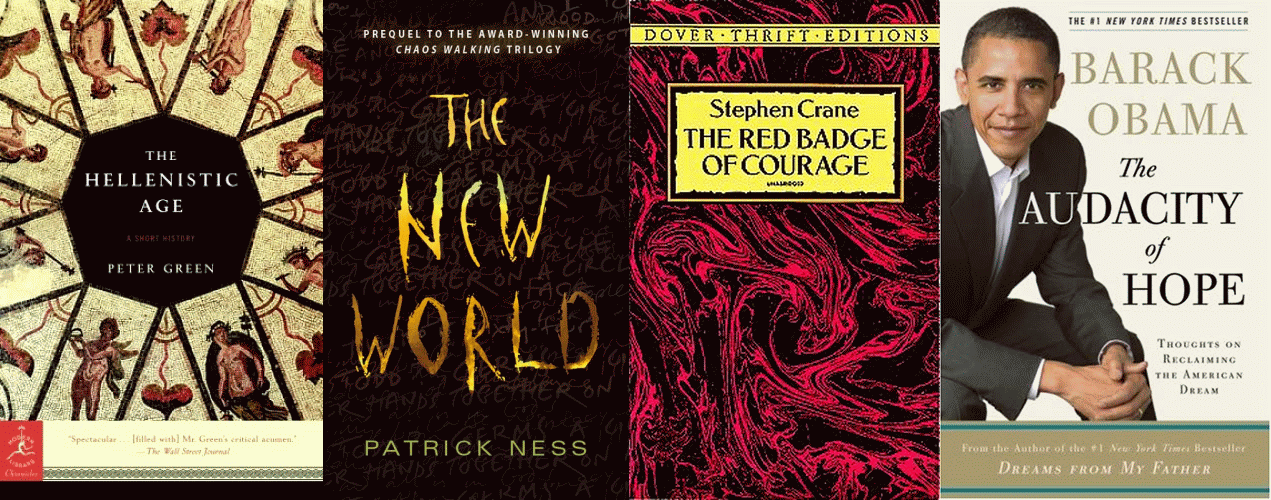
     I thought I would give a visual recap of titles covered to date as part of the 2011-2012 Reading Project.  Sure, it is much less loaded with serious titles than the 2010-2011 Reading Project, but it already has more non-fiction titles in the first five months so I have not abandoned hope.  There are quite a few types of fiction covered, too, so I don't feel as though I have locked into just reading types of books.  Sure, there are five Dover Thrift Edition titles in the mix (one quarter of the books read), but they are just so damned affordable.
     Anyway, feel free to comment on any of the titles you may have read and enjoyed (or hated). I feel rather confident that most people will have read at least three of these books.  Or just take note that this would only be six rows of books if I yanked the comic books and graphic novels out.  I would like to say that fourteen of the titles pictured were courtesy of the Forest Park Public Library and another four were borrowed from family members, so the 2011-2012 Reading Project has been quite economical to date.

The Imperial Cruise by James Bradley, Walking the Tightrope of Reason by Robert Foegelin, Great Short Short Stories edited by Paul Negri, and What Jesus Meant by Garry Wills

Conan the Barbarian Michael A. Stackpole, Seinfeld and Philosophy edited by William Irwin, The Memoirs of Sherlock Holmes by Sir Arthur Conan Doyle, and Naked Heat by Richard Castle

Kremin issues 1-4 by Charles Moissant

A Study in Scarlet by Sir Arthur Conan Doyle, Ian Edginton, and I.J.N. Culbard, The Beast of Chicago by Rick Geary, and School issues 1-4 by Brian Defferding

Wrath issues 1-7, written by Mike W. Barr, mostly drawn by David Ammerman (Malibu Comics)

The Night Man issues 1-15 (Malibu Comics)

Rousseau's Dog by David Edmonds and John Eidinow, "Cat Calls" by Cynthia Leitich Smith, The Adventures of Tom Sawyer by Mark Twain, "Rogue Hunter #1 – Gaia: Into the Abyss" by Kevis Hendrickson, and Herland by Charlotte Perkins Gilman

Arcadia by Tom Stoppard, The Power and the Glory by Graham Greene, Richard Castle's Deadly Storm by Brian Bendis, Kelly Sue Deconnick, and Lan Medina, Lord of the Flies by William Golding, and The Penguin Historical Atlas of Ancient Greece by Robert Morkot

The Hellenistic Age by Peter Green, "The New World" by Patrick Ness, The Red Badge of Courage by Stephen Crane, and The Audacity of Hope by Barack Obama

The Dead that Walk edited by Stephen Jones, "They" by Vincent Hobbes, The Time Machine by H.G. Wells, The Zombie Survival Guide: Recorded Attacks by Max Brooks, and Blockade Billy by Steven King

Wednesday, December 7, 2011

The Hellenistic Age (2007)

     There is a real and marked difference between history books written for the mass market – and I don't necessarily mean those titles that are dumbed down to be appealing to the pseudo-intellectuals – and those written for historians.  What author Peter Green, who penned one of my favorite books [The Greco-Persian Wars (1996)], assumes is at an introductory level may be for those who are dedicated to proper academic historiography is a dense and ultimately unfulfilling read.  While The Hellenistic Age (2007) does have much information about the royal lines and personages that vied for control of the disparate parts of Alexander the Great's empire, the general information about the age is mostly hidden and comes out in anecdotes and asides. 
     It is understandable that Green does not dwell long on how Alexander came to power or how he conquered multiple empires.  He has written on the topic of Alexander before and is not merely searching for a way to rehash material.  Ultimately, Alexander III of Macedon ("the Great") is important to the age because his conquest and empire define its beginning.  The cities founded by him and subsequently ruled by Macedonians (largely) loyal to him became important centers.  What information is given about the life and times of Alexander helps frame the intrigues that follow; it seems that much like "nobody out-crazies Ophelia" (thank you, Lisa Simpson), few lines in the whole of human history could even aspire to be regarded as competing with the Seleucids, Ptolemies, or competing Macedonian and Thracian lines for various thrones and lands.
     The Ptolemies in particular are a subject that cannot be correctly handled in this brief text.  Putting aside that every daughter from the line over a 100 year period seems to be named Cleopatra, the scheming is fascinating.  Sons murder mothers, mothers murder sons and daughters, people are summoned but flee – only to be executed in a place they presumed to be a safe-haven – or are married off to rivals and raise an army against the person who married them off.  Their rule in Egypt is just part of the story, one that is certainly more widely known to American schoolchildren than the Seleucid Empire.  Indeed, there is no escaping the interconnectedness of the fragmented and warring empires until they fall, one by one.
     The odd fascination with creating a dynastic line – something that is relatively new to the eastern Mediterranean – is contradicted by the willingness to kill of certain family members (or turn against the family altogether) to speed immediate political aims.  Culturally if not ethnically Greek, the Hellenistic kingdoms find themselves in a constant state of war.  Part of this, Green argues, stems from the motivation of Alexander's conquest in the first place – to make money.  Because modern war is so obviously a cost-generating endeavor, it takes a little mental gymnastics to order the mind to accept the reality of ancient conquests being about returning gold, silver, and slaves to the conquering nation and with little to no regard for the (not enslaved) population won in the battles.
     Green does not present a clear case for how Rome came to conquer the Hellenistic kingdoms other than to say that not even the Macedonian phalanx could stand up to the Roman legions.  Fine.  The question that I had – and really more related to Rome than the Hellenistic kingdoms – was: from where did Rome get all of her soldiers?  Rome conquers the Macedonians with help from rebellious Greek city-states, but these are too weak to resist Rome in any meaningful manner – even when banded together in "leagues".  But Rome does this during the Second Punic War (or so is my understanding from the text).  Lots of soldiers, more than one would think a city-state Republic (which Rome really is at the time) could be expected to muster for just one theater of the war.
     Rome gets involved in the way the Classical Greeks used to get involved – somebody came and asked for them to get in the fight.  The psychology of modern politics makes this seem like a ridiculous way to handle foreign relations, but it was the status quo in the Mediterranean for a good long time.  Indeed, it seems that the only things Rome wanted more than money (in the form of tribute or from direct conquest) and art (looted by the legions) was slaves.  The Hellenistic Age apparently operated – largely – on a slave economy, the kind that made it legal to go out and capture people in any conceivable manner so they could be sold for profit or ransomed back to their people.
     Green makes some comparison to the dominance of the slave trade to oil dependency, but he is not aggressive enough in this to please me.  The lesson learned – from various slave rebellions (where the rebellion was not over the fact that there were slaves or that slaves were treated poorly, but rather that some of the educated or aristocratic person who had been enslaved felt that they were suffering in an inappropriate position) – was to always keep the slaves busy.  That meant that rather than fostering efficiency – siege weaponry excepted – the Hellenistic Greeks turned to intellectual pursuits.  They became like Sheldon from The Big Bang Theory (2007-present), looking down on the practical application of science (see Howard being an engineer who actually designs real, functional things) in favor of the theoretical.  There was likewise a turning from public works and service to more selfish pursuits, including book reading.
     The Hellenistic Age is a good book, but it is not a quick read (despite its low page count).  Green does not seem as focused as he was with The Greco-Persian Wars, and cannot find a comfortable in-between his desire to write a text that is an introductory and accessible piece yet still fitting for one looking for a springboard into more serious, academic works.  Had I not taken the time to refresh myself with the age and its preceding (more glorious) Classical Age, I think I would have been both lost and frustrated, so I would caution any potential readers to have some recent familiarity with the material covered.

     What were a few of the passages that jumped out at me?
"It has often been pointed out that ancient inventors were familiar with steam power (indeed, produced a model) and could make effective pistons yet never combined their knowledge to build a steam-engine. Water-driven mills were known but not used. The same applied ti the compound pulley, which enormously reduced the energy needed to shift a given mass. The reason should now be clear. Any device that left the servile labor force with spare energy was seen as a direct stimulus to revolution." – p 77
     Yes, it bothers me that the slave economy delayed the implementation of the steam engine by close to 2000 years.  More than that, it offends me that the human race was doubled diminished because it ignored the drive to advance the (practical) knowledge of the species in favor of keeping others bound in service and robbed of any sense of freedom.  This endured for quite some time, and it is a sad legacy of the Hellenistic Age.  Seriously, that amount of human trafficking boggles the mind.
"As in the case with oil, there was a great deal of money to be made from the slave-trade by the unscrupulous. Any human being, rich or poor, high- or lowborn, of whatever nation, if seized in war or by pirates could be legitimately deprived of freedom, turned into a mere commodity. ...Like the oil-cartels, [the slave trade], in a very literal sense, kept the wheels turning." – p 77 
     See the note above.  Green doesn't develop this point further, but he is an historian and not a political scientist.  The implied warning is more alarming than the danger the traditions internal combustion engine and its fuel on the planet or the scarcity of petroleum.  The reliance – and profitability – of oil has kept new technologies from being fully developed.  Will we, as a species, find ourselves 200 years behind the scientific curve because our focus was on tinkering with an existing technology and fuel rather than properly exploring and developing alternatives?
Ptolemy IX Lathyros, who himself had be married to two of his sisters.
"On Lathyros' death in 81/0, [Sulla] sent out Ptolemy X's son as the successor. The youth (Ptomley XI) was required to marry Lathyros' daughter Cleopatra Berenice, his stepmother or, possibly, his mother. After the honeymoon, he murdered her and was duly lynched by the Alexandrian mob. Sulla (in this typically Roman) took no further steps to implement the will but washed his hands of the whole business." – p 121
     Here, we have Roman interference (Sulla) in Ptolemaic matters combined with the insanities that were the marriages in the royal line.  Part of the problem may have been the belief that it was a good idea to marry son to step-mother, or to sister, or mother, or to marry a daughter to successive brothers (to keep the power in the hands of the family).  The will in question was over who was to be in charge and whether or not Rome had any claim to Egypt.
Lucius Cornelius Sulla, a Roman who had great success mucking around with the Hellenistic Kingdoms.

"Berenice, with ambitions of her own and aware that Rome disliked petticoat governments, looked around desperately for a passable husband. A soi-distant Seleucid nicknamed, from his oafish manners, Kybiosaktes ("the Salt-Fish Hawker") proved so revolting that after a few days of marital intimacy, [Cleopatra Berenice (IV)] had him strangled." – p 125
      By this point in the story, it is a little hard to believe that anyone in their right mind would marry into any of the ruling families.  On the other hand, this type of behavior had become normative and is remarkable to us because it relates to the lineage of the ruling houses.  The way that Green brings all of this salaciousness to light, it is hard to believe that there is no premium cable series in the works for the Ptolemies.  Much more interesting (and more material with which to work) than the Tudors.

Cleopatra VII – the one that was married to two of her brothers, had a child by Julius Cesar and twins by Marc Anthony, and was just not dainty or demure.
"[T]he moviemakers' femme fatale is, in essence, Cleopatra as Horace and Propertius painted her." – p 129
     The Cleopatra in question is Cleopatra VII, the one that everyone knows.  I just liked this line because it is great writing.  It takes the interactions that seem so deviant and alien to modern sensibilities and places it in an easily accessible frame.  More than that, it makes the whole thing more human by showing that the propagandists of the time presented her in a manner that we could both recognize and understand.

"Yet in the end – and if there is a moral to be drawn from the Hellenistic age, this is surely it – the essential condition of the common people, from mountain tribesmen to fellahin and, a foriori, slaves, had changed little between the coming of Alexander and the death of Cleopatra; nor would it, until the advent of the Industrial Revolution meant that they were no longer the near-exclusive and stringently controlled source of the world's energy and could break free, at last, from that imprisoning and repetitive cycle." – p 130
     Here, Green makes a brief statement about how it didn't much matter to the peasantry who was in charge after the end of the Classical Age.  The overlords were often distant, almost exclusively foreign, and they were forced to labor for a mere subsistence existence.  Unfortunately, Green did not dedicate the focus of this book to the plight of the slave and how that did not change for nearly twenty centuries.
The various regions and peoples of the Hellenistic Age.

Greece, or as they undoubtedly thought of it, a hundred little realms of disparate people who share a common base language (and speak of form of Attic Greek to allow for trade).  We get a good (and true) story of how Rhodes came to have the funds to build the Colossus.
The Macedonian/Thracian Lineage.
The Selecuids.

The Ptolemies.  Take a look and see if you can figure out where it all went wrong.


Friday, December 2, 2011

Call Me Temujin [let's call this the second draft] (2004)

Some call him Genghis Khan, some call him Temujin.  Our script called him "Trevor".
     Even when I was stuck in a dead-end job (I cannot say that the current position is any better), I did manage to dig my claws into a coworker and turn him into a writing partner.  He penned a short (10 page) script when I asked him to come up with something the two of us – with no film-making experience – could attempt to film.  His answer was Call Me Temujin, and I hated it.  I know from records that my response was that it was "way too Asian".  I took a quick pass at it (and apparently doubled the length of it), inserting some jokes that I thought were funny.  That is the copy that is posted here.
     Of course, my writing partner turned that into a 25 page script and we made plans for writing a separate intro.  While he worked on the first draft of the introduction, I turned the 25 page version into a 75 page script.  Altogether, the script checked in at around 100 pages.  It was almost entirely dialogue (with cryptic and obscure references), had more cutaways than an episode of Family Guy (a show that was still cancelled at the time, and I don't think either of us were influenced by it), and would prove to be all kinds of impossible to even plan to film.  (To be fair, I did attempt to set up some filming in Colorado – under the guise of a visit to my father – some time later, but what we wrote was far from complete.)
     So, instead of burdening any reading audience with the lengthy script (at least not just yet), I thought I would post the oldest surviving edition of the script that I have.  The only note I have on the original script (other than mine) is from Debbie Trueblood who termed it as simply not being worth the time.  This one was deemed a slight improvement, but it still lacked the introduction of a plot.  Actually, the last version was also largely lacking a coherent plot, but if the revision ever gets finished, that may change.
     I would say that one could compare the writing style to Without Distinction and see what a difference Steve's influence had.  Of course, I could similarly say look at "Night Wolf" vs. "Dreamers" for how I attempt to write.  But there are some jokes here and no messy personal baggage.
     Enjoy.


“CALL ME TEMUJIN”


Written by

Steve Genge


“CALL ME TEMUJIN”


      FADE IN:

      INT.

      Four people drink and snack around a table.  The table has a sign that reads “WELCOME REINCARNATED TYRANTS AND VICTIMS”, sheets of “HELLO” stickers, a marker,snacks, punch, etc.  They all wear “HELLO I WAS” NAME stickers. They are: TREVOR with his “TEMUJIN” sticker, EMILY-“ODA”, EDUARDO-“WATANABE” and FRANK-“HASHBAT”.

                      EMILY
      At least people have heard of
      Genghis Khan.

                      TREVOR
      Use Temujin.  That was my birth
      name.  Genghis Khan meant               
      “Universal Monarch” and that
      reminds me how much more successful
      I was in that life than this
      one.                    

                      EMILY
      Wait, if I use Temujin, I’d ruin my     
      whole point.  Nobody’s heard of Oda,
      but nobody’s heard of Temujin                           
      either.  

                      TREVOR
      I’ve heard of Oda Nobunaga.                                 
                      EMILY
      From a video game probably.

                      TREVOR
      At first, yeah, but I read about
      him.  Feudal Japanese warlord who
      didn’t get along with Buddhist
      monks.               


                                                              2.

                      EMILY
      Not all of them.  I had some as
      allies.

                      EDUARDO
      Not me.  I died fighting Oda.

                      EMILY
      Small world.

                      EDUARDO
      Not really.  There’s a reason we’re
      here.

                      FRANK
      What were you fighting over?

                      EDUARDO
      I think he was angry that many of
      us were ringers.

                      TREVOR
      What, for the annual Buddhist-Taoist
      baseball game?  Aw, they didn’t
      have to do that.  The Taoists
      would’ve already been at a big
      enough disadvantage since they’re
      not supposed to do anything
      unnatural and there’s nothing more
      unnatural than the motion of
      throwing a curveball.  The monks
      would be sitting dead red the
      whole game.

                      EDUARDO
      I meant ringers in that they
      recruited a lot of unsavory
      fighters.  I had about as much
      business being a Buddhist monk as
      you do.

                      TREVOR
      Hey, why do you assume I’m not
      qualified?


                                                            3.

                      EDUARDO
      How much do you know about
      Buddhism?

                      TREVOR
      Very little.

                      EDUARDO
      There you go.  About as much as I
      did.  But I knew a lot about
      dropping people with one punch and
      beheading with one slice. 
      Apparently that knowledge was more 
      important.                                        

                      EMILY
      I was harder on them about their
      depictions of Buddha than I was
      about their recruiting. They
      weren’t happy when I pointed out
      that their statues of him as
      Chinese were inaccurate, that he
      was really Indian.

                      TREVOR
      That wasn’t in the books I read.
      They said you resented their
      warrior-monks interfering in
      politics.

                      EMILY
      History is written by the victors.

                      TREVOR
      Oda was the victor.

                      EMILY
      Yeah, but I had problems with the
      writer I commissioned.

                      TREVOR
      What, did he die in the middle of
      writing it or something?

                      EMILY
      No, he finished the book, but he
      kept delaying it for years.


                                                            4.

                      TREVOR
      Why?

                      EMILY
      He never said.  All I know is he
      was eventually reincarnated as J.D.
      Salinger.

                      FRANK
      What was it to you how they
      depicted Buddha?

                      EMILY
      Nothing really, I was being a
      trouble maker.  Another way to 
      undermine enemies.                                    

                      FRANK
      Why did they care if he was Indian?

                      EMILY
      I guess Japan wasn’t ready for a
      Caucasian Buddha.

                      EDUARDO
      So now he’s white?

                      EMILY
      I didn’t say “white”.  I said
      “Caucasian”.  That’s what East
      Indians are.  They’re darker than
      what most people think of when you
      say “Caucasian”, but so was Cary
      Grant.

                      FRANK
      It must be confusing when cops are
      looking for an Indian suspect and
      he’s described as Caucasian.

                      TREVOR
      Yeah, but the worst case would be
      when a Chinese suspect is described
      as Mongoloid and a SWAT teams ends
      up using concussion grenades before
      storming a special ed bus.              


                                                            5.

      Frank leafs through sheets of “HELLO” name tags on the table.

                      FRANK
      Where is everyone?

                      EMILY
      They’re probably home watching
      “American Idol”.

                      FRANK
      Yeah, can’t miss that.

                      EMILY
      One of the judges was a victim of
      Nero for calling his violin playing
      the worst he ever, ever, ever, ever
      heard.
                     
                      EDUARDO
      Nero didn’t mind him criticizing his
      music.  He was executed because he
      said basically the same thing
      every time.  He only varied how
      many “ever”s he used. 
                                    
                      FRANK
      That’s still a more dignified death
      than mine.  I died because of a
      cart.

                      TREVOR
      Oh.

                      EDUARDO
      You were run over by the juggernaut?
                           
                      FRANK
      No, when Genghis Khan conquered my
      people, he gave an order that
      anyone taller than a cart handle
      was to be massacred.  So I built
      this giant cart, and the handle was
      twice as tall as me, but they still
      didn’t spare me.


                                                            6.

                      EDUARDO
      You have to admit, that was against
      the spirit of the order.

                      FRANK
      Thanks to the spirit of the order,
      I wasted the final days of my life
      building that damn thing.  The
      last memory my son had of me was me
      yelling at him for not being good
      with a saw.

                      EMILY
      You could have saved yourself some
      work by making a the cart the same
      size, but with a giant handle.                              
                      FRANK
      That would have been even more
      suspicious.

                      TREVOR
      No, you could have told them the
      special design was needed to make
      it handi-accessible.

                      FRANK
      Being tall isn’t a handicap.

                      TREVOR
      It can be.  You can’t be a fighter
      pilot if you’re too tall.

                      FRANK
      I could say short people are
      handicapped at dunking a
      basketball.

                      TREVOR
      Yeah, but look how pilots talk
      about the joy of flight, though.
      Some wax poetic about the beauty
      and the sense of freedom it gives
      them.  There’s no poetry in Manute
      Bol dunking without jumping.


                                                            7.

                      EMILY
      You just wanted to somehow work
      Manute Bol into the conversation.

                      TREVOR
      No, actually I was about to set
      myself up for a crack about Henry
      Rollins’s poetry, but since I don’t
      know any of his, I mean, who knows?

                      FRANK
      Just because you can’t fit into an
      F-14 doesn’t mean you can’t pilot
      any aircraft.

                      TREVOR
      Okay, but how about health.  The
      tallest man ever, who was like
      almost nine feet tall, had trouble
      walking and died when he was in his
      twenties.

                      EDUARDO
      That is true.  Most people like
      that have health problems and die
      young.

                      FRANK
      Fine.  Being gigantically tall is a
      handicap, but telling the Mongol
      Horde that wouldn’t have saved my
      life.

                      TREVOR
      Not necessarily.  Just before my
      death, I was thinking of adding
      a Mongolians With Disabilities Act
      to the laws of The Great Yasa.  I
      even had captured artisans working
      on a special stirrup for
      paraplegics.                            
                           
                      EDUARDO
      Wasn’t your son massacred as well?


                                                            8.

                      FRANK
      No, he was shorter than a cart
      handle.  A regular one.

                      EMILY
      You were counting on someone who
      was maybe seven or eight year old
      for carpentry expertise?

                      FRANK
      He wasn’t a child then.  He was a
      thirty year old midget.  Somehow
      that wasn’t against the spirit of
      the order.  And somehow sawing your
      legs off, that also wasn’t against
      the spirit of the order.  Only what
      I did was. 

                      EDUARDO
      You said yourself amputation was
      an option.

                      FRANK
      How come I’m expected to have my
      legs severed with a rusty saw and
      no anesthesia by someone who can’t
      even cut straight, but people too
      big for a cockpit, under conditions
      a million times better, aren’t?

                      EDUARDO
      I wouldn’t expect you to do that in
      the present time, but people back
      then could take more pain.  Consider
      how much tougher our grandparents
      were, and that was only two
      generations ago.  Extrapolate
      eight-hundred years and imagine
      what they were like.

                      FRANK
      I was there.  I know.

                      EMILY
      Maybe sparing midgets was hypocrisy,
      but wasn’t that better than your
      son also dying?


                                                            9.

                      FRANK
      I know, but it kinda stung that
      the guy who ordered my death was
      a better son than my own.

                      TREVOR
      Oh.

                      EMILY
      Better at carpentry or massacres?

                      FRANK
      Probably both, but that wasn’t what
      I meant.  Genghis Khan annihilated
      my people out of revenge for them
      killing his father, but my son sees
      his dad killed, and what happens?
      Nothing.
                           
                      EMILY
      And men are still baffled that they
      always lose the custody battle.
      For mother’s day you’re expected to
      take her out to dinner, but
      apparently the best father’s day
      gift is revenge murder.           

                      FRANK
      I’m not saying the killings were
      good, but they showed how much his
      dad meant to him.

                      EMILY
      Not everybody has that kind of
      fiery personality.  Everyone
      grieves differently.

                      FRANK
      Fine, maybe, but I assume Genghis
      wasn’t still living at home when
      he was thirty.

                      TREVOR
      Hey, you know, it’s not that
      uncommon around the world for
      adults to live with their parents.


                                                            10.

                      FRANK
      You still live at home, don’t you?

                      EDUARDO
      In the basement, no less.                                

                      TREVOR
      What’s with people’s obsession
      with the basement?  The joke is
      always the adult who lives in his
      parents basement.  Does it matter
      what floor he’s on?  “Oh, he’s on
      the second floor.  That’s more
      independent than if he was in the
      basement.”

                      FRANK
      I think it’s expected to be a
      crappy place to stay.

                      TREVOR
      How come it’s cool for Hobbits to
      live underground, but it’s a joke
      when humans do it?

                      EDUARDO
      Most likely because the only people
      who are into Hobbits tend to be
      subterranean dwellers as well.

                     TREVOR        
      You know, I do pay rent.

                      EDUARDO
      Yes, to your parents.

                      TREVOR
      Why is it better to give money to
      strangers than someone related to
      you?  According to the Bible, we’re
      all related anyways, so by your
      logic everyone is a loser, or every
      renter is.

                      EDUARDO
      Doesn’t our belief in reincarnation
      preclude us from citing the Bible?


                                                            11.

                      TREVOR
      It doesn’t for me, pagan.

                      EDUARDO
      I don’t believe in any gods.  That
      makes you closer to a pagan than
      me.

                      TREVOR
      But there’s no contradiction with
      you believing in reincarnation?

                      EDUARDO
      It’s a New Age thing, although I
      suppose you’d take offense with
      that as well.

                      TREVOR
      Well really, I have a bigger
      problem with New Age music, than
      New Age spirituality.

                      EMILY
      That’s such a useless term.  People
      would probably lump both our
      beliefs together as New Age, even
      though they’re completely opposite.

                     TREVOR
      Why, what are they?

                      EMILY
      I believe we all have the essence
      of God in us.  Everyone.  The
      animals too.  Even the rocks and
      trees.

                      TREVOR
      If that’s the case, I really should
      feel bad about living in my parents
      basement. 

                      EDUARDO
      And you better think twice about
      skipping stones. 


                                                            12.

                      TREVOR
      Yeah, but on the other side of the
      ledger, I wouldn’t have to feel bad
      any more about those Project-X
      monkeys being able to pilot a plane
      while I can’t even drive a car.   
      And whenever I do something that
      people can’t understand, they’ll
      have to respect it as an essential
      part of some grand design.

                 EMILY
 Who’s to say, on balance, which way
 you’d be better off?

                 TREVOR
      That’s true.

                      EMILY
      See.  You should look before you
      mock.

      Trevor approaches the punch bowl.

                      TREVOR
      I’ve never really considered that
      before.  

      Trevor refills his cup.

                      TREVOR
      You know maybe it’s better so few
      came.

                      EDUARDO
      Why, because you’re more accustomed
      to playing video games in the
      basement than dealing with people?

                      TREVOR
      That has nothing to do with it,
      although every time I do I’m
      reminded why I don’t like to.  I’m
      just thinking of safety.

                      EDUARDO
      What’s the danger here?


                                                            13.

                      TREVOR
      Tyrants aren’t very endearing. 
      That’s why Mussolini was dragged
      through the street.

                      FRANK
      You don’t have to worry about me.

                      TREVOR
      I’m talking in general.  I’d
      expect someone to take revenge.

                      EMILY
      Why?  They have reunions of World
      War Two soldiers from opposing
      sides and they don’t end in
      fisticuffs.  And that’s much more
      recent.  That’s from this lifetime.

                      EDUARDO
      Proving my previous point about the
      toughness of our grandparents.
      They can get shot, step on a 
      landmine, lose a friend who was
      shot before being killed by a
      landmine, and still act peacefully
      around their former enemies.  But
      if a batter today has the ball
      graze his uniform, he charges the
      mound.

                      FRANK
      They wouldn’t be charging the mound
      if it was sure to end in a broken
      hip.

                      TREVOR
      Bo Jackson might.

                      EMILY
      The closest we had to trouble was
      when, remember that southerner who
      came?

                      FRANK
      The guy who was the reincarnation
      of Lincoln?


                                                            14.

                      EMILY
      Yeah, he insisted that he was a
      tyrant, but we disagreed.  He
      got pissed and swore up a storm.

                      FRANK
      Every other word was either a curse
      word or “Yankee”.

                      EDUARDO
      I think for him, they were the same.

                      EMILY
      It has to be weird when southerners
      travel overseas.  They’d probably
      go berserk if someone in England
      called them “Yanks”.

                      TREVOR
      I think it would be the opposite. 
      If they saw some protesters with
      “Yankee Go Home” signs, I think
      they’d go “Oh, they don’t like
      northerners either.  Can’t say I
      blame em’.  They killed my
      great-great-grandfather.”                               

                      EMILY
      But that was the worst we had.  He
      seemed angrier at himself than us.

                      TREVOR
      I’m surprised.

                      EMILY
      People who don’t believe us aren’t
      a threat.  People who do must
      believe in karma.
                           
                      TREVOR
      I’d sooner trust my life to the
      security guard protection of Bruce
      Campbell than karma.

                      EMILY
      That’s no knock on karma.  Campbell
      has quite a following.


                                                            15.

                      TREVOR
      Now bad stuff happens all the time. 
      If I get beat up, yeah, I guess it
      could be divine retribution.  But
      maybe it only reflects the fact
      that I learned self-defense from
      those kung-fu manuals you could
      order from comic book ads.

                      EMILY
      My gripe is that we’re supposed to
      learn different lessons from our
      different lives, but most aren’t
      useful for modern times.

                      FRANK
      Yeah, I know.

                      EMILY
      When I was a young Oda, I didn’t
      have much ambition to rule.  So one
      of my soldiers wanted to startle
      me into action in order to make me
      take my responsibilities seriously. 
      And he felt the best way to
      accomplish this wake up call was by
      committing suicide.

                      TREVOR
      Why can’t Tony Robbins use that in
      his motivational seminars?

                      EMILY
      But it worked.  I changed and I
      became this really good ruler.  Not
      necessarily the nicest person who
      ever walked the earth, but…

                      TREVOR
      You had to break some eggs to make
      your omelet.


                                                            16.

                      EMILY
      Yeah, so in a later life I was the
      mother of a couple shiftless young
      men, and I figure, hey, that was
      what I was like when I was young. 
      It worked for me so it should work
      for them.

                      TREVOR
      Were you still Japanese in that
      life?

                      EMILY
      No.

                      TREVOR
      The broken eggs didn’t make the
      omelet, did it?

                      EMILY
      They just became really sad and
      drank themselves to death.

                      EDUARDO
      That was an omelet for the Soviet
      Union.

                      TREVOR
      Only the Japanese have a healthy
      attitude about suicide.

                      EMILY
      Because they have such an unhealthy
      one about shame and dishonor.

                      FRANK
      My midget son had a similar kind of
      thing happen.  He came back as Brad
      Sellers, but the lesson from his
      Mongol life taught him to play
      small and he failed as a pro.

                      TREVOR
      For me, it’s the opposite.  I wish
      I could’ve kept some of Temujin’s
      mindset.
                            (MORE)


                                                            17.

                      TREVOR (CONT’D) 
      Back then, I was one of the greatest
      military geniuses of all time, but
      now I have trouble with “Command
      and Conquer 2”.

                      EDUARDO
      Just keep building tanks.

                      TREVOR
      Well yeah, I read that on the
      internet, but I didn’t need help
      with tactics when I was Temujin.

                      EDUARDO
      That would actually be more of a
      problem of strategy.

                      EMILY
      You’re still playing C and C two?

                      TREVOR
      I can hardly afford my stupid
      basement.  I don’t have the money
      for up-to-date computers.

                      EMILY
      Okay.

                      TREVOR
      No , but karma’s supposed to be
      this cosmic justice, but it seems
      perverse how I was far more gifted
      and talented as Temujin.  The only
      thing I have over him is my moral
      superiority and the fact that I’m
      not afraid of dogs.  Now I get the
      credit for the morals, so really
      the only bonus was bravery over a
      dumber and weaker form of life,
      ignoring whatever divine essence
      they might have.

                      EMILY
      You’re taking for granted
      everything you have.


                                                            18.

                      TREVOR
      No I’m not.  He even had a better
      beard.  I don’t want to sound
      racist, but I don’t like being
      out-bearded by an Asian.
      How would they feel if they were
      out-mathed by Americans?

                      EDUARDO
      Next time you want make sure you
      don’t come off as racist, don’t
      start your sentence with “I don’t
      want to sound racist.”  Oh, and
      then don’t follow it with a racist
      statement, either.

                      TREVOR
      Don’t I get a little bit of a
      break?  It’s acceptable to make
      jokes at the expense of your own
      ethnic group, right, so doesn’t an
      ethnicity from a past life excuse
      me at least partly?

                      EDUARDO
      You spent whatever Asian-joke
      capital you had in the Mongoloid
      comment.

                      EMILY
      Genghis Khan was more gifted in his
      person, but you were more blessed
      in the world you have.

                      TREVOR
      Yeah, but Temujin owned more of it,
      so it’s debatable which is the
      greater total value.

                      EMILY
      There were no video games back then.

                      TREVOR
      That’s true.


                                                            19.

                      EMILY
      It was not too long ago that
      entertaining meant having people
      over and talking to them.

                      TREVOR
      Dark times those were.

                      EMILY
      You have comforts Genghis Khan
      never dreamed of.                                    

                      FRANK
      And you live in a world where you
      aren’t expected to have torturous
      surgery.

                      EDUARDO
      If our generation wasn’t so soft,
      you’d appreciate everything you
      have.          

                      TREVOR
      Ah, but that’s the reason you can’t
      trust karma for protection.  No
      matter how bad you are, you’re
      still guaranteed progressively
      better standards of living in later
      lives.  Then what incentive is there
      to be good?

      TREVOR takes a drink.

                      TREVOR
      Maybe when I get home I’ll E-mail
      Bruce Campbell.

                            FADE OUT.


THE END