Showing posts with label Philosophy. Show all posts

Tuesday, May 22, 2012

Philosophers in 90 Minutes (Part Four)

     Author Paul Strathern is largely more comfortable writing about philosophers whose contributions fall in the political realm than he is in discussing how Augustine or Aquinas integrated Ancient Greek philosophies into the Christian tradition.  He spends much of Locke in 90 Minutes (1999) not so much discussing (or even mentioning) specific contributions Locke made – using one of the more traditional cop-outs in maintaining that we would only look upon them as common sense" – but in humanizing Locke.  He also does a better than average job of covering the history of the era (considering the brevity of the book).
     At the same time, Strathern takes the time to do some quality English-bashing.  While this is usually tame, he does rise up to show what may be some contempt rather than playfulness in exploring the nature of the English.  See the following example:
           The English have always been very good at being boring,
           and several times in history have emerged for 
           considerable periods as undisputed world masters in the 
           field.  This was one of them.  Under the Puritans all 
           conspicuous signs of enjoyment were banned.  Even 
           Christmas was banned, despite what it celebrated.    
          Citizens were expected to work all day and spend the rest 
          of their time conforming.  Life was given over to Puritan 
          indoctrination, the thought police, informers (on the likes of 
          wicked Christmas pudding eaters), and long sessions spent 
          studying the principles of Markism, Lukism, and Johnism.  
          Until in the end even the English had had enough, and 
          decided to invite Charles II to take over.  They preferred to be 
          ruled by a drunkard who lived with a prostitute, that than do 
          without Christmas pudding. [p. 19-20]
     Strathern also exposes his distaste for actual philosophy (this is made clear in a different book discussed later in this post) by attacking the contributions of philosophers who dared to believe that metaphysics is a fit subject to explore.  I have no idea where this fits in with mainstream, working (in academia) philosophers; it certainly was not prominent at any of the various colleges/universities that saw fit to let me take classes in the subject.  He is more couched in his criticism here, allowing some merit at least to Kant, but only in the aesthetics of the system he created (German philosophers really do have an innate love of systems), not in value derived from the system.
           Without Descartes there might have been no modern philosophy.  
           But it was Locke who fathered its main line of development—the 
           British empiricists, who then provoked Kant to produce the 
           greatest philosophical system of them all, which in turn gave rise to 
           the elephantine folly of Hegel, and the consequent disbelief in all 
           systems by anyone except Marxists and optimistic punters. [p. 42]
     I would have preferred for Strathern to give more attention to Locke's works – he even goes a little light in quoting from them in the excerpts at the end of the book – but I cannot find a lot of fault in the book as a general overview.  It does help to be familiar with Locke's writing going in, but as a short biography of the man, his time, and his general ideas, this book is fine.


     Strathern has probably his best (certainly of those that I have read) book in the series with J.S. Mill in 90 Minutes (2002).  This isn't because Mill is the most influential philosopher he has covered – everyone after Kant has been trying to answer him, and Kant himself was just setting out to refute Hume, and Hume...well, he tried his best to establish that philosophy had no relation to the day-to-day life most of us engage in, the one that lets us hold a job, earn a living, have a good time...basically survive – but rather because Strathern finds many pointed ways to make Mill's arguments in favor of Utilitarianism and general equality easily recognizable in modern Western society.
     Not that the book has an encouraging start.  The entire introduction is dedicated to Jeremy Bentham, with Strathern seemingly eager to reduce Mill to simply repeat the ideas and take the credit.  Strathern does make the effort to show where Mill branched off on his own in regards to the philosophy, but he does so with much amateur guessing as to the psychological motives behind his work (having already exposed his distaste for psychology/psychiatry; it being a fake science, like economics, according to Strathern). 
      He does – supposing on Mill's sexual experience on resentment of his father aside – a rather elegant job of not letting the history of the man or his era overwhelm the deeper thoughts expressed in the philosophy while still doing justice to them.  Here are the various bits of the book that caught my attention:
           A few years later [after entering the civil service at the age of eighteen] 
           John Stuart Mill  also took on the task of of editing the influential 
           Westminster Review, which attracted such writers as Coleridge and
           George Eliot.  (Among this magazine's many philosophical and literary
           achievements were the introduction of Kant to general English 
           readership and a review of of the unknown Schopenhauer, which 
           overnight made him  belatedly famous in Germany. [p. 26]
     This really doesn't stress Mill's importance with the Westminster Review as it does the Review's importance all on its own.  Mill is, by extension, important early on because of his relationship to it rather than vice versa.
           Metaphysics Mill was content to dismiss, but German metaphysics was
           one of the few subjects that provoked his passionate outbursts.  He 
           even declared that being conversant with Hegel "tends to deprave one's
           intellect." [p. 27]
     This combines Strathern's general distaste for metaphysics and his outright hatred of Hegel (or at least the Hegelian philosophic system).  But at the same time it gives good insight into the otherwise proper – to the point of being a caricature of the trait – Mill having human emotions.
      Strathern points out Lobachevsky's introduction of non-Euclidean geometry, which rendered mathematics that "often had no correlate in the physical world.  Mathematical space and physical space were in no way identical: here experience and mathematics were two entirely different things." [p. 36]  This is related to how empiricism cannot explain a complete and thorough understanding of mathematics, a problem which Mill never quite overcame.
           Mill realized that the laws that govern economics are concerned with 
           production, not with distribution.  The productivity of labor, of the soil, of 
           machinery—these can all be organized more or less efficiently according 
           to certain objective laws.  These laws are affected by certain limiting 
           factors, such as nature (glut or famine), productivity (of labor, or machine),
           and so forth.  Wealth is thus produced according to laws and objective 
           factors which enable us to maximize its quantity. [p. 37]
     This is a huge breakthrough in terms of viewing economics.  It had, to date, only been concerned with looking at one half of the equation.  Mill argued that what had long been ignored was the moral component to the distribution of goods, services, and wealth.  It could not be approached with only efficiency or a desire to maximize transactions as the sole guiding principles.
           Utilitarianism remains at least the guiding principle in all labor-market 
           bargaining, union negotiations, and executive salary levels.  It may not be 
           adhered to, but it undeniably informs all such social interaction—it is the 
           one common denominator.  It remains a yard stick by which most of us 
           judge the distribution of wealth.  Ludicrously inflated earnings for senior 
           executives of large corporations are said to be "what the market dictates."  
           This is seen as a matter of production, beyond moral debate.  Objections to 
           such practice make use of Mill's original distinction and insist that it is a 
           matter of distribution.  This means that such remunerations are subject to 
           more than simply economic considerations.  They fall within the realm of 
           moral judgment.  And the most pertinent application here would seem to 
           many to be the Utilitarian idea of the common good. [p. 40-41]
     I would like to think that passage speaks for itself.
           Mill is well aware of Hume's argument and seeks to circumvent it.  He 
           does not smuggle an ought into his argument, where previously there had 
           only been an is; instead he presents a psychological fact.  At this point it is 
           worth reiterating in full Bentham's core Utilitarian principles, to which Mill 
           continued to subscribe: "Nature has placed mankind under the governance of 
           two sovereign masters, pain and pleasure.  It is for them alone to point out 
           what we ought to do, as well as to determine what we shall do....
           The standard of right and wrong [is] fastened to their throne.  They govern us 
           in all we do, in all we say, in all we think: every effort we make to throw off 
           subjection will serve but to demonstrate and confirm...[this] principle of 
           utility."  Mill concurs: "I regard utility as the ultimate appeal in all ethical 
           questions." [p. 46-47]
     Hume had a primary objection of how moral systems inserted ought to and ought not to into arguments without any real logical connection to the is and is not statements that preceded them.  While I find Utilitarianism to be a deeply flawed system for determining proper moral action, it was still an improvement over philosophies that stifled the sense of and role of self in determining moral choice.
           Bentham's concept of liberty had not been entirely theoretical.  His belief in the
           freedom of the individual had even led him to suggest that the law forbidding 
           homosexuality should be repealed: "How a voluntary act of this sort by two 
           individuals can be said to have anything to do with the safety of them or any 
          other individual whatever, is somewhat difficult to be conceived."  Such 
          advanced ideas were not widely promoted at a time when those "caught in 
          buggery" ended up on the gallows.  Betham's opinion on homosexuality, 
          especially coming from a man of high-minded principles who had no 
          sexual experience whatsoever—he remained chaste throughout his life—speaks 
          volumes for the liberalizing effect of his Utilitarianism. [p. 57-58]
     This is the kind of 1830s thinking that I would be okay with us returning to.  I'm not really sure if Bentham's sexuality, or thorough lack of sexual inclination, has any bearing on the merits of his argument; I wouldn't have presented it in a book about Mill. 
           At one point he was asked, "Did you declare that the English working 
           classes, though differing from some other countries in being ashamed of 
           lying, were yet 'generally liars'?"  Mill immediately replied, "I did."  The 
           working-class members of the audience responded with appreciative 
           applause, and Mill was duly elected. [p. 63-64]
     This is a funny story, made better because Mill's original plan for running for office was to do no campaigning, give no speeches, and engage in no debates – thinking that this freed up to voters to make informed choices without undue influence from the candidate.
           "So long as an opinion is strongly rooted in the feelings, it gains rather than 
           loses in stability by having a preponderant weight of argument against it. For 
           if it were accepted as a result of argument, the refutation of the argument 
           might shake the solidity of the conviction; but when it rests solely on feeling, 
           the worse it fares in argumentative contest, the more persuaded its adherents 
           are that their feelings must have some deeper ground, which the arguments 
           do not reach."  [p. 65]
     And that is how Mill crushes the faith-based/intuitive argument.
           "It is better to be a human being dissatisfied than a pig satisfied; better to be 
           Socrates dissatisfied than a fool satisfied.  And if the fool, or the pig, is of a 
          different opinion, it is because they only know their side of the question." 
          [p. 75, from Utilitarianism]
     Rather strong words for a man who was largely arguing in favor of pleasure (of a sort) at all times for the most people.
           "Over himself, over his own body and mind, the individual is sovereign." 
           [p. 76, from On Liberty]
     I would like to think the implications of that are easy to recognize.  And yet there is an entire political party dedicated to proving this is not the case, all the while arguing for limited government interference in the lives and over the rights of the individual.

     As strong as the book on Mill was, Hume in 90 Minutes (1999) proved to be a total disaster.  Not only does Strathern spend most of his time expressing how much he loves Hume (in that he is a Humean), he does this while failing to give an engaging (and possibility inaccurate) account of Hume's life. 

     Strathern clearly has a selective reading of Hume's philosophical works (nothing on the Clever Knave, nothing on how the mundane life is anathema to philosophical pursuits is mentioned here). Worse, he seems to have a fundamentally flawed view of it, thinking that there is something more than a general reduction to general uncertainty (on principle, not practicality, logic, reason, or experience). 
     I am not an expert on Hume.  I have read most of An Enquiry Concerning the Principles of Morals (1751) as well as most of An Enquiry Concerning Human Understanding (1748), with the support structure of a great professor and competent classmates to help me make sense of the material.  It would seem that Strathern either didn't read them or has a completely alien understanding of the general points of them. 
     If there were a book in this series to avoid, this is it.  Not because it is likely to offend, but because it really does nothing to help the reader gain a better understanding of the man or his works.

Tuesday, May 15, 2012

The Essential Marcus Aurelius (2008)

     Want the general experience of having read Marcus Aurelius' Meditations (160-180) without the tedium of actually having to read the full text?  I would suggest The Essential Marcus Aurelius (2008).  Not that I'm any kind of expert on the subject, but I know I was greatly appreciative of much of the seemingly redundant philosophy.
     Not that there is anything wrong with what Aurelius wrote – it is just that the same ideas are covered with more skill and tact in other philosophies and/or religions.  It is clear that Aurelius is largely afraid (to some degree) of his eventual death, and found it a constant struggle to find meaning in his life in light of this.  He seems oddly appreciative of life for a man who spent his time killing people at the fringes of the Empire. 
     The strange thing is that the commonness of his writing is what makes it seem wholly unimportant.  George Gershwin seems to have a better manner to explain that fame is not guaranteed to endure in "Nice Work if You Can Get It" (1937), and even there it was as an aside to the notion that love may be a greater reward that external validations,. 
      Anyway, I have selected a few things from Aurelius' Meditations as condensed in this book:

8.51
"It is as if someone standing by a fountain of pure and sweet water were to yell curses at it, yet the fountain never stops bubbling fresh water.  Even if you should hurl mud or even throw shit into it, the water will quickly disperse it and wash it away, and in no way be defiled.  How, then, can you have such a fountain within yourself?  By guarding your freedom each and every hour with kindness, simplicity, and self-respect."  [p. 65-66]
     I mostly like this one because Aurelius seems to be okay with drinking shitty water.  Because the fecal matter is going to settle in that fountain.  I just don't think he thought this through.

10.16
"Stop philosophizing about what a good man is and be one." [p. 76]
     Good advice, right?  But it kind of requires that he stops writing at that point.  There is an entire school of thought that proper philosophers live their philosophies rather than detail them for others.

10.25
"[W]hoever gives in to fear, pain, or anger is a fugitive." [p. 77]

12.13
"How ridiculous, what a stranger in his own land, is the person who is surprised by anything that happens in life." [p. 92]

Friday, May 4, 2012

Philosophers in 90 Minutes (Part Three)

     In St. Augustine in 90 Minutes (1997), Paul Strathern comes right out and admits that the Bishop of Hippo was most likely the brightest Western mind between the death of Aristotle and the birth of Thomas Aquinas.  Unfortunately, he spends much of the limited space in the book lamenting that Augustine spend a fair amount of time trying to stamp out or refute heresies and cults instead of advancing thought beyond the strictures of the Church.  The end result is that Strathern comes off more mean-spirited than joking in his tone.
     There is plenty of worthwhile information in the small tome, but this is one that Strathern would have been well suited to farm out to another writer.  It isn't just because he clearly has an axe to grind against the Church for restricting philosophy for over a thousand years, though that has certainly put off many who have read this.  No, Strathern should have had someone else write this because he couldn't be bothered to put in the work to separate the philosophy of Augustine from Plato or the Church, deciding instead that it was just the merging of Platonic ideas with Christian theology.

     Strathern tries to be a little too cute in Thomas Aquinas in 90 Minutes (1998).  He tells the story of young Thomas' quest to become a philosopher-monk as though it were a truthful fairytale.  It does much to humanize Thomas and take some of the severity out of the era, but it is not a solid foundation upon which to explain the contributions he made to Christian philosophy (and what would come to be known as Thomism).  It is also weird that the picture on the cover doesn't show the cow-eyed, pot-bellied figure described in the book. 
      Strathern decides to spend his energy describing the connective tissues between Aristotle and Aquinas rather than allowing Thomas to have any ideas of his own.  Maybe that is accurate, but it feels like Strathern is still grinding an axe against the Catholic Church and wanting to keep philosophy as something that can only be infected by religion.
     It isn't a bad read; I think it does a fine job of giving a rough overview of Thomas Aquinas in short order.  But it is another one where Strathern was likely not the best choice to have as the author.

Thursday, May 3, 2012

Philosophers in 90 Minutes (Part Two)

     Paul Strathern will not be noted for being able to stay on-topic in the Philosophers in 90 Minutes series.  In the case of Socrates in 90 Minutes (1997), he manages to take quite a few pot shots at the field of psychiatry.  It is also worth noting that Strathern thinks that society in general reviles psychiatrists (I don't know if this is the case or not) while making no effort to separate psychiatry – a fake science to Strathern's mind – from psychology or even a modern way of living.
     He also has some difficulty when it comes to nailing down Socrates' particular contributions.  This is more than understandable.  Socrates never wrote anything down and what information that has survived about him is not just contradictory (the two primary sources are not in accordance with one another), but – in the case of Plato – tainted by the student possibly attributing ideas to the master that were, in fact, the student's.
     Still, it is a good, quick read.  Not as funny as the one on Heidegger, but not as dismissive as the one on Kant.  

    I'm not sure what to make of Plato in 90 Minutes (1996).  Strathern does manage to paint a solid picture of the life and times of Plato (though I do know a small amount about both, so I may have been filling in gaps that should not have been with foreknowledge), but he does not give as much attention to the works of Plato as I would have expected.
     In particular, The Republic (~380 BCE) is not given much examination as to its content.  Instead, Strathern mentions the Analogy of the Cave (which is 9th grade World History material to me) and a handful of the characteristics of Plato's sketch of an indeal society.  More time is spent mocking the ideas offered and trying to tie The Republic to Fascims, Nazism, and Stalinist Communism. 
     It is a good book.  In fact, it might be the one book in the series that I would recommend to others as a first read.  But it does not put the focus on the enduring value of Platonic philosophy – which becomes maddening when reading about St. Augustine incorporating Platonic thought into Christian orthodoxy and knowing that Strathern didn't much cover it in the first place – as much as it tries to show the colorful life and times of Plato. 

     I make no secret that my true interest in philosophy is in its various moral theories.  I don't care much about ontology or epistemology (which at some point either degenerates into our uncertainty about everything or rests upon some supposition so we can move forward and understand something).  Give me something about right vs. wrong, good vs. evil.  That is why I was very disappointed that Strathern give only the slightest mention of The Ethics (more commonly studied as the Nicomachean Ethics, as Nicomachus compiled the notes into the text).
     More troubling was Strathern taking up a couple of pages to tell the story of him wandering around (in the rain), looking for Ancient Stagira, looking for the birthplace of Aristotle.  It may be a humanizing moment for the author, but one that isn't necessary in so short a book.  It felt more like wasted space that a way to bookend Strathern's take on the philosopher.
     I think this book could have heaped both more praise and blame at the feet of Aristotle, but Strathern chooses instead to remain somewhat reserved on the subject.  The end result is that this ends up being one of the weakest I have seen.  Not horrible, but not a great introduction to such an important figure.

Wednesday, May 2, 2012

Philosophers in 90 Minutes (Part One)

Paul Strathern
     I doubt that Paul Strathern, or publisher Ivan R. Dee for that matter, is all that concerned with whether or not he is pleasing the prejudices readers bring to his short little histories of various figures.  He certainly does not beat around the bush with the role the Roman Catholicism played in stifling philosophy and meaningful academic advancement.  As such, people has vented their frustration that Strathern has not properly worshiped the Saints he has covered in the in 90 Minutes series.  I would point these people towards the philosophic figures he has covered, where most are personally savaged to some degree.  When it came to St. Augustine and Thomas Aquinas, Strathern generally praises the men, ignores the religion itself, and reiterates (because I think most of us have knowledge of this by the time we decide to read anything on the topic of philosophy on our own) that dogmatic thinking is contrary to intellectualism and any advancement of understanding.
     Strathern generally fits more of the history – sometimes more focused on the individual, sometimes on the era – than the philosophic contributions.  This satisfies one of the things I want to know at the expense of the other, but I will freely admit that most of the men (I have seen one woman covered in his Authors in 90 Minutes series) have ideas that cannot be properly defined in less words than they themselves used.  Giving a nutshell – really more of a sketch – of the contributions is (in some cases) enough for the casual reader, and by always including biographical information about the philosopher in question, there is not only a context for the thought but a humanization of the thinkers.

     I started reading this series with Heidegger in 90 Minutes (2002).  Yes, I found the Swastika shadow funny.  Still do, though Strathern goes to some lengths to ensure that the reader does not easily forgive Martin Heidegger's association with them (most accounts that I have read make it clear that Heidegger was motivated by a need to not be thrown out of academia when the Nazis rose to power rather than any belief in their cause – some stating that he left the party before the Nazis invaded Poland and started WWII).  He paints Heidegger as a needy, neurotic, perhaps asocial individual who found a way to reinterpret the world through the universal fear of death.  That is taking Heidegger's phenomenology shoving it into the smallest nutshell he could find. 
     If one has read either History of the Concept of Time (1925) – translated by Dr. Theodore Kisiel, who I met while at NIU – or its logical extension, Being and Time (1927), then one knows that its is almost impossible to follow Heidegger's line of thought without an expert on call for help.  Strathern fully embraces the difficulty with Heidegger's repurposing of language; how could he not?  But he does get around to giving the reader a rough concept of how phenomenology influenced the children's classic The Neverending Story (1979).

     I was hoping for something more substantial with Strathern's Kant in 90 Minutes (1996).  Largely because I am – as much as I am any one thing – a Kantian.  Instead of giving any attention to Kant's most easily identifiable contribution to the field of philosophy, the Categorical Imperative, Strathern goes with brief overviews of some of the points of the Critique of Pure Reason (1781; 1787), the Critique of Practical Reason (1788), and the Critique of Judgment (1790). Not Religion Within the Limits of Reason Alone (1793), Fundamental Principles of the Metaphysics of Morals (1785), or the Metaphysics of Morals (1797). 
     In a short book, it is nearly impossible to do more than state that Kant destroyed the notion of space and time as we understand them (and clearly, we have chosen not to go his route since we still understand them in a practical sense) without giving the reasoning as to how Kant came to his conclusion and why he may be right.  (Kant argues that time and space are both categories of perception and have meaning only to the extent they allow us to order our understanding and experiences.  Moreover, as we cannot be the things we perceive, we can never have real knowledge of them, but only that of which we perceive – we cannot reason things as we do ideas.  Thus our knowledge of the world is only related to the ultimate truth of the world in as much as our perceptions are flawless and sync up with proper reasoning.)
     Strathern does do a good job of both praising Kant as quite possibly the brightest mind since St. Augustine of Aquinas (and until Wittgenstein) and showing where his limitations were obvious.  This is no piece of idol worship, but Strathern does seem to hold Kant in higher esteem than most of the other figures in the series (at least as far as I've read).  Unfortunately, he does not seem especially well versed in Kantian philosophy (and Strathern seems to believe that current philosophers no longer advocate any kind of metaphysical thinking, which is not what I experienced in my time studying philosophy). 
     There is a better book by Roger Scruton – Kant: A Very Short Introduction (2001) –  and I suggest that one instead.  Not as easy a read, but more rewarding.

     Rousseau in 90 Minutes (2002) doesn't give the reader any sense of just how crazy Jean-Jacques Rousseau really was.  Indeed, it is remarkable how he tries to make him a rather sane, sympathetic figure.  Strathern also doesn't provide any great insight into the philosophy JJR.  As such, this book falls well short – and expectedly so – of David Edmunds & John Eidinow's Rousseau's Dog: Two Great Thinkers at War in the Age of Enlightenment (2007).  Strathern does give a good general sense to the man who advocated for liberty, but not so much his paranoia or his constant battles against the system he exploited to (farcically) live life on his own terms.  Not a bad read by any stretch of the imagination, but this is not where one should end when reading about Rousseau.

Monday, April 30, 2012

On Bullshit (2005)

     I certainly would not have paid money for (Professor) Harry G. Frankfurt's On Bullshit (2005), seeing as how it is little more than an exploratory paper on the nature of bullshit, and how it differs from things such as humbug and lying.  So long as I can still access the Roosevelt University library with my student ID, I have access to academic papers for free (if one considers how much money the school charged me for my time there to be settled with the degree, otherwise I am just afforded the opportunity to draw down against the account) and that means that I should be able to get things like this for free.  In book form, I was able to do the same thing from the local public library.
     On Bullshit tries to be academically honest in its exploration as to the nature of bullshit and how it has come to pervade situations where meaningful discourse should be more commonplace – Frankfurt places no onus on casual bullshit other than to note it is a way to keep some level of emotional reserve and protection from repercussions from outlandish ideas when used in casual situations – while at the same time maintaining a position that allows him to use mild humor rather than just dry, academic writing.  This makes it a marginally enjoyable read, but one that is marred by Frankfurt's inability to fully delve into the nature of bullshit and how it is employed in modern discourse.
     Frankfurt also gets lazy from time to time.  He goes too far astray when he wants to conclude that in the phrase "to shoot the bull", shoot is a stand-in for shit.  I wonder if he feels the same applies to "shooting the breeze"?  That would be messy, at least in the direction the wind was blowing.  It ignores the etymology of the phrase in favor of some wry humor, but Frankfurt never even introduces the phrase "to shoot the shit", which would defuse his entire line of thought on the matter while still advancing the examination as to the nature of bullshit
     For those who are willing to kill a small amount of time reading something mildly academic, On Bullshit is a fine diversion.  But it won't satisfy those looking for a more thoughtful examination of the linguistic and moralistic implications of the use of bullshit, nor will it make the casual reader happy with its lack of a definitive statement of conclusion.  I liked it, but I think it should have been much better.
     Now, the quotes stolen from the book (one of which was stolen right out of another book):

  • Is the bullshitter by his very nature a mindless slob?  Is his product necessarily messy or unrefined?  The word shit does, to be sure, suggest this.  Excrement is not designed or crafted at all; it is merely emitted, or dumped.  p. 21-22
  • Although I was only seven when my father was killed, I remember him very well and some of the things he used to say. ...One of the first things he taught me was, "Never tell a lie when you can bullshit your way through." p. 48 [Quote taken from Eric Ambler's novel Dirty Story (1967)]
  • Someone who lies and someone who tells the truth are playing on opposite sides, so to speak, in the same game.  Each responds to the facts as he understands them, although the response of one is guided by the authority of the truth, while the response of the other defies that authority and refuses to meet its demands.  The bullshitter ignores these demands altogether.  He does not reject the authority of the truth, as the liar does, and oppose himself to it. He pays no attention to it at all.  By virtue of this, bullshit is a greater enemy of the truth than lies are.  p.60-61
  • Our natures are, indeed, elusively insubstantial—notoriously less stable and less inherent than the natures of other things.  And insofar as that is the case, sincerity itself is bullshit.  p. 67

Wednesday, April 25, 2012

Waiting for Godot (1954)

     Tragic.  Sad.  Often funny (though I'm not much for the more physical comedy, and don't find the prostate issue funny at all).  Ultimately unknowable.  That Beckett apparently vehemently denied that Godot – a name North Americans have been mispronouncing for some time – can be understood to be God is perplexing, if only because God is just as vague and inaccessible as any knowledge of being, of why we, especially given that we are destined to not-be shortly thereafter.
     Waiting for Godot (1954) is absurd, but in the abstract.  Its primary characters are never referred to by their listed names (I don't know if that is brilliant or banal, but it is something).  It has no sense of place except that it is one incapable of giving the men what they need while simultaneously evocative of longing and change.
     I wouldn't want a steady diet of this from any playwright, but I finally understand why so many people are drawn to it.

Friday, December 30, 2011

The 2011-2012 Reading Project to Date (August - December)

     I thought I would give a visual recap of titles covered to date as part of the 2011-2012 Reading Project.  Sure, it is much less loaded with serious titles than the 2010-2011 Reading Project, but it already has more non-fiction titles in the first five months so I have not abandoned hope.  There are quite a few types of fiction covered, too, so I don't feel as though I have locked into just reading types of books.  Sure, there are five Dover Thrift Edition titles in the mix (one quarter of the books read), but they are just so damned affordable.
     Anyway, feel free to comment on any of the titles you may have read and enjoyed (or hated). I feel rather confident that most people will have read at least three of these books.  Or just take note that this would only be six rows of books if I yanked the comic books and graphic novels out.  I would like to say that fourteen of the titles pictured were courtesy of the Forest Park Public Library and another four were borrowed from family members, so the 2011-2012 Reading Project has been quite economical to date.

The Imperial Cruise by James Bradley, Walking the Tightrope of Reason by Robert Foegelin, Great Short Short Stories edited by Paul Negri, and What Jesus Meant by Garry Wills

Conan the Barbarian Michael A. Stackpole, Seinfeld and Philosophy edited by William Irwin, The Memoirs of Sherlock Holmes by Sir Arthur Conan Doyle, and Naked Heat by Richard Castle

Kremin issues 1-4 by Charles Moissant

A Study in Scarlet by Sir Arthur Conan Doyle, Ian Edginton, and I.J.N. Culbard, The Beast of Chicago by Rick Geary, and School issues 1-4 by Brian Defferding

Wrath issues 1-7, written by Mike W. Barr, mostly drawn by David Ammerman (Malibu Comics)

The Night Man issues 1-15 (Malibu Comics)

Rousseau's Dog by David Edmonds and John Eidinow, "Cat Calls" by Cynthia Leitich Smith, The Adventures of Tom Sawyer by Mark Twain, "Rogue Hunter #1 – Gaia: Into the Abyss" by Kevis Hendrickson, and Herland by Charlotte Perkins Gilman

Arcadia by Tom Stoppard, The Power and the Glory by Graham Greene, Richard Castle's Deadly Storm by Brian Bendis, Kelly Sue Deconnick, and Lan Medina, Lord of the Flies by William Golding, and The Penguin Historical Atlas of Ancient Greece by Robert Morkot

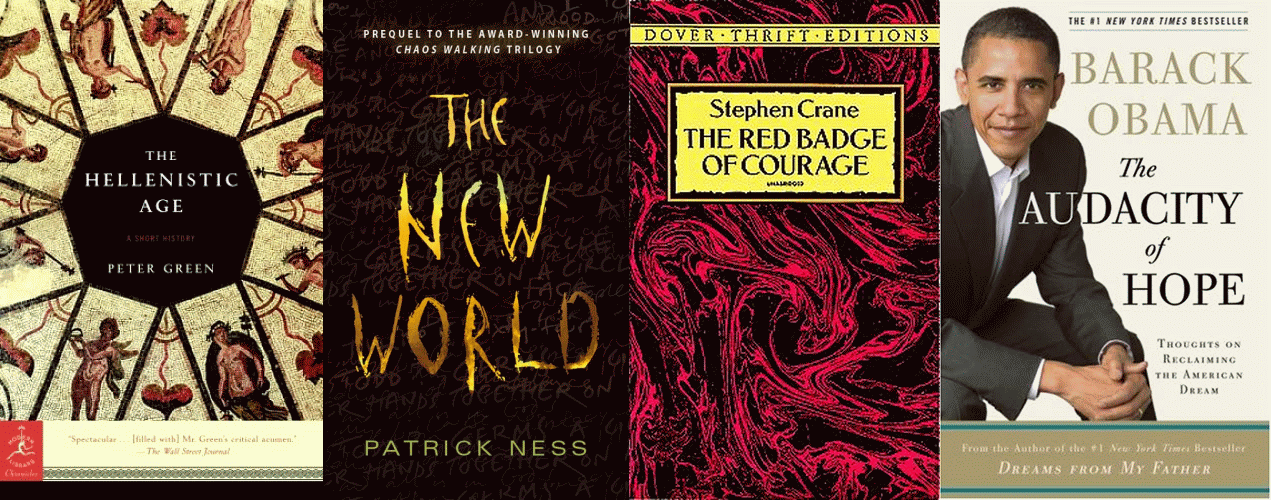
The Hellenistic Age by Peter Green, "The New World" by Patrick Ness, The Red Badge of Courage by Stephen Crane, and The Audacity of Hope by Barack Obama

The Dead that Walk edited by Stephen Jones, "They" by Vincent Hobbes, The Time Machine by H.G. Wells, The Zombie Survival Guide: Recorded Attacks by Max Brooks, and Blockade Billy by Steven King

Monday, October 10, 2011

Rousseau's Dog (2006)

     I am somewhat ashamed to admit that it took me eight days – of actual reading – to finish Rousseau's Dog (2006).  In keeping with my desire to not fault myself for the slow progression, I am going to lay the blame squarely on all of the various and sundry foreign names with which one needed to stay familiar in order to follow the tale.  It also has much to do with my general level of unfamiliarity (especially in comparison to those I know who are degreed historians) with reading historical as opposed to philosophical or psychological texts, which is where my very limited experience lies.
     I was disappointed with Rousseau's Dog, not because it largely ignored the philosophies made famous by the two gentlemen at the heart of the story – Jean-Jaques Rousseau and David Hume – but rather because neither author brought any psychological insight to the examination of the feud between them.  Indeed, so much of the book is wasted (in my opinion, and specifically in regards to what I would have preferred) giving a wordy depiction of Rousseau's history and Hume's treatment in Paris that the actual disagreement between the two seems ancillary to author's purpose.  Rather, they seem to desire to present each philosopher as human beings, well known in their time, but respected for different purposes than they are today..  As means of a conclusion, they tepidly tread into the realm of the psyches of the two men – though to be fair, Rousseau's is an obviously troubled one throughout the account – but arrive at weak and largely unsupported conclusions (given the evidence presented in the book).
     Just as frustrating, the authors seem to chose the least interesting portions of quotes to make their points.  It is enough to (again, as in the case with Penguin Island) make me wish I were fluent in French so that I could go to the source documentation.  It is clear that the authors are unaware of the case they are making throughout the book in regards to the dispositions of both men, or so I assume judging by their curious sentiment of siding with noted paranoid Rousseau in his claims against Hume.  Many are taken as fact without introducing compelling reason to do so (often the exclusion of a direct response by Hume or the exercising of politics within Hume's personal correspondence is the reasoning offered to prefer Rousseau's accounts of events for the feud, even after establishing that Rousseau is not a reliable witness to the human interactions in which he engages).
Rousseau didn't like his portrait by Ramsay, thinking that Hume had somehow conspired to make him appear suspect.  Hume just looks like a fat British lord.
     All of that may make it seem like I didn't enjoy the book, which I did.  I just didn't enjoy it as much as I wanted to.  It is the wrong type of history for me; too concentrated on meaningful people and their unimportant events.  I find it akin to a high-minded, well researched (though only moderately well presented) gossip book.  It has little to speak to how the relationship between the two men, even in its brief state, did little to influence how their work has been received.
     The authors make a couple of factual mistakes – the most glaring (to me) being the total misrepresentation of Themistocles' time in exile in Persia – or at least present information that is well at odds with what I know from independent research aforehand .  They also, to my chagrin, attempt to place Rousseau in a high esteem with Kant, higher than that held for Hume.  I cannot speak to the truth of that, but it certainly doesn't square with what exceedingly little I know of the East Prussian's taste in literature, and his ability to value it over the philosophical work that set his mind in motion.
     Anyway, this was one of the books I abandoned reading halfway through some years ago (actually, I had left off on page 126, and the two central figures were just meeting).  One of the purposes of the reading projects is to put an end to the "started, but never finished" stable of books I have accumulated, and this is the second title removed from it (the first being Walking the Tightrope of Reason).  Rousseau's Dog was undoubtedly more rewarding than reading a Castle novel or the 26 comic book issues (I treated School: A Ghost Story as a graphic novel) tackled for the theme week .  Still, I don't think I would go to these authors to read up on Bobby Fischer (I might go with Frank Brady's book on him, though).  They convinced me that they are capable of great research and somewhat clear presentation, but they lack the tools to get at the underlying elements that interest me.

Thursday, September 15, 2011

The Singular Determinant: On the Topic of the Allowance of Free Action

     I didn't get the draft of the short story on which I am working done in time for today's post.  So I went and dug up an old paper from the last Philosophy class I took.  I can only assume that it will see nowhere near the traffic that the Case Study does.  I went and added pictures to go with the music, film, and television sources.
      

The Singular Determinant: On the Topic of the Allowance of Free Action 1

Living on a lighted stage
Approaches the unreal
For those who think and feel
In touch with some reality
Beyond the gilded cage

Cast in this unlikely role,
Ill-equipped to act
With insufficient tact
One must put up barriers
To keep oneself intact

Living in the limelight
The universal dream
For those who wish to seem

Those who wish to be
Must put aside the alienation
Get on with the fascination
The real relation
The underlying theme

Living in a fisheye lens
Caught in the camera eye
I have no heart to lie
I cant pretend a stranger
Is a long-awaited friend

All the worlds indeed a stage
And we are merely players
Performers and portrayers
Each another’s audience
Outside the gilded cage 2
Canadian prog-rock trio Rush
                        
     What are we to supposed Neil Peart is addressing with these lyrics?  Is he only describing the life of a famous, successful musician, or is he describing something more primal, more elemental to human existence?  The former is entirely plausible, for Rush was quite successful when this song was penned (it is from Rush’s 1981 album Moving Pictures), and Rush clearly performs on a stage while performing before an audience, under many lights which serve to highlight the members.  However, Peart is at the same time explaining a truth that exists for both Rush (the band) and people in general.  What is at stake is the nature of the individual.  Should the individual seek external definition and act merely as an object to be observed and assessed by others?  Or should the individual risk alienation – being considered as a distinct other not fitting into the prescribed mold – and reject external direction and determination of one’s being?
     More to the point, what does Peart mean when addressing the stranger?  Is this merely a statement that he cannot engage in perfunctory glad-handing of people he does not know, or a deeper statement as to the nature of the self in relation to others, that the relationship between the self and the other is one that needs to be carefully guarded to hold on the sense of one’s own identity?  Can one who was once a friend become a stranger – can the other change his or her nature, or is the nature of the other determined only be the observing being?
     These questions may seem beyond the scope of a pop-rock song written and recorded by a Canadian power trio, though Rush did write several songs that are clearly influenced by the works of Ayn Rand.  While Rand is a poor philosopher (the Penguin Dictionary of Philosophy describes objectivism as a “so-called philosophy”3), many have taken her decrying of altruism and religion to heart.  Leonard Piekoff made an attempt to present objectivism as an actual philosophy, one of which is the is the importance of selfishness and individual achievement.  Acknowledging this, it is not beyond reason to see an existential influence in a song such as “Limelight.”
     What is of interest in “Limelight” is how it can be understood in phenomenological terms, specifically in regards to the self as proposed by Martin Heidegger and Erwin Straus.  Rush addresses something that is presented in regards to the sense of self in regards to the other (the greater societal other rather than just an individual).  To Heidegger, this is best seen in regards to the authentic vs. inauthentic life, which is indeed supposed to be a struggle.  When Peart writes that “living in the limelight / the universal dream / for those who wish to seem,” he is representing the possibility that the highest achievement of the inauthentic being – a being wholly corrupted by society and robbed of a sense of self, or at least determinant self direction – is to be seen, respected, lauded by society.  The authentic being, on the other hand, is sure to receive some degree of “alientation” – a supreme sense of being different from the societal other – when engaging in a struggle for the better understanding of the self on one’s own terms.  For Heidegger, there is an implicit sense of guilt in failing to seek to live the authentic life, and the risk is immense – one can fall away from one’s self (though this is likely to mean one’s sense of self) and be left with nothing.  As the definition of the self would come from the societal other, it is not controlled by the being.  It would not be his or hers.  The individual would literally be left with nothing of their own.  Instead, the individual must seek “the underlying theme” – the self.
     For Straus, there is another risk.  The individual must interact with other beings to be sure, but there must be some sort of regulator to ensure that the sense of self is not obliterated by the societal other.  Straus labels this “shame.”  Straus’ concept of shame is not merely concealing shame, but also preservative shame.   Here, preservative shame can best be seen in the song with the lyrics: “Cast in this unlikely role / ill-equipped to act / with insufficient tact / one must put up barriers / to keep oneself intact.”  The barrier (singular) for Straus is shame.  It allows for the self to determine the risk of exposing oneself in one’s actions.   Shame is what allows for the continued sense of self.  Much as phenomenology posits that the being finds itself in the world, Peart imagines a being with necessary social interactions but not sufficiently equipped to deal with the societal other without risking the self.

Friday, September 9, 2011

Seinfeld and Philosophy [A Book about Everything and Nothing] (2000)

     So the most important lesson I've learned about my first book in the Pop Culture and Philosophy series – this one being a Christmas gift from a few years ago – was that I am not going to be able to progress through the series (the ones I would want to read, at any rate) by getting them from the library.  As if this were an actual philosophy text, I could not resist the urge to write notes and underline lines – or entire segments – in an effort to keep my thoughts on the matters accessible.  I also learned that the current state of philosophical writing for a mainstream audience is horrifically inadequate; Dr. Cunning was right to warn me away from pursuing an advanced degree in the field if this is anywhere near the level of discourse I could expect from fellow students, let alone professors.
Jerry
     What is good about Seinfeld and Philosophy [A Book about Everything and Nothing] (2000)?  At the top of the list I would suggest that it kindly reminded me of how good Seinfeld (1989-1998) was when it worked.  There were a few essays that did a good job of encapsulating the ideas behind very complex philosophical concepts.  And some of the essays were written in such a way that they weren't laborious ramblings devoid of a concise point.  Please allow me, if you are willing, to not follow that example and go on a seemingly pointless ramble not bound by a central theme, but done as bullet points.

Socrates, sort of
▸    Editor William Irwin (then Assistant Professor of Philosophy at King's College, now Professor of Philosophy and Director of the Honor's Program at the same institution) makes a common error – one that needs to be addressed – in asserting that "Socrates who was thought mad and ultimately put to death for trying to draw attention to such a higher plane of thought and reality." (Jerry and Socrates, p. 9).  This puts the onus of the political execution of Socrates not on his corrupting the youth (the most common misconception of why he was executed, perhaps because it the charge of which he was found guilty) but of advancing a deeper understanding of reason and the world.  Let us be clear: Socrates was executed because several of his students were agitators who opposed the Democracy in Athens and eventually led to the implementation of an oligarchical rule (supported by the Spartans) and a resultant civil war between the Men of the City and Men of Piraeus.  It is historical fact; the charge of corrupting of the youth was a more of a nod to the possibility that allowing Socrates to remain in Athens could lead to another generation who would try to destroy the Democracy.  As Socrates wouldn't accept exile as an option – Athens was his home – death was the only viable political option.  It is hard for me – as a reader – to take Irwin seriously when he wants to take such a simplistic approach to the fate of Socrates.

▸    Daniel Barwick (Assistant Professor at SUNY College of Technology – Alfred) may not misunderstand Aristotlean Virtue Ethics (more on this later), but he sure does like misrepresenting the context behind or the actual meaning of the lines he quotes from Seinfeld.  He takes George Constanza's pronouncement – to lawyer Cheryl – that "I'm disturbed!  I'm depressed! I'm inadequate! I got it all!" ("The Visa") to mean that George hates himself, and not that he feels he can work his less desirable qualities into something that can entice an attractive woman to sleep with him.  There is a difference between hating oneself – which it can be argued that George does – and believing that one's shortcomings can be used as an unlikely advantage in procuring sex.  Barwick likewise misunderstands George's desire to watch a movie at Jerry's:
     He hates that his life is boring:
     Because if I watch [a video] at my apartment 
     I feel like I'm not doing anything.  If I watch 
     it here, I'm out of the house, I'm doing 
     something.
     ("The Junior Mints") 
     – George's Failed Quest for Happiness (p. 21)
 This is so much bigger than George finding his life to be boring.  Instead, George needs to have an audience or witnesses to what he is doing in order for him to feel that there is something being done.  It is a statement, and one that fits much better with the accusation that George hates himself, that anything solely related to George is nothing worth noting; it may as well be nothing or simply not be done.  In context that is much closer to my life, there is little reward to be found in watching a bad movie, but I can attempt to manufacture some meaning behind it if I express my opinions on it and those opinions find an audience.  Simply having the opinions isn't much of an accomplishment. 
George Constanza
     Barwick takes the line: "She thinks I'm a nice guy.  Women always think I'm nice.  But women don't want nice." ("The Cafe") to represent George hating that his faults are obvious to women.  First, I think that the knowledgeable viewer of Seinfeld would not characterize George as nice.  Second, George is giving voice to the notion that he can be easily dismissed as a non-sexual entity by women who are simply looking for something he does not appear to be.  This is really more the bane of his existence, that he cannot get beyond his own vanity and insecurity to adopt a coping strategy that would allow him to approach women as something other than a bald, short, fat, often unemployed man who – at times – lives with his parents.  It isn't that he hates that his flaws are easily visible to others, it is that he doesn't know how to hide them from himself – to concoct the perfect lie that would enable him to believe he is more than he is – that keeps him dubious about his prospects with women.  And the writers aren't even consistent on this.
     On page 23, Barwick misunderstands George's line, "When you're hopeless you don't care.  And when you don't care, the indifference makes you attractive." ("The Fix-Up") as a surrender to his problems.  Instead, and I want to give the writers credit here, it is more of an astute observation that perhaps the least attractive quality one can have is a palpable aura or sense of desperation.  George knows this.  He is pondering why he cannot have a level of contentment in his current lot in life – just an acceptance of it – and that from this level of satisfaction and not desperately searching for redemption through the mercies of the fairer sex that he may not just find himself in a better place to enter into a relationship, but that he could properly appear as having attractive traits to quality women.
     Barwick also makes the semi-common argument that Aristotle argued that one can become a virtuous person.  I am not a scholar of Aristotle and will cede that there are many who read the Nichomachean Ethics in such a way that true virtues can be developed.  However, it was my understanding of the text – and one reinforced by Dr. James King – that Aristotle more properly argues that one's character is essentially a trait one is born with, and the best that can be accomplished with those who will not know true virtue is to get them to ape the acts of the virtuous (a prerequisite in learning how to be properly virtuous anyway), usually by means of threat.  Be good or else, which can be clearly seen in the Aristotlean influence in the early Roman Catholic Church.  Barwick may have a much greater understanding of Aristotle than do I, and he may be right in that real virtues can be fostered in individuals, but not in ones as deeply flawed as George (a point that Barwick does make).


Elaine Benes
▸ Sarah E. Worth (Assistant Professor of Philosophy at Furman) tackles whether Elaine Benes is – or has the potential to be – a feminist icon (in Elaine Benes: Feminist Icon or Just One of the Boys?).  I was much more impressed with a criticism of how women are presented on television – "As the average female television character falls into a certain set of stereotypes, we presume that those stereotypes should work in the real world as well" (p. 27) – than I was with her take on feminism in general.  Worth is addressing the need (for lack of a better term) for writers to present female characters with girlish traits as a means of making them appear to be more real.  It is this kind of lazy thinking that leads to female characters who are, with no reasonable explanation, at odds with themselves.  It is why I have such a problem with how the main character of Against the Wall is presented when the writers/directors/producers feel she must be made real in some convoluted feminine manner.  It isn't so much that we (the audience) actually expect the stereotypes to really hold true in the real world, more that we want them to loosely apply.  Doing less would mean that the way women are presented on television is absolutely false and acts as an insult to our real-life experiences.
     At any rate, Worth ends up making the mistake of siding with Carol Gilligan (and not Kohlberg or Kant), thinking that there is some kind of defense of gender needed when what is at issue is cultural norms and how gender roles affect the application of reason.  Worth presents another feminist rebuttal to the application of reason when it comes to morality with Nel Nodding's ethic of care:
     "I should act always in such as to 
     promote the well-being of both the 
     others to whom I am in relation and 
     the self which is relationally 
     constituted."
     – Nel Noddings, Caring: A Feminine 
        Approach to Moral Education, 1984
Never mind that this approach is so narrow in scope as to allow one to take actions blatantly hostile towards others so long as those others can be constituted to be some kind of unknown, this is merely a repacking of a type of utilitarianism that puts the well-being of the self as one of the primary concerns of morality.  Few start the position of the good with the idea of what's good for me?, but we get to see it here.
     Worth goes on to reduce other NBC sitcom characters to being less worthy of feminist admiration than Elaine.  She characterizes Phoebe and Rachel from Friends (1994-2004) as a street performer and not especially well educated, respectively.  This is just factually wrong, where Phoebe is a masseuse and Rachel starts the show with a college degree (though not a post-graduate one) in some field related to fashion.  Worth calls Carla from Cheers (1982-1993) as "unattractive" (where I would have called her "brash" and "crude"), somehow making Elaine's appearance a boon for her feminism.  Still, Worth thinks that Elaine is too weak to be a feminist and is merely a product of feminism.

The Kramer
▸ Irwin returns to write of Kramer and Kierkegaard.  He misunderstands or misrepresents lines and scenes, and not always towards some valuable point.  He makes the point that Kramer is the only of the Seinfeld Four who could effectively survive without the others (p. 48), clearly ignoring that Kramer, left to his own devices, becomes the prime suspect in the hunt for a serial killer terrorizing Los Angeles.  But Irwin does not do a particularly good job of explaining the Kierkegaardian points he is trying to explain.  Given the length of the essay, this is what is most disappointing.  We learn nothing about what it means for Kramer to be living a life at the aesthetic level – and most of the other contributing authors make the point that Kramer may be the character most representative of trying to maintain some sort of moral semblance.

▸ Eric Bronson (Adjunct Professor of Philosophy at Berkeley College in New York) writes a short essay about Seinfeld and Tao.  I don't feel qualified to write on Tao, but I also don't feel that Bronson gave me enough of a sense that he does either.

▸ Mark T. Conrad (writer) does a decent job of explaining the Kantian notion of time and space – even though he is concentrating on the Platonic and Nietzschean concepts of time, understanding, and recurrence.  He also makes a few arguments about how a joke must be structured – that the punchline must be said (and not simply made obvious) – that I cannot abide.  He does have some idea of how to relate memory and the past to one's conception of the self, but much less than I could find in the typical cognitive psychology jounral article dealing with the same issue.  I respect what he was trying to accomplish with his essay, but found it to be lacking in proper focus and ultimately not making the points, but rather arriving at them when they are declared to be correct.

▸Jennifer McMahon (Assistant Professor of Philosophy at Centre College) gives a long examination of Sarte – one in which she essentially calls the majority of Sarte scholars idiots who have missed the obvious in reading him.  I HATE phenomenology; other than it allowing us to reformulate the Socratic/Platonic phrase "The unexamined life is not worth living" into the more meaningful (and helpful) the inauthentic life is not worth living, phenomenology primarily serves as an obstacle to using something other than observation to understand anything.

▸ My brief response to Kelly Dean Jolley's (Associate Professor of Philosophy at Auburn) essay on Wittgenstein was "Who the fuck cares?"  It is just another reminder of the endless bullshit that exists in the fields of philosophical inquiry, and Jolley presents it in such a matter that I must wonder why – except for lack of competition – one would endeavor to even take Wittgenstein and the conception of the commonplace seriously.

     There is more, but I guess I want to keep this from being seemingly endless.  Only a couple of the contributing authors presented both the philosophical concepts and the relation to Seinfeld in a clear manner (which wholly discounts the need to be entertaining).  Taken on the whole, the book is too simplistic to offer much in the way of insight about the concepts and too liberal with the interpreting the show to impress a fan.  I think there is something to be had with an approach like this, but it needs tighter editorial control and a better central theme.