Showing posts with label Detective Story. Show all posts

Friday, December 30, 2011

The 2011-2012 Reading Project to Date (August - December)

     I thought I would give a visual recap of titles covered to date as part of the 2011-2012 Reading Project.  Sure, it is much less loaded with serious titles than the 2010-2011 Reading Project, but it already has more non-fiction titles in the first five months so I have not abandoned hope.  There are quite a few types of fiction covered, too, so I don't feel as though I have locked into just reading types of books.  Sure, there are five Dover Thrift Edition titles in the mix (one quarter of the books read), but they are just so damned affordable.
     Anyway, feel free to comment on any of the titles you may have read and enjoyed (or hated). I feel rather confident that most people will have read at least three of these books.  Or just take note that this would only be six rows of books if I yanked the comic books and graphic novels out.  I would like to say that fourteen of the titles pictured were courtesy of the Forest Park Public Library and another four were borrowed from family members, so the 2011-2012 Reading Project has been quite economical to date.

The Imperial Cruise by James Bradley, Walking the Tightrope of Reason by Robert Foegelin, Great Short Short Stories edited by Paul Negri, and What Jesus Meant by Garry Wills

Conan the Barbarian Michael A. Stackpole, Seinfeld and Philosophy edited by William Irwin, The Memoirs of Sherlock Holmes by Sir Arthur Conan Doyle, and Naked Heat by Richard Castle

Kremin issues 1-4 by Charles Moissant

A Study in Scarlet by Sir Arthur Conan Doyle, Ian Edginton, and I.J.N. Culbard, The Beast of Chicago by Rick Geary, and School issues 1-4 by Brian Defferding

Wrath issues 1-7, written by Mike W. Barr, mostly drawn by David Ammerman (Malibu Comics)

The Night Man issues 1-15 (Malibu Comics)

Rousseau's Dog by David Edmonds and John Eidinow, "Cat Calls" by Cynthia Leitich Smith, The Adventures of Tom Sawyer by Mark Twain, "Rogue Hunter #1 – Gaia: Into the Abyss" by Kevis Hendrickson, and Herland by Charlotte Perkins Gilman

Arcadia by Tom Stoppard, The Power and the Glory by Graham Greene, Richard Castle's Deadly Storm by Brian Bendis, Kelly Sue Deconnick, and Lan Medina, Lord of the Flies by William Golding, and The Penguin Historical Atlas of Ancient Greece by Robert Morkot

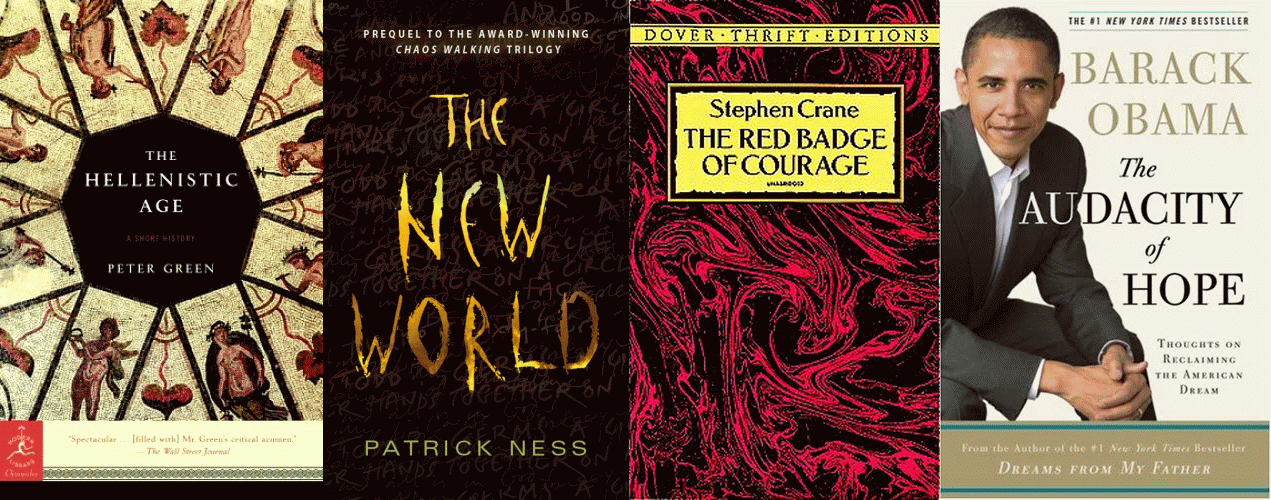
The Hellenistic Age by Peter Green, "The New World" by Patrick Ness, The Red Badge of Courage by Stephen Crane, and The Audacity of Hope by Barack Obama

The Dead that Walk edited by Stephen Jones, "They" by Vincent Hobbes, The Time Machine by H.G. Wells, The Zombie Survival Guide: Recorded Attacks by Max Brooks, and Blockade Billy by Steven King

Wednesday, September 28, 2011

A Study in Scarlet [Graphic Novel] (2010)

     Say what you will, I have some inner need to either work in themes or to work towards completion when it comes to a body of written work.  In both these manners the graphic novel of Sir Arthur Conan Doyle's A Study in Scarlet (2010 for the graphic novel; 1886 for the original) fits as there is decidedly a theme this week of supporting the illustrated story and Conan Doyle's Memoirs of Sherlock Holmes were reviewed on 20 September, 2011.  Granted, reading the graphic novel will allow me to not have to pick up the original tale for some time, but it does give me the illusion of having read it.
     I do want to admit – in an ugly sort of way – that I greatly enjoyed being able to finish this in the span of about an hour, much faster than if I were reading the original.  Likewise, much of the needless description of unimportant details are left out as I.N.J. Culbard illustrates the scenes well and perhaps improves upon some of Conan Doyle's approaches to setting the scene.  Unfortunately, neither illustrator Culbard or "text adapter" Ian Edginton can do little to mask some of Conan Doyle's shortcomings when it comes to imagining characters.
     If you are like me – and not in all the bad ways – then you likely grew up with a level of admiration for Sherlock Holmes.  I mean, come on, he's the world's smartest man.  And he can handle himself in a fight.  And he solves crimes.  And stops international incidents from causing wars.  He is about as English a superhero as one could imagine, and he doesn't need to come from a distant planet or be bitten by a spider to get his powers.  But in reading through the stories, there is so much withheld from the reader that it makes it impossible to appreciate what Holmes is actually doing.  And the rest of the cast is usually so confused as to how to go about detective work that the only role they serve is for Holmes to explain what he has done – things hidden from the reader until the end.
     I kind of hate that kind of storytelling.  I think of it as the Henry Lopez school of building a mystery – never mind that Mr. Lopez is working in a different medium and more than a century after Conan Doyle – where surprises can be sprung simply because no information regarding them was ever offered in the first place.  Modern detective stories usually give more of an insight as to the work.  Even comedic approaches like USA's Psych (2006-whenever USA cancels it) show the actual observations, but retain the Holmesian wrap-up speach as to how the mystery was solved.  Shawn Spencer (James Roday), a modern super-observant detective, pretends to be psychic and hides behind humor rather than endlessly berating the police force for not picking up on every single clue.
Shawn Spencer and Guster Burton, Psych's answer to Holmes and Watson.  Less pretentiousness, more snarkiness.  And occasionally the detectives know more than they do.
     Back to A Study in Scarlet.  Conan Doyle gives a brief account of how Watson came to return to England and meet Holmes.  It feels very unsatisfactory, and it is hard to imagine how these two men could come to develop a strong sense of friendship.  Watson comes across as a dullard who is living off of a government settlement due to his injuries in the Battle of Maiwand (in Afghanistan).  Holmes seems like a self-important twat (in the British sense) who is only interested in someone with whom he can split the rent and bully with his intellect.
     As for the story, it actually is pretty imaginative.  Two men are killed and Scotland Yard does not know how to find the killer – and Conan Doyle actually treats the inspectors with a small amount of respect in regards to their thinking and methods.  Holmes stumbles around, insults people, goes missing for periods of time, and then announces he has determined who the murderer is, but needs to get him as to find out why.  That leads to a rather dull and lengthy tale of the motivation behind the killings.  However, we do learn that Watson can diagnose an aneurism simply by checking someone's pulse, so that is quite impressive.
Page 17, where Watson assesses Holmes
     The drawing style feels modern while still evoking a comfortable image of Victorian England.  I prefer how the cutaway scenes are handled to the main story, but both are well done.  The scenes move at a good clip, and the faces come across as emotive enough to get the job done.  The action – there isn't much – is a little lackluster in appearance, but maybe it is meant to be restrained to begin with.
     I think the asking price of $14.95 is kind of high.  I checked a copy of from the local library – at a cost of $0, which is always pretty solid.  Still, it isn't a price gouge.  And if one were really into all things Sherlock Holmes, this would make a fine addition to the collection.  It is also is probably a better means of introducing the characters to the younger set – especially if they can see this before the Guy Ritchie films –than the alternatives.

Tuesday, September 20, 2011

The Memoirs of Sherlock Holmes (1894)

     The most recent Sherlock Holmes to which I had been exposed was the nightmare conjured by Guy Ritchie in his 2009 film.  I liked Robert Downey, Jr. and Jude Law as Holmes and Watson, respectively, but the entire films seemed antithetical to what I remembered about the stories by Sir Arthur Conan Doyle.  I just couldn't get excited about the idea of a modern day Holmes to even give Sherlock (2010) a chance.  But how much did I really remember about Conan Doyle's writing?
     The answer, it would seem, would turn out to be, almost nothing.
Basil Rathbone as Sherlock Holmes
     Maybe my memories had absorbed too much of the image of Basil Rathbone as the famous detective – and I wouldn't wager that I remember his many Sherlock Holmes films any better than I did the original material.  Maybe it was that I hadn't read any Conan Doyle since 1988; my general rule is that if I haven't read it since 1995, I can treat the material as though it is new to me.
     What struck me most when reading the Dover Thrift Edition reprint of The Memoirs of Sherlock Holmes (2010 for Dover; 1894 for the original) was that I did not care much for Conan Doyle's style of writing.  Endless quoting within quotes and descriptions that seem to go on for days dominate most of the tales.  Seldom is the information presented to the reader to give any idea of how Holmes will solve the puzzle at hand.  While this collection of short stories is a pretty poor choice of where to jump back into the exploits Conan Doyle's legendary detective – A Study in Scarlet (1887) or The Sign of Four (1890) would have been much better choices – I was still disappointed that there was so little development of the principle characters: Holmes and Watson.  Instead, Conan Doyle offers brief descriptions of the men and their activities, deciding instead to spend endless paragraphs to vague depictions of late 19th Century London and its surrounding villages and neighborhoods.
Holmes and Moriarty at Reichenbach Falls
     There are some good stories within the collection (the only one I remembered was "The Crooked Man", and I read that back in 1986), and it does have two important events in the Holmes mythos.  First, it introduces the character of Mycroft Holmes, Sherlock's older brother.  Second, and much more importantly, it introduces Professor Moriarty – then kills both he and Holmes at Reichenbach Falls in Switzerland.  The rest of the tales seem a little small for the skills and feats of legendary Sherlock Holmes, but are still miles ahead of the screenplay penned by Michael Robert Johnson, Anthony Peckham and Simon Kinberg (for the Ritchie disaster).
     For the price – $3.50 – the book is fine.  It is a little odd to have physician Conan Doyle make repeated references to brain fever (a malady that can have one bedridden for weeks at a time) which is anything from being in shock to encephalitis or meningitis, and never having either Holmes or Watson clarify the matter.  But I have seen much worse at much higher prices, and even when I was frustrated with Conan Doyle's style I still found some enjoyment in the stories.
     The Memoirs of Sherlock Holmes (DTE) includes the following tales:
▸    “Silver Blaze”
▸    “The Yellow Face”
▸    “The Stock-broker’s Clerk”
▸     “The ‘Gloria Scot’”
▸    “The Musgrave Ritual”
▸    “The Reigate Puzzle”
▸    “The Crooked Man”
▸    “The Resident Patient”
▸    “The Greek Interpreter”
▸    “The Naval Treaty”
▸    “The Final Problem”