Showing posts with label Supernatural. Show all posts

Tuesday, March 13, 2012

The Dark (2005)

     John Fawcett directed one of my favorite movies.  Actually, it is the only movie that I wish I had directed (and I am not a director, nor am I anywhere near being a director), flaws and all.  That movie is not The Dark (2005).
     Not that I can entirely fault Fawcett for the problems I had with the movie, but his use of some of the camera techniques – and I am going to presume his hand is at work with some of the editing – that have been ruining modern horror films draws much of the moodiness and all of the etherealness from the film.  John Carpenter noted that he fucked up his version of The Fog (1980) by having it feel too grounded and solid.  The Dark may not be either of those, but instead of ghostly or dreamlike, it goes for washed-out color and moldy-looking.  Maybe that is Welsh Hell, but it isn't scary.  Worse, it isn't particularly engaging.
     No, the real problem comes from having a victim who just sort of is – Sarah (Sophie Stuckey) is both underdeveloped and unlikeable – and a mother (Maria Bello) who needs absolutely no nudging to full-on acceptance of the supernatural events.  That could work for me, but it would require setting the story around the beginning of the 20th Century, not the 21st.  There is no development of the mythology driving the supernatural forces.  Oh, and there is a prime assumption that sheep are scary.
     I do remember when this film was in theaters and how much I wanted to see it.  I'm not sure why.  Maybe it was because I hadn't learned that Sean Bean isn't given much to do in movies (at least not in the ones I've seen).  Maybe I thought it would be a slow, moody, psychological examination of a parent descending into madness because of the loss of a child (I think this is what the ads promised).  Instead, it comes across as a film that spent its budget in an odd fashion – those boat searching scenes probably cost more than any special effects sequence – with an obligatory unhappy ending.

Wednesday, March 7, 2012

Patient Zero (2009)

     Before I spent two weeks reading books on the do's and don'ts of writing fiction, I would have merely found Jonathan Maberry's Patient Zero (2009) to be tiresome and poorly written.  Having read those books, however, I can point to Maberry's novel as a prime example of bad writing in nearly every form, though not always to a disastrous level.  Not always, but when Maberry insists on having the least likeable protagonist – ever – narrate about ¾ of the story, which only made me wish that somebody would kill that character so that the middle-of-the-road zombie-plague story could go on without me hating the story because of who was telling it.
     Why have most of the novel narrated in the first person while the rest is told in a more traditional third person?  Maybe because Maberry doesn't believe in writing conventions, and maybe because he thought it  clever.  Whatever his reasoning, it is largely an effort that shouldn't have been made. 
     The bigger question should have been why is the protagonist, Joe Ledger, the best at everything?  He is the smartest cop (though he does no kind of police-like investigations – maybe Maberry didn't want to do the research into finding out how that worked), the best shot (better than the Delta Force guys), the best Martial Artist (even though he doesn't understand how the character's form works), the best judge of character, the guys who makes all of the connections with little help (other than to have people to supply expository information) from the other characters, and, of course, he has the biggest cock in the world.  That last bit may be an exaggeration, but Maberry does let the reader know that Ledger has a big dick, and the character knows it, too.
     Overlong, full of points that go nowhere (a bad guy disfigures his face for seemingly no reason, just as this characters need to be where he disfigured his face ends up being ridiculous because he could have gotten from A to C without every needing to go to B, and B is never explored other than to have the character cut a huge gash in his face), and celebrating an adolescent's view of ultra-masculinity, Patient Zero is a prime example of a book to avoid.  That is disappointing, because the basic story is one that would make a fine supernatural (though Maberry makes it a medical issue) thriller if the author and his main character didn't get in the way.  If scenes were not consistently indescribable or characters perpetually at a loss for words, I wouldn't be convinced that Maberry is a bad writer (I may have just thought that this one book was poorly written).
     Whatever the cause for the many faults in this book, they are more than enough for me to warn everyone I can to stay away from it.  It is beyond bad.  It is a waste of time.

Friday, December 30, 2011

The 2011-2012 Reading Project to Date (August - December)

     I thought I would give a visual recap of titles covered to date as part of the 2011-2012 Reading Project.  Sure, it is much less loaded with serious titles than the 2010-2011 Reading Project, but it already has more non-fiction titles in the first five months so I have not abandoned hope.  There are quite a few types of fiction covered, too, so I don't feel as though I have locked into just reading types of books.  Sure, there are five Dover Thrift Edition titles in the mix (one quarter of the books read), but they are just so damned affordable.
     Anyway, feel free to comment on any of the titles you may have read and enjoyed (or hated). I feel rather confident that most people will have read at least three of these books.  Or just take note that this would only be six rows of books if I yanked the comic books and graphic novels out.  I would like to say that fourteen of the titles pictured were courtesy of the Forest Park Public Library and another four were borrowed from family members, so the 2011-2012 Reading Project has been quite economical to date.

The Imperial Cruise by James Bradley, Walking the Tightrope of Reason by Robert Foegelin, Great Short Short Stories edited by Paul Negri, and What Jesus Meant by Garry Wills

Conan the Barbarian Michael A. Stackpole, Seinfeld and Philosophy edited by William Irwin, The Memoirs of Sherlock Holmes by Sir Arthur Conan Doyle, and Naked Heat by Richard Castle

Kremin issues 1-4 by Charles Moissant

A Study in Scarlet by Sir Arthur Conan Doyle, Ian Edginton, and I.J.N. Culbard, The Beast of Chicago by Rick Geary, and School issues 1-4 by Brian Defferding

Wrath issues 1-7, written by Mike W. Barr, mostly drawn by David Ammerman (Malibu Comics)

The Night Man issues 1-15 (Malibu Comics)

Rousseau's Dog by David Edmonds and John Eidinow, "Cat Calls" by Cynthia Leitich Smith, The Adventures of Tom Sawyer by Mark Twain, "Rogue Hunter #1 – Gaia: Into the Abyss" by Kevis Hendrickson, and Herland by Charlotte Perkins Gilman

Arcadia by Tom Stoppard, The Power and the Glory by Graham Greene, Richard Castle's Deadly Storm by Brian Bendis, Kelly Sue Deconnick, and Lan Medina, Lord of the Flies by William Golding, and The Penguin Historical Atlas of Ancient Greece by Robert Morkot

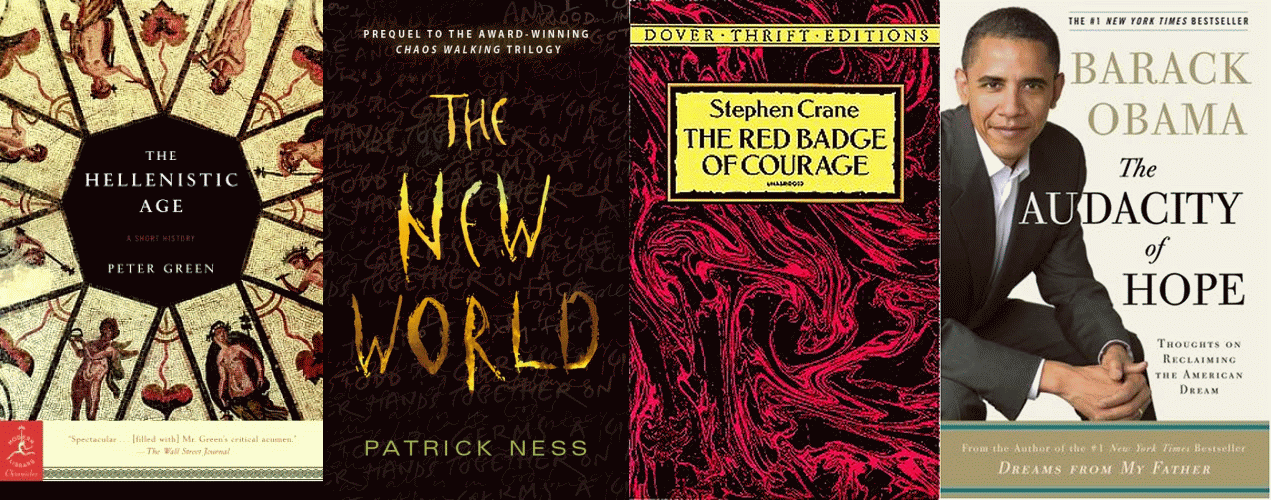
The Hellenistic Age by Peter Green, "The New World" by Patrick Ness, The Red Badge of Courage by Stephen Crane, and The Audacity of Hope by Barack Obama

The Dead that Walk edited by Stephen Jones, "They" by Vincent Hobbes, The Time Machine by H.G. Wells, The Zombie Survival Guide: Recorded Attacks by Max Brooks, and Blockade Billy by Steven King

Wednesday, October 12, 2011

Cat Calls (2010)

     "Cat Calls" marks my entry into the world of free short stories available via Amazon.com for the Kindle.  Nothing, other than it being a no-cost proposition merited adding it to my meager Kindle-friendly library.  That library sits at sixteen titles, one of which I guess I would have an author credit ("GM Challenge Compilation", available here) as I take up about three pages worth of the book with my prattle.  I, of course, do not have an actual Kindle, so these few titles are really just eBooks that aren't rendered via Acrobat as far as I am concerned.
     "Cat Calls" is a brief venture into the world of the supernatural, on a couple of levels that don't seem to make a great deal of sense – this is not a Reese's Peanut Butter Cups moment, at least not as written.  I imagine that Smith is writing for the audience that has made Twilight in the phenomenon others tell me it is.  It is monsters meet sexuality, but in a somewhat tame way (I wonder if I would feel that way were I a fifteen year old girl, though).  Smith doesn't overindulge in lengthy description, or rely on existing tropes to fill this brief piece; she has some decent dialogue and at least one instance of well crafted imagery.  At the same time, there isn't anything new within the piece, making it feel like the type of fiction everyone who styles oneself as an author think could be churned out to fill an order.
     I am more interested in the concept of marketing free short stories, or even treatments that serve as an introduction of sorts to future stories, as a means to grow an audience. The cost of nothing (but time) has to have some allure to people other than me.  I would likely never heard of Smith had I not done a search for free Kindle short stories.  What she writes about – werecreatures, psychic readings, vampires, and such – should have some level of appeal for me.  Hell, my newest PFS character is (apparently VERY UNOFFICIALLY) a weredragon, so I'm not opposed to shaeshifters.  But Smith seems to be writing not so much about the metaphors of how the journey into womanhood is beset with types of wild dangers, instead just making the supernatural elements the devices that direct the action.  Still, I would not have even known that much without this story being made available for free.
     I am curious as to how many people take the time to look for short stories when they are perusing the free section of the Kindle offerings.  Certainly, given the amount of public domain titles one can acquire for nothing – Robert Louis Stevenson's Treasure Island (1881-82) was auto-added to the library when I set-up the Kindle program on the computer – it cannot be easy to convince people to dive into the unknowns first.  Granted, Smith apparently has enjoyed a fair amount of success before I stumbled across "Cat Calls", but to me she was an unknown author.  I am one of those who much prefers to wander about an actual bookstore than use a search engine to find something I don't know I'm looking for.  This of course would change if I were actually an author and had a book listed on Amazon.com, because then I would want all search engines to steer people to my material.
     I am likely to look for some other free offerings that are not of the 'old and distinguished' variety, and I'll try to do more justice to those than I have to "Cat Calls".  As much joy as I may get over the fact I can get Fundamental Principles of the Metaphysics of Morals (1785) for free, I have no idea the quality of the translation and cannot mark-up the pages with my notes when using any sort of eReader.  It seems to me that the Kindle and its brothers are best suited for lighter fiction.