I have to wonder what it would be like to be able to read Pierre Boulle's Planet of the Apes (1963) in its original French. Knowing only enough of the language to be able to fumble my way through the label on a package of cheese (this actually was useful at the previous job), it would be impossible for me to be able to handle something as simple as a picture book in French. Actually, in most any language other than English. Still, there is an air of something – a kind of self-possessed importance – that permeates the book, both in the overstated purposeful way that space-faring journalist Ulysee Mérou carries his indignation and in the general attitude that Boulle seems to have towards mankind's achievements in general. In my limited experience, this feels very French.
From the format that apes the Victorian through Pulp-era adventure stories to the experience of a learned man stranded amongst alien others (and cared for by a wise and kind female), much of Planet of the Apes comes off like a refutation of the points made in Charlotte Perkins Gilman's Herland (1915). The French are not renowned for being progressive (as a society) in regards to gender roles – see Sartre's commentary on how women tricked men into running the world – and Boulle repeatedly hammers home the superiority of man the gender (perhaps man the species as well, at least when compared to apes). Naming the planet Soror (Latin for sister...thanks, Wikipedia!), Boulle is not trying to hide the parallels. Instead, he paints a horrific vision of general society and what happens when one is pulled from the top level of civilization.
Other than struggle with his commentaries on humanity, the false promise of feminine progressiveness, and the existential quandaries that come from being forced to doubt one's place in the universe, Boulle manages a rather decent piece of low-action adventure science fiction. I suspect that enough of the rhythm of the language is lost that is seems more pedestrian in English, but that is a guess. I'd like to think it was more profound, more earth-shattering in its unique vision when it first was published. It seems that Boulle wants to hint at and dance around the issues rather than confront them, even in an oblique manner.
Now, I am extremely biased on the subject. Franklin J. Schaffer's Planet of the Apes (1968) is one of my all-time favorite films, one that is direct and forceful in the many commentaries it fires at the audience. It also has a much more American hero, one who is easy to hate while impossible not to view as humanity's most unlikely champion. That isn't what is embodied in the novel, and while part of me knows this is for the best, it left me feeling that Boulle did not completely capture the possibilities of his own story. At the same time, the many people who have adapted the "Apes" movies and TV series did their best to draw out the elements Boulle included. Indeed, the much despised shock-ending of Tim Burton's version of Planet of the Apes (2001) – one Kevin Smith stupidly claimed as having originated – is presupposed in the novel.
Planet of the Apes will never replace the 1968 film in my heart. But I am glad that I took the time to read it. There is something worthwhile buried within it, sure, but it is (even as a translation) a fine book to read to break up the more serious titles.
Original fiction, opinions, and reviews that are decidedly not related to work. Also, apparently where people go to read about Steven Pfiel.
Showing posts with label Novel. Show all posts
Tuesday, June 12, 2012
Tuesday, May 29, 2012
Make Love! The Bruce Campbell Way (2005)
Make Love! The Bruce Campbell Way (2005) marks Bruce Campbell's first venture into humorous fiction (his first book being a memoir on how a guy from Michigan ended up a B-Movie icon with not a lot of extra money to show for it). Knowing that Campbell's humor runs not just towards the lowbrow but to the most repetitive slapstick the Three Stooges ever performed, I didn't have high expectations for this. Sure, Campbell is a literate guy – he has at least been reading scripts in all that time as an actor and director – but I did not expect him to be able to build a compelling narrative without dedicating some serious time to honing this new craft.
In fact, there is not really much of a plot to Make Love!; it really is composed around a handful of recurring ideas. Rather than tell the story in a conventional manner, Campbell intersperses his supposedly focal idea – he has been cast as the third major character in an A-list Hollywood movie (filming in New York) – with sketches that really have nothing to do with the story except to show how wacky Campbell's fake life is. These asides (for the most part) end up being better than the story about Campbell destroying Mike Nichols' movie.
The best part of the book – sorry, Bruce – are the worked-up photos and gag visuals. These were what led me to laugh out loud repeatedly. Not so much for Campbell being inserted into numerous alternate personae but the fake signs and such. So much better than the disasters that came out from Jon Stewart (and The Daily Show writers) that one has to wonder if Campbell and Craig "Kif" Sanborn have struck a rare kind of comic gold by working together.
The only part of the book that I actively didn't like was when Campbell confused Dungeons & Dragons with hide and go seek. For a guy who has appeared at numerous gaming conventions (and game fairs), and who would be age appropriate for AD&D's heyday, this was a real letdown. I was also surprised that in his acknowledgements Campbell didn't thank (or even acknowledge) Richard Gere, Renée Zellweger, or Mike Nichols; if one is going to use real people in ficticious situations – like having Gere happily cheat on his wife – that person should probably give them some mention or thanks.
I don't know that anyone who isn't a fan of Campbell-the-actor who would ever find reason to read this, but it isn't bad. It just isn't very mature. Maybe that is part of Campbell's charm, that he can be fake smarmy while retaining his innocent immaturity. It works, for the most part, here.
In fact, there is not really much of a plot to Make Love!; it really is composed around a handful of recurring ideas. Rather than tell the story in a conventional manner, Campbell intersperses his supposedly focal idea – he has been cast as the third major character in an A-list Hollywood movie (filming in New York) – with sketches that really have nothing to do with the story except to show how wacky Campbell's fake life is. These asides (for the most part) end up being better than the story about Campbell destroying Mike Nichols' movie.
The best part of the book – sorry, Bruce – are the worked-up photos and gag visuals. These were what led me to laugh out loud repeatedly. Not so much for Campbell being inserted into numerous alternate personae but the fake signs and such. So much better than the disasters that came out from Jon Stewart (and The Daily Show writers) that one has to wonder if Campbell and Craig "Kif" Sanborn have struck a rare kind of comic gold by working together.
The only part of the book that I actively didn't like was when Campbell confused Dungeons & Dragons with hide and go seek. For a guy who has appeared at numerous gaming conventions (and game fairs), and who would be age appropriate for AD&D's heyday, this was a real letdown. I was also surprised that in his acknowledgements Campbell didn't thank (or even acknowledge) Richard Gere, Renée Zellweger, or Mike Nichols; if one is going to use real people in ficticious situations – like having Gere happily cheat on his wife – that person should probably give them some mention or thanks.
I don't know that anyone who isn't a fan of Campbell-the-actor who would ever find reason to read this, but it isn't bad. It just isn't very mature. Maybe that is part of Campbell's charm, that he can be fake smarmy while retaining his innocent immaturity. It works, for the most part, here.
Monday, May 21, 2012
Mrs. Frisby and the Rats of NIMH (1971)
I remember the first – and to that point, only – time I read Mrs. Frisby and the Rats of NIMH (1971). It was well after Don Bluth's animated adaptation, The Secret of NIMH (1982), at least as how time is seen to a child. To my knowledge, I was the last of my friends to actually read the book; I distinctly remember asking Joel Tysiak for the title of the book so that I didn't end up reading something nobody else had. I can't explain why that last part was important because I still don't know.
As a child, I don't know if I got beyond the simple narrative of the story. It certainly was more tame than the movie. No magic. There isn't some sinister force working against the good rats. It certainly didn't seem all that heroic. The best thing going for it – it seemed – was that it had talking animals.
Giving it another pass as an adult, I was struck by O'Brien's economy of language. He doesn't draw this tale out to preposterous lengths, choosing instead to keep the story continuously moving forward with only the necessary descriptive adjectives and adverbs. He certainly challenges the vocabulary of the average 10 year old with it (I don't know the target audience, but it feels like it is pre-tween), but not in an aggressive or impolite manner. Indeed, I can imagine children gleaning most of the meaning from context and happily turning to the (online) dictionary for any words beyond them.
It has at its core an interesting concept for a children's book. It is about the everyday heroics of parenting made manifest in the quest to keep a child safe. The good relationship the late Jonathan Frisby built with the Rats (and how well he was regarded by other various creatures) allow for Mrs. Frisby to seek out allies and do right for her children. She cannot do it alone, but she is not so obstinate as to even try to forgo seeking help. She is also a good enough soul to offer help to others when she is in position to do as much.
In an animal world where most of those she encounters are smarter than she is, Mrs. Frisby isn't rejected or looked down upon. She is different, but she is still valued. Largely treated as an equal by the Rats (who know she is not), she becomes a keeper of their history for their time on the Fitzgibbon farm and the informant who keeps them from being exterminated. That O'Brien could do all of this with a gentle yet engaging tone, one that has certainly made many a young reader strive to find out what comes next without fretting about the lack of control the mouse has in a world of Rats, men, owls, and Dragon (the cat).
Mrs. Frisby is the ultimate mother-as-hero, but she is presented also as how a child would be among adults. Her actions have merit. She matters. O'Brien makes it happen through the story, not as some tagged on lines to reassure the little ones that she is like them and they like her.
I certainly don't read much in the way of books aimed a children. Hell, until recently, I could be said to not be doing much in the way of reading. But I glad I gave this book another look. It is a great example of how to write – and do so exceptionally well – for children.
As a child, I don't know if I got beyond the simple narrative of the story. It certainly was more tame than the movie. No magic. There isn't some sinister force working against the good rats. It certainly didn't seem all that heroic. The best thing going for it – it seemed – was that it had talking animals.
Giving it another pass as an adult, I was struck by O'Brien's economy of language. He doesn't draw this tale out to preposterous lengths, choosing instead to keep the story continuously moving forward with only the necessary descriptive adjectives and adverbs. He certainly challenges the vocabulary of the average 10 year old with it (I don't know the target audience, but it feels like it is pre-tween), but not in an aggressive or impolite manner. Indeed, I can imagine children gleaning most of the meaning from context and happily turning to the (online) dictionary for any words beyond them.
It has at its core an interesting concept for a children's book. It is about the everyday heroics of parenting made manifest in the quest to keep a child safe. The good relationship the late Jonathan Frisby built with the Rats (and how well he was regarded by other various creatures) allow for Mrs. Frisby to seek out allies and do right for her children. She cannot do it alone, but she is not so obstinate as to even try to forgo seeking help. She is also a good enough soul to offer help to others when she is in position to do as much.
In an animal world where most of those she encounters are smarter than she is, Mrs. Frisby isn't rejected or looked down upon. She is different, but she is still valued. Largely treated as an equal by the Rats (who know she is not), she becomes a keeper of their history for their time on the Fitzgibbon farm and the informant who keeps them from being exterminated. That O'Brien could do all of this with a gentle yet engaging tone, one that has certainly made many a young reader strive to find out what comes next without fretting about the lack of control the mouse has in a world of Rats, men, owls, and Dragon (the cat).
Mrs. Frisby is the ultimate mother-as-hero, but she is presented also as how a child would be among adults. Her actions have merit. She matters. O'Brien makes it happen through the story, not as some tagged on lines to reassure the little ones that she is like them and they like her.
I certainly don't read much in the way of books aimed a children. Hell, until recently, I could be said to not be doing much in the way of reading. But I glad I gave this book another look. It is a great example of how to write – and do so exceptionally well – for children.
Wednesday, May 9, 2012
Heat Rises (2011)
Why am I reading these books? Isn't it enough that I watch – usually on tape or via ABC.com – Castle (2009-present)? Is there really a need for me to support the franchise by reading the supplemental material? I look upon this as my ongoing struggle with a need to achieve some acceptable level of fandom, even though I am aware that this unobtainable (because there is no real meaning in how one is viewed as a fan of something in the eyes of others).
Heat Rises (2011) is the third novel credited to Richard Castle, a television character who spends his time getting coffee for a squad of homicide detectives (apparently writing mostly off-screen). It follows the formula of the earlier books and television show in that it is filled with needless misdirection and revisiting of suspect characters (because the detectives can't seem to do the legwork before dragging them in to be interviewed or confronting them at their homes or places of business). In book form, this feels quite tedious. Why not let the characters seem a little more on the ball?
What the book does offer that is lacking in the TV show is frequent (and not well described) sex between the lead detective, Nikki Heat (Nikki doesn't seem to have a less ridiculous first name, but that's okay because every frequently refers to her, when speaking to her, by her full name...just like all of us do in our regular lives with our family, friends, lovers, coworkers, and enemies) and supposedly gifted journalist Jameson Rook. That would be fine if it were handled by a more adept author, but "Richard Castle" handles the placement of the sex scenes with all the gentleness of a child stomping an ill-fitting shoe to make it fit.
That is not the real problem with the book. No, it suffers from an inability to have most of the disparate elements have any real relationship to what the plot is supposed to be. I don't know how this is the draft that the editors decided was good enough. It could have absolutely used more direction from the editor, but it isn't a book that is going to make it on its literary chops – see Shatner's TekWar (1989) for a book that only needed to be good enough for die-hard Shatner fans to find satisfactory before it went to press – so all it needs to do is be written in coherent sentences.
Maddeningly, the Castle books never do anything to try to develop the characters. "Richard Castle" is happy to just ape the show, albeit with less charm and little wit. Again and again it strikes me that Castle must not be a very good writer. We kind of know this on the show when he considers a contract to write James Bond novels (no offense, Eric Van Lustbader), but to be constantly reminded of it in the books supposedly written by the character feels like an insult. Why doesn't investigative reporter Rook know how to do research or investigate? Because "Richard Castle" doesn't want to do the research to show what that entails, because it would grow the character beyond a stand-in for Castle-on-TV, and because it would make the guess work the police do look very stupid in comparison.
Why can't this series get someone who will do the Castle books some level of justice? I have enjoyed some books that should be in the same vein of Castle's books. Surely there are authors on par with Stephen Woodworth or Philip Hawley, Jr. who would be willing to ghost write a Castle novel (there's a paycheck, right?). I don't know who actually writes these Castle books – I don't care enough to even search to see if that is readily available information – but it feels like it is a junior member of the show's writing staff who would not have a chance to get a book published otherwise.
Heat Rises felt like work for much of the book. It gets much better towards the end, where it starts to build some momentum and the characters stop being inconsistent. Then that falls apart and most of the elements are exposed as being unrelated to the central story and so they are just dropped. Not a good book, but if you feel the need to prove your fandom, go ahead and read it. Or read it again, because that means you are an even more serious fan.
Heat Rises (2011) is the third novel credited to Richard Castle, a television character who spends his time getting coffee for a squad of homicide detectives (apparently writing mostly off-screen). It follows the formula of the earlier books and television show in that it is filled with needless misdirection and revisiting of suspect characters (because the detectives can't seem to do the legwork before dragging them in to be interviewed or confronting them at their homes or places of business). In book form, this feels quite tedious. Why not let the characters seem a little more on the ball?
What the book does offer that is lacking in the TV show is frequent (and not well described) sex between the lead detective, Nikki Heat (Nikki doesn't seem to have a less ridiculous first name, but that's okay because every frequently refers to her, when speaking to her, by her full name...just like all of us do in our regular lives with our family, friends, lovers, coworkers, and enemies) and supposedly gifted journalist Jameson Rook. That would be fine if it were handled by a more adept author, but "Richard Castle" handles the placement of the sex scenes with all the gentleness of a child stomping an ill-fitting shoe to make it fit.
That is not the real problem with the book. No, it suffers from an inability to have most of the disparate elements have any real relationship to what the plot is supposed to be. I don't know how this is the draft that the editors decided was good enough. It could have absolutely used more direction from the editor, but it isn't a book that is going to make it on its literary chops – see Shatner's TekWar (1989) for a book that only needed to be good enough for die-hard Shatner fans to find satisfactory before it went to press – so all it needs to do is be written in coherent sentences.
Maddeningly, the Castle books never do anything to try to develop the characters. "Richard Castle" is happy to just ape the show, albeit with less charm and little wit. Again and again it strikes me that Castle must not be a very good writer. We kind of know this on the show when he considers a contract to write James Bond novels (no offense, Eric Van Lustbader), but to be constantly reminded of it in the books supposedly written by the character feels like an insult. Why doesn't investigative reporter Rook know how to do research or investigate? Because "Richard Castle" doesn't want to do the research to show what that entails, because it would grow the character beyond a stand-in for Castle-on-TV, and because it would make the guess work the police do look very stupid in comparison.
Why can't this series get someone who will do the Castle books some level of justice? I have enjoyed some books that should be in the same vein of Castle's books. Surely there are authors on par with Stephen Woodworth or Philip Hawley, Jr. who would be willing to ghost write a Castle novel (there's a paycheck, right?). I don't know who actually writes these Castle books – I don't care enough to even search to see if that is readily available information – but it feels like it is a junior member of the show's writing staff who would not have a chance to get a book published otherwise.
Heat Rises felt like work for much of the book. It gets much better towards the end, where it starts to build some momentum and the characters stop being inconsistent. Then that falls apart and most of the elements are exposed as being unrelated to the central story and so they are just dropped. Not a good book, but if you feel the need to prove your fandom, go ahead and read it. Or read it again, because that means you are an even more serious fan.
Friday, April 20, 2012
The Lion, the Witch, and the Wardrobe (1950)
I am just going to assume that everyone over the age of ten – those who were raised in the USA or the UK, at least – has more than a passing awareness of C.S. Lewis' The Lion, the Witch, and the Wardrobe (1950). The copy of the book that I read showed up in the house some time around the mid-1980s (itself published in 1970, so I assume it was a hand-me-down from my cousins), which was well after I had been traumatized by the animated version of the story (the vision of a shaved, sickly Aslan still haunts me...well, on the exceedingly rare occasion that I have cause to think of it). I know that the second book in the series, Prince Caspian (1951) was also a lurker among the books my brother and I never read, but it apparently did not survive the 10 moves since leaving Palos Park, IL.
My motivation for reading this now was two-fold. One, I had never read it (and it is a staple of fantasy literature, even if it is aimed for younger readers). Two, I figured I could finish it rather quickly. As a matter of fact, it got picked up when it did because I needed something to read while having new tires put on the car. I judged – rightly so – that it would not be so demanding that the noise of the adjoining garage would preclude any progress. In the 45 minutes I was there, I got 71 pages into the story and filled out three pieces of paperwork for the work order.
Now, having seen the big budget live action film version (2005), I was on the look out for differences. I enjoyed the Disney/Walden Media version, but I really only took the time to see it because they had the presence of mind to include the shot of the charging minotaur in the previews. I had no idea if there were minotaurs in Lewis' book (there are), but I want them in most of my fantasy films. Whether they belong or not, I want axe-wielding minotaurs. To get back on track, I was impressed at how well the film teased out the bits of the book and made the world seem more whole. It also softened how harsh the story seems to be on Edmund (who does not have much of any redeeming characteristics in the novel).
Yes, it is weird that Father Christmas exists in the fantasy world of Narnia. But not as much as I thought when watching the movie. Lewis tells the entire tale in a conspiratorial – yet grandfatherly – manner. It is clear that it is meant for younger children, full of wonder and willing to give magical qualities to the world in which they live (in this case, it is another land accessible through some magic furniture). In that regards, it really works. The Christian overtones may be too obvious to adults, but they would most likely be reassuring to children (that what they are taught in church, and presumably by parents who take them to church, has meaning in the fantasy world of Narnia).
I wouldn't put The Lion, The Witch, and The Wardrobe up there with The Lord of the Rings (1954-55) in terms of quality of story or writing, but it is much more accessible. It is the kind of a story that a younger reader can understand (I remember friends who read The Lord of the Rings in 5th grade, and I hold to this day that they would not be able to get much out of it at that age). It doesn't have much to say other than that those whose need to exercise control are born out of greed and fear are the tyrants we cannot allow to remain in power (apply that lesson to current politics as you will).
My motivation for reading this now was two-fold. One, I had never read it (and it is a staple of fantasy literature, even if it is aimed for younger readers). Two, I figured I could finish it rather quickly. As a matter of fact, it got picked up when it did because I needed something to read while having new tires put on the car. I judged – rightly so – that it would not be so demanding that the noise of the adjoining garage would preclude any progress. In the 45 minutes I was there, I got 71 pages into the story and filled out three pieces of paperwork for the work order.
Now, having seen the big budget live action film version (2005), I was on the look out for differences. I enjoyed the Disney/Walden Media version, but I really only took the time to see it because they had the presence of mind to include the shot of the charging minotaur in the previews. I had no idea if there were minotaurs in Lewis' book (there are), but I want them in most of my fantasy films. Whether they belong or not, I want axe-wielding minotaurs. To get back on track, I was impressed at how well the film teased out the bits of the book and made the world seem more whole. It also softened how harsh the story seems to be on Edmund (who does not have much of any redeeming characteristics in the novel).
Yes, it is weird that Father Christmas exists in the fantasy world of Narnia. But not as much as I thought when watching the movie. Lewis tells the entire tale in a conspiratorial – yet grandfatherly – manner. It is clear that it is meant for younger children, full of wonder and willing to give magical qualities to the world in which they live (in this case, it is another land accessible through some magic furniture). In that regards, it really works. The Christian overtones may be too obvious to adults, but they would most likely be reassuring to children (that what they are taught in church, and presumably by parents who take them to church, has meaning in the fantasy world of Narnia).
I wouldn't put The Lion, The Witch, and The Wardrobe up there with The Lord of the Rings (1954-55) in terms of quality of story or writing, but it is much more accessible. It is the kind of a story that a younger reader can understand (I remember friends who read The Lord of the Rings in 5th grade, and I hold to this day that they would not be able to get much out of it at that age). It doesn't have much to say other than that those whose need to exercise control are born out of greed and fear are the tyrants we cannot allow to remain in power (apply that lesson to current politics as you will).
Thursday, April 19, 2012
Journey to Sorrow's End (1982)
ElfQuest got started back in 1978. I was introduced to it in December of 1984 by Michael Pempek. He let me borrow the first graphic novel, and soon afterwards I was collecting the Marvel versions of the ElfQuest comics, had the first four graphic novels, issue #21 from WaRP Graphics (the almost no artwork, lots of background on how Wendy and Richard Pini made a go of it), the board game (wholly unplayable), and the role-playing game from Chaosism, Inc. (with the few supplements that were made for it). I even had all of the Ral Partha produced miniatures, though I never dared to try to paint them.
The novelization of the first graphic novel – itself the compilation of the first five issues of the comic – arrived in 1982. Published by Playboy for some odd reason. During the summer of 1986, I managed to read it. Probably the first book I read that wasn't an assignment or made to feel like an assignment (I remember there being a reading list some point in the elementary school years, and that I did the absolute minimum to keep myself out of trouble with it). I knew the story. I had read the story – as a graphic novel, in the Marvel reprints (under the Epic logo) where sometimes extra material got added – already. But I wanted to read it again. And for it to be about reading it and not just looking at the cool looking, human-murdering elves.
Jump forward in time almost 26 years. I picked up my copy of Journey to Sorrow's End (1982), I guess one of the rare Ace printings to feature the original cover, for the first time since the early 1990s. But I have been thinking about how much I really do miss the World of Two Moons and its elfin inhabitants. It is also one of the few novels I have where it feels right to see an occasional illustration pop up. Because it is, still, a very visual story.
Unfortunately for me, what I imagined while reading the book again was simply the panels of the first graphic novel. I shouldn't make that sound like a complaint. I think that it is great that Wendy's artwork is forever in my mind, but there wasn't a whole bunch on the written page to draw that same imagery out. If I didn't know exactly how the elves looked – or what a Zwoot was – I don't think the novelization would have been enough for me.
At the same time, it drew me back into the story enough to get me all excited for ElfQuest again. I even tracked down the two other novelizations of the later graphic novels. Let me note my outrage here that there is not a fourth novelization, that in the novels there is no war with Guttlecraw's trolls, no reaching the Palace of the High Ones. What the hell, man?! No Kahvi? No protective armor vs. the brawn of the larger trolls? No Two-Edge? No showing how all of it, the seemingly randomness of it all was shaped by an individual? That the creators had a sense of story and that it played out, somewhat precisely, in the space of 20 issues? It makes such a huge disconnect between the novels and their graphic novel sources that it troubles me to think about reading through them.
Anyway, the whole of the ElfQuest catalogue – the comics that it – is available for free at ElfQuest.com. I cannot be clear enough in my hope that everyone at least take a look at the stuff from the Original Quest. As for novelizations, I think Journey to Sorrow's End works in that it is both true to, and evocative of, its source material. But it does not surpass it. It just gives another format in which to enjoy it.
![]() |
| Bearclaw vs. Madcoil |
Jump forward in time almost 26 years. I picked up my copy of Journey to Sorrow's End (1982), I guess one of the rare Ace printings to feature the original cover, for the first time since the early 1990s. But I have been thinking about how much I really do miss the World of Two Moons and its elfin inhabitants. It is also one of the few novels I have where it feels right to see an occasional illustration pop up. Because it is, still, a very visual story.
Unfortunately for me, what I imagined while reading the book again was simply the panels of the first graphic novel. I shouldn't make that sound like a complaint. I think that it is great that Wendy's artwork is forever in my mind, but there wasn't a whole bunch on the written page to draw that same imagery out. If I didn't know exactly how the elves looked – or what a Zwoot was – I don't think the novelization would have been enough for me.
![]() |
| Ral Partha mini of Kahvi |
Anyway, the whole of the ElfQuest catalogue – the comics that it – is available for free at ElfQuest.com. I cannot be clear enough in my hope that everyone at least take a look at the stuff from the Original Quest. As for novelizations, I think Journey to Sorrow's End works in that it is both true to, and evocative of, its source material. But it does not surpass it. It just gives another format in which to enjoy it.
Thursday, April 12, 2012
The Lake of Death (2004)
I guess I didn't expect to be that rusty with the world of Krynn, but I also didn't realize I hadn't read a Dragonlance novel since 1996. A sixteen year break from a setting – and one that I was not all that into to begin with – will make one a stranger to a much of it. And things kept on happening in the in-between, so I shouldn't have been all that surprised that I there would be wait, what happened? moments. My return to Krynn wasn't born out of a deep and abiding love of the setting (though I must admit I would have been more excited about a Living Dragonlance campaign than those for Greyhawk or the Realms), but the belief that I owed it to Jean Rabe to finally read one of her novels.
I have taken seminars on writing from Jean (at GenCon, back when it was still in Milwaukee), been a guest in her home, and played RPG games with her (both as a player and as a GM). While I had read some short stories and RPG supplements written by her, I just never got around to reading one of her novels. When I think about it, that makes me quite the asshole. Now, I guess I could have contacted her and asked which of her books best represented her style and ability (and I would be willing to bet that it probably wouldn't be a Dragonlance novel), but I also wanted something with which I was familiar because...well, what if I hated how she wrote? It had been a long while.
Luckily (and I mean that for me), The Lake of Death (2004) ended up being a pleasurable read, much better than I would have expected given how simple and direct the plot was. Sure, Jean has to make references to what had happened before the story – this actually helped me grasp the way the world had changed and who the heroes have been after the Chronicles trilogy – and has to work with the creatures inherent to the setting, but I felt that she made the story very much her own.
The characters in The Lake of Death have clearly appeared in other books, so regular readers would be revisiting them. In that regard, it felt a little unrewarding to jump into their story far from the beginning (I am not going to read a bunch of Dragonlance books, however, just to be better acquainted with the characters in this one). But Jean does a very good job in defining their personalities (with the exception of Ragh, the sivak, who seems a little cardboard) and making it seem as though they would be worthy of a story without the preamble. The relationship between Feril and a ghostly spirit is both funny and sad at the same time, and I think best displays Jean's ability to step beyond the normal bounds of licensed fiction.
Anyway, TheLake of Death ended up being a fun, quick read. I don't know that there would be much appeal outside those who read Dragonlance or feel they owe it to the author to finally start reading something from her catalog. It is well better than average writing. And I know that I won't have to hang my head in shame the next time I see Jean Rabe.
I have taken seminars on writing from Jean (at GenCon, back when it was still in Milwaukee), been a guest in her home, and played RPG games with her (both as a player and as a GM). While I had read some short stories and RPG supplements written by her, I just never got around to reading one of her novels. When I think about it, that makes me quite the asshole. Now, I guess I could have contacted her and asked which of her books best represented her style and ability (and I would be willing to bet that it probably wouldn't be a Dragonlance novel), but I also wanted something with which I was familiar because...well, what if I hated how she wrote? It had been a long while.
Luckily (and I mean that for me), The Lake of Death (2004) ended up being a pleasurable read, much better than I would have expected given how simple and direct the plot was. Sure, Jean has to make references to what had happened before the story – this actually helped me grasp the way the world had changed and who the heroes have been after the Chronicles trilogy – and has to work with the creatures inherent to the setting, but I felt that she made the story very much her own.
The characters in The Lake of Death have clearly appeared in other books, so regular readers would be revisiting them. In that regard, it felt a little unrewarding to jump into their story far from the beginning (I am not going to read a bunch of Dragonlance books, however, just to be better acquainted with the characters in this one). But Jean does a very good job in defining their personalities (with the exception of Ragh, the sivak, who seems a little cardboard) and making it seem as though they would be worthy of a story without the preamble. The relationship between Feril and a ghostly spirit is both funny and sad at the same time, and I think best displays Jean's ability to step beyond the normal bounds of licensed fiction.
Anyway, TheLake of Death ended up being a fun, quick read. I don't know that there would be much appeal outside those who read Dragonlance or feel they owe it to the author to finally start reading something from her catalog. It is well better than average writing. And I know that I won't have to hang my head in shame the next time I see Jean Rabe.
Wednesday, March 7, 2012
Patient Zero (2009)
Before I spent two weeks reading books on the do's and don'ts of writing fiction, I would have merely found Jonathan Maberry's Patient Zero (2009) to be tiresome and poorly written. Having read those books, however, I can point to Maberry's novel as a prime example of bad writing in nearly every form, though not always to a disastrous level. Not always, but when Maberry insists on having the least likeable protagonist – ever – narrate about ¾ of the story, which only made me wish that somebody would kill that character so that the middle-of-the-road zombie-plague story could go on without me hating the story because of who was telling it.
Why have most of the novel narrated in the first person while the rest is told in a more traditional third person? Maybe because Maberry doesn't believe in writing conventions, and maybe because he thought it clever. Whatever his reasoning, it is largely an effort that shouldn't have been made.
The bigger question should have been why is the protagonist, Joe Ledger, the best at everything? He is the smartest cop (though he does no kind of police-like investigations – maybe Maberry didn't want to do the research into finding out how that worked), the best shot (better than the Delta Force guys), the best Martial Artist (even though he doesn't understand how the character's form works), the best judge of character, the guys who makes all of the connections with little help (other than to have people to supply expository information) from the other characters, and, of course, he has the biggest cock in the world. That last bit may be an exaggeration, but Maberry does let the reader know that Ledger has a big dick, and the character knows it, too.
Overlong, full of points that go nowhere (a bad guy disfigures his face for seemingly no reason, just as this characters need to be where he disfigured his face ends up being ridiculous because he could have gotten from A to C without every needing to go to B, and B is never explored other than to have the character cut a huge gash in his face), and celebrating an adolescent's view of ultra-masculinity, Patient Zero is a prime example of a book to avoid. That is disappointing, because the basic story is one that would make a fine supernatural (though Maberry makes it a medical issue) thriller if the author and his main character didn't get in the way. If scenes were not consistently indescribable or characters perpetually at a loss for words, I wouldn't be convinced that Maberry is a bad writer (I may have just thought that this one book was poorly written).
Whatever the cause for the many faults in this book, they are more than enough for me to warn everyone I can to stay away from it. It is beyond bad. It is a waste of time.
Why have most of the novel narrated in the first person while the rest is told in a more traditional third person? Maybe because Maberry doesn't believe in writing conventions, and maybe because he thought it clever. Whatever his reasoning, it is largely an effort that shouldn't have been made.
The bigger question should have been why is the protagonist, Joe Ledger, the best at everything? He is the smartest cop (though he does no kind of police-like investigations – maybe Maberry didn't want to do the research into finding out how that worked), the best shot (better than the Delta Force guys), the best Martial Artist (even though he doesn't understand how the character's form works), the best judge of character, the guys who makes all of the connections with little help (other than to have people to supply expository information) from the other characters, and, of course, he has the biggest cock in the world. That last bit may be an exaggeration, but Maberry does let the reader know that Ledger has a big dick, and the character knows it, too.
Overlong, full of points that go nowhere (a bad guy disfigures his face for seemingly no reason, just as this characters need to be where he disfigured his face ends up being ridiculous because he could have gotten from A to C without every needing to go to B, and B is never explored other than to have the character cut a huge gash in his face), and celebrating an adolescent's view of ultra-masculinity, Patient Zero is a prime example of a book to avoid. That is disappointing, because the basic story is one that would make a fine supernatural (though Maberry makes it a medical issue) thriller if the author and his main character didn't get in the way. If scenes were not consistently indescribable or characters perpetually at a loss for words, I wouldn't be convinced that Maberry is a bad writer (I may have just thought that this one book was poorly written).
Whatever the cause for the many faults in this book, they are more than enough for me to warn everyone I can to stay away from it. It is beyond bad. It is a waste of time.
Labels:
Books,
Fiction,
Government,
Novel,
Supernatural,
Thriller
Tuesday, February 28, 2012
TekWar (1989)
So, I remember watching the Action Pack TV movies (and then single season of the series) based on William Shatner's TekWar books. They were pretty bad. But I like Greg Evigan – I'm of the age that I remember him as both BJ McKay and Joey Harris – and I sure had plenty of time to waste on bad television, so I stuck with it. Somewhere in my mind, I wondered how bad the source material was. And now I have an idea.
William Shatner's idea for describing the future in TekWar (1989) to to have plastic everywhere – plasglass, plascast, even just straight plastic – and make the robots/androids/cyborgs have shiny metal parts. He replaces newspapers and magazines with fax editions (this may have seemed like a good idea in 1989, but it seems extraordinarily shortsighted now), but books are still printed – just on-demand. Most importantly, the hero, Jake Cardigan, has contacts everywhere and isn't devastated that his wife and son are nowhere to be found after he is released from prison.
Mostly, I was interested in how much of what the recent books I had read would be present in Shatner's work. The answer is too much. Descriptions are usually either too detailed (in the wrong places) or skipped over altogether. There is little editing to keep him from using the same wording or phrasing repeatedly – everything happens "at exactly" a given time. Always. Minor or background character pop-up for almost no reason and contribute nothing to the story. The characters from South of the Border never learned the English terms for yes, please, or nothing. Worst, the central motivation that seems to be driving Cardigan is never investigated or resolved.
Shatner clearly knew that setting his novel in the realm of Sci-Fi would be an easier draw for his fans. But his would-be hard boiled detective is set adrift in an almost cartoonish existence with no emotional anchors. Cardigan has relationships with all kinds of people, but none of them feel very authentic or for a purpose other than allowing Shatner to avoid having to describe how investigations actually are conducted. Even as light genre fiction, TekWar is a bad offering. But it didn't cost me anything other than the two days it took to read, so it could have been much worse.
William Shatner's idea for describing the future in TekWar (1989) to to have plastic everywhere – plasglass, plascast, even just straight plastic – and make the robots/androids/cyborgs have shiny metal parts. He replaces newspapers and magazines with fax editions (this may have seemed like a good idea in 1989, but it seems extraordinarily shortsighted now), but books are still printed – just on-demand. Most importantly, the hero, Jake Cardigan, has contacts everywhere and isn't devastated that his wife and son are nowhere to be found after he is released from prison.
Mostly, I was interested in how much of what the recent books I had read would be present in Shatner's work. The answer is too much. Descriptions are usually either too detailed (in the wrong places) or skipped over altogether. There is little editing to keep him from using the same wording or phrasing repeatedly – everything happens "at exactly" a given time. Always. Minor or background character pop-up for almost no reason and contribute nothing to the story. The characters from South of the Border never learned the English terms for yes, please, or nothing. Worst, the central motivation that seems to be driving Cardigan is never investigated or resolved.
Shatner clearly knew that setting his novel in the realm of Sci-Fi would be an easier draw for his fans. But his would-be hard boiled detective is set adrift in an almost cartoonish existence with no emotional anchors. Cardigan has relationships with all kinds of people, but none of them feel very authentic or for a purpose other than allowing Shatner to avoid having to describe how investigations actually are conducted. Even as light genre fiction, TekWar is a bad offering. But it didn't cost me anything other than the two days it took to read, so it could have been much worse.
Tuesday, January 31, 2012
Adventures of Huckleberry Finn (1885)
I want to go on the record and state that Adventures of Huckleberry Finn (1885) is nowhere near as well crafted, compelling, or meaningful as The Adventures of Tom Sawyer (1876). I am wholly aware that I am committing some form of literary heresy with that statement. The latter is widely viewed as a children's story, but it contains more truth about the struggle to be an adventuresome boy while still growing into a man. It deals with young (and honest) love, financial inequities, and life on what was essentially the frontier.
In contrast, Huck Finn abandons its deeper truths after the first third of the story, first in favor of a comical take on Americana con-artistry, then in destroying the virtue built into the Tom Sawyer character nine years earlier. Maybe it was how disrespectful Twain was to his own creation that soured me most on this book, but I think it also had something to do with the easy realization that there is no adequate ending to the tale. Instead, Twain places Jim back in shackles and cannot seem to return Huck to the realization that a slave is also a person and should be respected as one.
If the second half of Huck Finn had been as well written as the first half (or the first third, especially), it would be the American masterpiece it is celebrated to be. Instead, the book gets bogged down with the idea that young women (especially) are creatures to be marveled at (and perhaps politely lusted after), that men are essentially creatures looking to take advantage of others, and that the injustice in slavery is largely based in the separation of families – a huge step back from the early revelations at which Huck grasps to understand.
The absolute worst part of the story is the handling of the revelation of what happened to Huck's father (even worse than Tom's appearance). It feels cheap, and it is quite obviously a cheat. As a frustrated writer, I know the temptation to wrap up unattended – and sometimes forgotten – elements with a wave of the hand and a simple statement that voids any concern for them. I was hoping for something much better from a book as well regarded as this one is.
Now, all of this is not to say that I am not happy that I read the book. There is enough good material to make the less than good sufferable. But it doesn't end up being the story it starts out to be (yes, I have been insanely guilty of that myself) and seems to wander away from having a point or even a consistent point of view.
In contrast, Huck Finn abandons its deeper truths after the first third of the story, first in favor of a comical take on Americana con-artistry, then in destroying the virtue built into the Tom Sawyer character nine years earlier. Maybe it was how disrespectful Twain was to his own creation that soured me most on this book, but I think it also had something to do with the easy realization that there is no adequate ending to the tale. Instead, Twain places Jim back in shackles and cannot seem to return Huck to the realization that a slave is also a person and should be respected as one.
If the second half of Huck Finn had been as well written as the first half (or the first third, especially), it would be the American masterpiece it is celebrated to be. Instead, the book gets bogged down with the idea that young women (especially) are creatures to be marveled at (and perhaps politely lusted after), that men are essentially creatures looking to take advantage of others, and that the injustice in slavery is largely based in the separation of families – a huge step back from the early revelations at which Huck grasps to understand.
The absolute worst part of the story is the handling of the revelation of what happened to Huck's father (even worse than Tom's appearance). It feels cheap, and it is quite obviously a cheat. As a frustrated writer, I know the temptation to wrap up unattended – and sometimes forgotten – elements with a wave of the hand and a simple statement that voids any concern for them. I was hoping for something much better from a book as well regarded as this one is.
Now, all of this is not to say that I am not happy that I read the book. There is enough good material to make the less than good sufferable. But it doesn't end up being the story it starts out to be (yes, I have been insanely guilty of that myself) and seems to wander away from having a point or even a consistent point of view.
Tuesday, January 24, 2012
Legends of the Dragonrealm, Volume III (2011)
Sure, Richard A. Knaak's Dragonrealm setting hasn't changed much since I started reading the novels in 1989. Then again, most the books and novellas were written between 1989 and 1994, so there isn't a lot of room for change. I was rather excited when the novels were collected into the Legends of the Dragonrealm books. Volume I had Fire Drake (1989), Ice Dragon (1989), and Wolfhelm (1990). The only real reason I had to pick it up – assuming really liking the Dragonrealm setting enough to buy the book just to support the re-release isn't justification – was the inclusion of a rather crude map of the setting. Volume II collected Shadow Steed (1990), The Shrouded Realm (1991), and Children of the Drake (1991), and the short story/novella "Skins" (2003; previously available in pdf only). "Skins" was a major disappointment and made me less than hopeful for where Knaak could take the characters after having worked in licensed fiction (Dragonlance, Conan, World of Warcraft, and Diablo) for so long now. And it wasn't like the last full-fledge Dragonrealm novel, The Horse King (1997), was one that I enjoyed.
But my fears have (momentarily) melted away with the novellas that make up the last third of Legends of the Dragonrealm, Volume III (2011) – it also contains the previously published novels The Crystal Dragon (1993) and Dragon Crown (1994). Though "Past Dance" (2002), "Storm Lord" (2003), and "The Still Lands" (2004) all have been available as pdfs, I never risked reading them before now. It turns out the three – when taken together – make up a fun and compelling mini-novel that does more to tie the ongoing Dragonrealm story together and move it forward than any of the previous novels.
Now, one should not expect Knaak to challenge the reader with unsavory choices and frequent character deaths. As a matter of fact, I don't think I can point to an author I've read who is reluctant to kill of his creations. The one character who dies over and over again is actually resurrected in the short stories and is finally linked with his much earlier self. Sure, I was disappointed that original him wasn't given more due, but I was about as excited reading the novellas as I was when I was tearing through the original novels back in high school.
Part of the reason is because Knaak feels as invested in these characters as he was some twenty years ago. Part of the reason is because I've read most of the novels three times (though I have never re-read the two novels which did not make the cut for the Legends colllections). But there is a real story being created, and I was happy that it wasn't rooted in the daddy issues that sometimes dominate Knaak's fantasy novels. Instead, the very powerful mages of the Dragonrealm continue to run up against forces and beings just as powerful as they are and cannot rely solely on their ability to magick their way out of all situations. Maybe the master of Wenslis deserved much better treatment (I still want to see him get his own novel), but the rest felt as though they were given their proper due and more.
Now, one should not jump into the Dragonrealm at Volume III. It is best experienced in order, though I could easily see reading Shadow Steed after the two Origins of the Dragonrealm novels (The Shrouded Realm and Children of the Drake) and getting more out of it. There may not be an ultimate moral to the Dragonrealm stories, and they certainly have not been as celebrated as George R.R. Martin's lengthy Song of Ice and Fire novels, but they are enjoyable light fantasy fiction. More than that, they are engaging. And the addition of the novellas in Volume III show that Knaak still has great love for his characters and setting. That means there is still life left in that world, and I would encourage anyone who likes the genre to give the collections a chance.
But my fears have (momentarily) melted away with the novellas that make up the last third of Legends of the Dragonrealm, Volume III (2011) – it also contains the previously published novels The Crystal Dragon (1993) and Dragon Crown (1994). Though "Past Dance" (2002), "Storm Lord" (2003), and "The Still Lands" (2004) all have been available as pdfs, I never risked reading them before now. It turns out the three – when taken together – make up a fun and compelling mini-novel that does more to tie the ongoing Dragonrealm story together and move it forward than any of the previous novels.
Now, one should not expect Knaak to challenge the reader with unsavory choices and frequent character deaths. As a matter of fact, I don't think I can point to an author I've read who is reluctant to kill of his creations. The one character who dies over and over again is actually resurrected in the short stories and is finally linked with his much earlier self. Sure, I was disappointed that original him wasn't given more due, but I was about as excited reading the novellas as I was when I was tearing through the original novels back in high school.
Part of the reason is because Knaak feels as invested in these characters as he was some twenty years ago. Part of the reason is because I've read most of the novels three times (though I have never re-read the two novels which did not make the cut for the Legends colllections). But there is a real story being created, and I was happy that it wasn't rooted in the daddy issues that sometimes dominate Knaak's fantasy novels. Instead, the very powerful mages of the Dragonrealm continue to run up against forces and beings just as powerful as they are and cannot rely solely on their ability to magick their way out of all situations. Maybe the master of Wenslis deserved much better treatment (I still want to see him get his own novel), but the rest felt as though they were given their proper due and more.
Now, one should not jump into the Dragonrealm at Volume III. It is best experienced in order, though I could easily see reading Shadow Steed after the two Origins of the Dragonrealm novels (The Shrouded Realm and Children of the Drake) and getting more out of it. There may not be an ultimate moral to the Dragonrealm stories, and they certainly have not been as celebrated as George R.R. Martin's lengthy Song of Ice and Fire novels, but they are enjoyable light fantasy fiction. More than that, they are engaging. And the addition of the novellas in Volume III show that Knaak still has great love for his characters and setting. That means there is still life left in that world, and I would encourage anyone who likes the genre to give the collections a chance.
Friday, December 30, 2011
The 2011-2012 Reading Project to Date (August - December)
I thought I would give a visual recap of titles covered to date as part of the 2011-2012 Reading Project. Sure, it is much less loaded with serious titles than the 2010-2011 Reading Project, but it already has more non-fiction titles in the first five months so I have not abandoned hope. There are quite a few types of fiction covered, too, so I don't feel as though I have locked into just reading types of books. Sure, there are five Dover Thrift Edition titles in the mix (one quarter of the books read), but they are just so damned affordable.
Anyway, feel free to comment on any of the titles you may have read and enjoyed (or hated). I feel rather confident that most people will have read at least three of these books. Or just take note that this would only be six rows of books if I yanked the comic books and graphic novels out. I would like to say that fourteen of the titles pictured were courtesy of the Forest Park Public Library and another four were borrowed from family members, so the 2011-2012 Reading Project has been quite economical to date.
![]() |
| The Imperial Cruise by James Bradley, Walking the Tightrope of Reason by Robert Foegelin, Great Short Short Stories edited by Paul Negri, and What Jesus Meant by Garry Wills |
![]() |
| Conan the Barbarian Michael A. Stackpole, Seinfeld and Philosophy edited by William Irwin, The Memoirs of Sherlock Holmes by Sir Arthur Conan Doyle, and Naked Heat by Richard Castle |
![]() |
| Kremin issues 1-4 by Charles Moissant |
![]() |
| A Study in Scarlet by Sir Arthur Conan Doyle, Ian Edginton, and I.J.N. Culbard, The Beast of Chicago by Rick Geary, and School issues 1-4 by Brian Defferding |
![]() |
| Wrath issues 1-7, written by Mike W. Barr, mostly drawn by David Ammerman (Malibu Comics) |
![]() |
| The Night Man issues 1-15 (Malibu Comics) |
![]() |
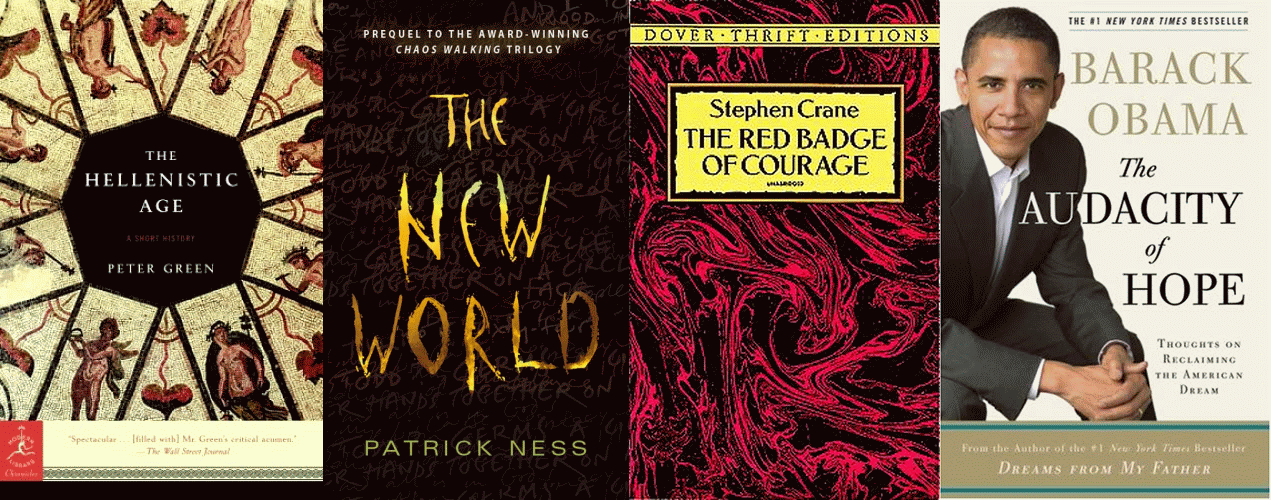
| The Hellenistic Age by Peter Green, "The New World" by Patrick Ness, The Red Badge of Courage by Stephen Crane, and The Audacity of Hope by Barack Obama |
![]() |
| The Dead that Walk edited by Stephen Jones, "They" by Vincent Hobbes, The Time Machine by H.G. Wells, The Zombie Survival Guide: Recorded Attacks by Max Brooks, and Blockade Billy by Steven King |
Labels:
Books,
Comic Books,
Crime,
Detective Story,
Ethics,
Fantasy,
Fiction,
Government,
Graphic Novel,
History,
Literature,
Non-Fiction,
Novel,
Philosophy,
Plays,
Religion,
Sci-Fi,
Short Stories,
Supernatural
Tuesday, November 22, 2011
Lord of the Flies (1954)
A couple of things first. Yes, I should have read this some twenty-odd years ago. Yes, my vision of Ralph is a young, skinny Balthazar Getty – before Young Guns II (1990) and Feast (2005) – because seeing that 1990 version of the story had been my exposure to it (and I saw it in the theater opening weekend). Clearly one could never film the story as written, because nobody is going to make and mass market a story with scores of naked British boys running around on a tropical island. I hope that much is true. How did I come to read it now? Well, I have a stack – and list – of non-fiction books I want to read as part of this year's reading project, but I wanted to get another novel in this month. My mother has a couple of copies of this book, but the one I borrowed was her's in high school; I have a feeling that one cannot find this book with a $1.25 cover price at present.
I would like to think I get what Golding was going for, even when he used relatively obscure meanings for commonplace words. I thought the inclusion of the actual Lord of the Flies felt forced and out of place, as though Golding had his manuscript together but lacked a proper impetus/plot device to drive the big change while simultaneously giving it another level of meaning. Maybe I'm wholly wrong on that note. I did have some slight difficulty keeping some of the minor players straight – another result of knowing that only three of the characters really matter in the scope of the story – but that quickly resolved itself.
What did strike me was how uncharacteristic of my experiences were Golding's expectations of these children. While I do not want to equate Indian Guides or Cub Scouts to British schools (I imagine the latter to be much more strict and regimented, especially in the 1950s), I do know that when I was a child, we children made good account of which of us were where and who was in charge. Moreover, we didn't seem to have any problem trying to organize (though we clearly lacked any know-how and most ability to do anything worthwhile without great direction and guidance). Golding's boys don't know who all is on the island – and that is amongst themselves – and fell that there is still a great need to indulge in endless play. That seems very contradictory to the human nature I've witnessed. Then again, I grew up in a world that had already read Lord of the Flies, so perhaps we were being slightly readied for better behavior should we ever crash land on an island and have to fend for ourselves.
Yes, the cruelty of the boys – when it is finally allowed to come out – feels true. So does the ever returning sense of uncertainty that all of the boys experience. There is something very real that Golding is touching on, but he seems to dance around it at times, content to have his characters dash off for a swim or talk over one another rather than delve deeper into their beings.
Now, Lord of the Flies is not to be confused with the Cheapass Games product "Lord of the Fries", itself a disappointing follow-up to the great "Give Me the Brain". By the way, "Give Me the Brain" is also better than The Walking Dead, but as it is an interactive that should be expected. No, this is a good book (that I guess I can't quite accept as great) that most people read when they are closer in age to the victims of circumstance that people it.
I would like to think I get what Golding was going for, even when he used relatively obscure meanings for commonplace words. I thought the inclusion of the actual Lord of the Flies felt forced and out of place, as though Golding had his manuscript together but lacked a proper impetus/plot device to drive the big change while simultaneously giving it another level of meaning. Maybe I'm wholly wrong on that note. I did have some slight difficulty keeping some of the minor players straight – another result of knowing that only three of the characters really matter in the scope of the story – but that quickly resolved itself.
What did strike me was how uncharacteristic of my experiences were Golding's expectations of these children. While I do not want to equate Indian Guides or Cub Scouts to British schools (I imagine the latter to be much more strict and regimented, especially in the 1950s), I do know that when I was a child, we children made good account of which of us were where and who was in charge. Moreover, we didn't seem to have any problem trying to organize (though we clearly lacked any know-how and most ability to do anything worthwhile without great direction and guidance). Golding's boys don't know who all is on the island – and that is amongst themselves – and fell that there is still a great need to indulge in endless play. That seems very contradictory to the human nature I've witnessed. Then again, I grew up in a world that had already read Lord of the Flies, so perhaps we were being slightly readied for better behavior should we ever crash land on an island and have to fend for ourselves.
Yes, the cruelty of the boys – when it is finally allowed to come out – feels true. So does the ever returning sense of uncertainty that all of the boys experience. There is something very real that Golding is touching on, but he seems to dance around it at times, content to have his characters dash off for a swim or talk over one another rather than delve deeper into their beings.
Now, Lord of the Flies is not to be confused with the Cheapass Games product "Lord of the Fries", itself a disappointing follow-up to the great "Give Me the Brain". By the way, "Give Me the Brain" is also better than The Walking Dead, but as it is an interactive that should be expected. No, this is a good book (that I guess I can't quite accept as great) that most people read when they are closer in age to the victims of circumstance that people it.
![]() |
| "Give Me the Brain", in all of its original Cheapass glory. |
![]() |
| "Lord of the Fries" goes deluxe. There just seems something contradictory about a deluxe Cheapass Game. |
Friday, November 18, 2011
The Power and the Glory (1940)
Back in the mid-1990s I had the good fortune to have a professor who took the GenEd literature course we students took during a summer session – some because it would transfer to real schools, some because they needed credits to get back into real schools, and some because they had no means of taking courses at a real school. He had us read the standards that the good students read in high school, The Sun Also Rises (1926) and The Great Gatsby (1925) and an insane amount of short stories (I want to say we read 50 for the eight week class). One of the short stories was "The Destructors" (1954) by Graham Greene. He strongly encouraged us the read The Power and the Glory (1940) – he couldn't get approval to add it to the approved curriculum. Strangely, I made no effort to read the novel for about 15 years.
I don't know that anything I have to say about The Power and the Glory will do it justice. It is surprisingly good and overcomes the disinterest Greene seems to have in his own characters for the first two chapters. Sure, I had to actually look up the word "quay" (a wharf or reinforced bank where ships are loaded or unloaded) and had to flashback to how june bugs popped off the kerosene lamps at Owasippe (a Boy Scout camp near Whitehall, MI) in order to understand all of the beetles "exploding" against the walls and lights. Once Greene seems willing to give some depth to his characters the story becomes alive and urgent.
Sadly, I am more than willing to admit my ignorance of the real world situation that lead to priests being outlawed in the state of Tabasco. Part of me wanted this entire story to be allegorical, but Greene makes (some of) the sins of man into a type of virtue and gives an eloquent voice as to what the sacraments provide. His Whisky Priest has plenty of time to reflect on the nature of the Church and what he has to offer to them. There is a role that God plays in their lives, but he doesn't pretend to know what it is. Those he tends to often have a type of weakness of character, where those who tend to him – non-Catholics all, and one atheist who may be the second most important character in the novel – display the strength of character the Church has not fostered. Greene both celebrates and condemns the Church at the same time, a remarkable feat.
There are a few lines/ideas that stuck out for me (and in a relatively short span of pages):
✝ On page 172, Greene's Whisky Priest muses on power and dangers of Love, thinking 'Love is not wrong, but love should be happy and open - it is only wrong when it is secret, unhappy... It can be more unhappy than anything but the loss of God. It is the loss of God. You don't need a penance, my child, you have suffered quite enough,' and to this other, 'Lust is not the worst thing. It is because any day, any time, lust may turn into love that we have to avoid it. And when we love our sin then we are damned indeed.' Later, the priest allows for Love to be the scariest thing God has to offer. He would run away from even a glimmer of that kind of force.
✝ On page 182, Greene has one of the best lines ever. 'All the same, it's good to see a priest with a conscience. It's a sign of evolution'. In the novel, a schoolteacher offers this biting critique of how the priests used to take what little money the peasants had and denied the children the things they needed to survive for the services of baptism and communion. The Whisky Priest had finally come to terms with what he needed to do as a man, but he is properly diagnosed as having evolved from a man fleeing the persecution to one who will take seriously his sacred duties (and is hoping for information about one of his benefactors).
✝ On Page 194, on the topic of what is allowable Greene offers, 'A man may want to rape a woman. Are we to allow it because he wants to? Suffering is wrong.' Now this seems pretty straightforward, but the Church – and the Whisky Priest – have argued that suffering in this world may make the blessings of Heavan that much more sweet. The Lieutenant – the man who has been charged with eliminating the last remaining priest – is presenting what he feels to be a reasonable vision of the future. There will be law and order, and thus justice. But there won't be any lies about how there is something to be gained – something noble – in being made to suffer. Suffering is something that should be abhorred and its causes challenged. That this type of world needs the priest to be executed is the contradiction that cannot be overcome.
How good is The Power and the Glory? I would easily put it in the top 20 books I've ever read (I didn't feel this way in the early chapters). While I abandoned Cormac McCarthy's The Road (2006) because I felt it was going nowhere – see what happens when books aren't part of a project – I have to imagine that it cannot put humanity, suffering, and the compassion in better light than Green did 66 years earlier. I cannot imagine this novel making much of an impression on an adolescent and how it may deeply offend Catholics, so it makes sense that it is not a staple of high school literature classes. But I would definitely recommend that everyone read it.
Monday, October 31, 2011
Herland (1915)
Maybe I just don't have much of an appetite for the utopian novel (or novella). The idea that all of the tension and dramatic action comes from a critique of the inequalities and injustices of modern – at the time of the writing, at least – society doesn't seem to one I want to see as central to the telling of the tale. The dystopian tale seems to be a much bigger staple of the Science Fiction genre, and it would appear that it is one that works to greater effect. Then again, this may just be a function of familiarity. Titles like Fahrenheit 451 (1953), Brave New World (1932), and 1984 (1949) are not just staple of the American educational system but almost required reading for any Sci-Fi/gamer geek. Factor in movies like Blade Runner (1982), Brazil (1985), Children of Men (2006), Equilibrium (2002), Logan's Run (1976), The Running Man (1987), Screamers (1995), Soylent Green (1973), They Live (1988), Robocop (1987), The Road Warrior (1981), and Escape from New York (1981), and it is unlikely that one can contemplate a world without many possible dystopian fuutres. The same emphasis is not placed on utopian stories. Aside from Plato's Republic (~380 BCE) – and maybe St. Augustine's City of God (413-426) for the religiously minded – there isn't a great tradition of teaching the utopian tales.
Charlotte Perkins Gilman's Herland (1915) operates as both an imagining of a utopian society (for a little more than half of the world, at least) and a scathing critique on the state of the world. The odd pacing of the tale – a memoir recounted by one of the three men, the most moderate and least judgmental of women in general – leaves Herland without much of a sense of urgency or tension. There is a fair amount of building up of the three male characters (Vandyk Jennings, Jeff Margrave, and Terry O. Nicholson) and their place in the real, male-dominated world. This section of the novel reads like a lighter, less detailed take on the typical adventure tale of the era. The point, and one certainly not lost on the women of the time (or any readers now) is that the most masculine, domineering character is antithetical to the development of women or their role in society. The other male characters are somewhat helpless against him while trapped in the confines of their own culture.
One of the fundamental problems with Herland is Gilman's misunderstanding of human nature and psychology. Because she posits that it is fundamental to the nature of women to be concerned with the welfare and well-being of children above all else – including a sense of self – Gilman crafts a society of women that has no purpose other than service to the nation and future generations. There is no sense of individuality as we (members of a contemporary Western culture) would understand it. There is absolutely no concept of sexual identity; their is knowledge of sexual acts (through observation of animals and an understanding of the before-time, when there were men in Herland), but as these are not needing to produce children, they are deemed unnecessary and not pursued. I'll leave it to women to decide if sexuality is something that can be cast aside given the ability to simply wish children into existence. My limited education on human nature (both in the fields of philosophy and psychology) would indicate otherwise – certainly Aristophanes has argued otherwise.
Still, even with its decidedly anti-male (there was no way to be anti-establishment without being anti-male) tone, Herland is a rather fun and engaging read. Because Gilman is so concerned with establishing the qualities she deemed to be inherently feminine are superior to the ones favored by men (and perhaps correctly lists the best qualities as neither masculine nor feminine, but human), she doesn't provide a society that is accessible to the male reader. There are some conceits that truly help her vision – everyone in Herland is part of the same extended family, all are given equal opportunity in terms of education and vocation, and the general clannishness has worked so well that there are no real criminals (so no need for a punitive government or God).
Herland is forced into ecological conservation by geography and population. There are no other societies to encounter, people to conquer, or land to seize. Part of this is a necessity for the all female society to develop and endure. What it leaves unanswered is whether it is the nature of the women (and their dedication to life) or the isolation that led to the enlightened and utopian state. I don't think Gilman wanted an easy answer to that question. She allows for the fact (as she saw it) that even though men and women love differently – men love in a selfish and demanding way in Gilman's eyes (again, I'll leave it to others to judge whether this is true) – they can and do find ways to meaningful share their lives and compliment each other. Gilman makes it as unbalanced in favor of the women as she saw it for the men in the real world, but did not view it as an inequality because of how women were not hurtful with their love.
There is much to admire about how education and physical activity are stressed in Herland. Sure, Gilman believes that women could be every bit as strong as men (not on the individual basis, but across the board, which is just a total misunderstanding of physiology), but her women only use force as a restraint, a means of keeping the foolish from injuring themselves and/or others. That the denial of most rights to the men trapped in Herland is not seen as any sort of violation by Gilman gives away how much she mistrusts male authority and prerogatives. As a man reading her nearly a century after she wrote it, I am not especially sympathetic to her desire to put men in their place. Furthermore, her utopian society seems oddly limiting. It is unclear who is making the decisions on one's fitness for birthing children, raising children, or the field of vocation one undertakes, but there is a controlling body.
As for some specific points from the book that struck me:
• When a man has nothing to give a woman, is dependent wholly on his personal attraction, his courtship is under limitations. (Chapter VIII – The Girls of Herland)
I think Gilman is addressing both the inequity amongst men, how those with means could easily position themselves better to woo a mate, as well as how women were indoctrinated to accede to men of such men as a manner to ensure a better chance for her children to grow up. The idea of a woman choosing a man (and that is always the case, at least in my experience) based upon who he is and not what he can provide would be considered foolish; Gilman makes this point exactly in her short story "If I Were a Man". In the case of Herland, Gilman is noting how the ladies man has no success among women who measure men (people, really) solely on merit, for all he has to offer are the shiny baubles he thinks women are wont to have.
• They loved one another with a practically universal affection, rising to exquisite and unbroken friendships, and broadening to a devotion to their country and people for which our word "patriotism" is no definition at all.
• They loved their country because it was their nursery, playground, and workshop—theirs and their children's. ...That, of course, is the keynote of the whole distinction—their children.
Maybe their is something to the male ego that screams out for possession and domination of the land. It is certainly true that fathers do tend to be less concerned about the lives and futures of their children then the respective mothers are (this varies with each person, but men do tend to be much less sacrificing then women when it comes to children). The larger point being made is that Western culture tends to focus more on the present than what is being done to ensure the best situation for future generations, and it is a point that never (to date) stops being true.
• " 'Why, you blessed child,' she said, 'you've got the wrong idea altogether. You do not have to think that there ever was such a God—for there wasn't. Or such a happening—for there wasn't. Not even that this hideous false idea was believed by anybody. But only this—that people who are utterly ignorant will believe anything—which you certainly knew before.' " (Chapter X – Their Religions and Our Marriages)
Well, it is more than clear how Gilman felt about Christianity (and religion in general). Here she is making the case against following the strictures of ancestors and believing in a God who exists to levy punishment and judgment against His children. The women of Herland had no need for retribution or vengeance, and thus the concept of a deity who claims those as prime attributes is reprehensible. I think that is a pretty good place to start in the examination of a divine being, though. Does He/She/It have a need to judge and punish others, or can the Divine instead serve to give guidance and inspiration alone? I don't have an answer to that, but I must imagine that such a criticism being directed at religion was just as outrageous as suggesting that all of the great accomplishments wrought by men and competition may have simply been seen much earlier (and without individual fanfare) were societies such that they were concerned with working in concert for the general well-being of the citizenry.
Charlotte Perkins Gilman's Herland (1915) operates as both an imagining of a utopian society (for a little more than half of the world, at least) and a scathing critique on the state of the world. The odd pacing of the tale – a memoir recounted by one of the three men, the most moderate and least judgmental of women in general – leaves Herland without much of a sense of urgency or tension. There is a fair amount of building up of the three male characters (Vandyk Jennings, Jeff Margrave, and Terry O. Nicholson) and their place in the real, male-dominated world. This section of the novel reads like a lighter, less detailed take on the typical adventure tale of the era. The point, and one certainly not lost on the women of the time (or any readers now) is that the most masculine, domineering character is antithetical to the development of women or their role in society. The other male characters are somewhat helpless against him while trapped in the confines of their own culture.
One of the fundamental problems with Herland is Gilman's misunderstanding of human nature and psychology. Because she posits that it is fundamental to the nature of women to be concerned with the welfare and well-being of children above all else – including a sense of self – Gilman crafts a society of women that has no purpose other than service to the nation and future generations. There is no sense of individuality as we (members of a contemporary Western culture) would understand it. There is absolutely no concept of sexual identity; their is knowledge of sexual acts (through observation of animals and an understanding of the before-time, when there were men in Herland), but as these are not needing to produce children, they are deemed unnecessary and not pursued. I'll leave it to women to decide if sexuality is something that can be cast aside given the ability to simply wish children into existence. My limited education on human nature (both in the fields of philosophy and psychology) would indicate otherwise – certainly Aristophanes has argued otherwise.
Still, even with its decidedly anti-male (there was no way to be anti-establishment without being anti-male) tone, Herland is a rather fun and engaging read. Because Gilman is so concerned with establishing the qualities she deemed to be inherently feminine are superior to the ones favored by men (and perhaps correctly lists the best qualities as neither masculine nor feminine, but human), she doesn't provide a society that is accessible to the male reader. There are some conceits that truly help her vision – everyone in Herland is part of the same extended family, all are given equal opportunity in terms of education and vocation, and the general clannishness has worked so well that there are no real criminals (so no need for a punitive government or God).
Herland is forced into ecological conservation by geography and population. There are no other societies to encounter, people to conquer, or land to seize. Part of this is a necessity for the all female society to develop and endure. What it leaves unanswered is whether it is the nature of the women (and their dedication to life) or the isolation that led to the enlightened and utopian state. I don't think Gilman wanted an easy answer to that question. She allows for the fact (as she saw it) that even though men and women love differently – men love in a selfish and demanding way in Gilman's eyes (again, I'll leave it to others to judge whether this is true) – they can and do find ways to meaningful share their lives and compliment each other. Gilman makes it as unbalanced in favor of the women as she saw it for the men in the real world, but did not view it as an inequality because of how women were not hurtful with their love.
There is much to admire about how education and physical activity are stressed in Herland. Sure, Gilman believes that women could be every bit as strong as men (not on the individual basis, but across the board, which is just a total misunderstanding of physiology), but her women only use force as a restraint, a means of keeping the foolish from injuring themselves and/or others. That the denial of most rights to the men trapped in Herland is not seen as any sort of violation by Gilman gives away how much she mistrusts male authority and prerogatives. As a man reading her nearly a century after she wrote it, I am not especially sympathetic to her desire to put men in their place. Furthermore, her utopian society seems oddly limiting. It is unclear who is making the decisions on one's fitness for birthing children, raising children, or the field of vocation one undertakes, but there is a controlling body.
As for some specific points from the book that struck me:
• When a man has nothing to give a woman, is dependent wholly on his personal attraction, his courtship is under limitations. (Chapter VIII – The Girls of Herland)
I think Gilman is addressing both the inequity amongst men, how those with means could easily position themselves better to woo a mate, as well as how women were indoctrinated to accede to men of such men as a manner to ensure a better chance for her children to grow up. The idea of a woman choosing a man (and that is always the case, at least in my experience) based upon who he is and not what he can provide would be considered foolish; Gilman makes this point exactly in her short story "If I Were a Man". In the case of Herland, Gilman is noting how the ladies man has no success among women who measure men (people, really) solely on merit, for all he has to offer are the shiny baubles he thinks women are wont to have.
• They loved one another with a practically universal affection, rising to exquisite and unbroken friendships, and broadening to a devotion to their country and people for which our word "patriotism" is no definition at all.
Patriotism, red hot, is compatible with the existence of a neglect of national interests, a dishonesty, a cold indifference to the suffering of millions. Patriotism is largely pride, and very largely combativeness. Patriotism generally has a chip on its shoulder. (Chapter VIII – The Girls of Herland)
Gilman gives a very nice critique of nationalism, and how patriotism is often pledged in an 'us against them' manner. She does see a sense of filial bond as a feminine quality and conquest (and self-aggrandizement) as male. But what I like about this is how it strips down the conceit of patriotism as only applying to interests one chooses to choose as his own, ignoring the plight of his fellow citizens as though they were somehow unfit for the benefits of the society and nation which he calls his own.• They loved their country because it was their nursery, playground, and workshop—theirs and their children's. ...That, of course, is the keynote of the whole distinction—their children.
Maybe their is something to the male ego that screams out for possession and domination of the land. It is certainly true that fathers do tend to be less concerned about the lives and futures of their children then the respective mothers are (this varies with each person, but men do tend to be much less sacrificing then women when it comes to children). The larger point being made is that Western culture tends to focus more on the present than what is being done to ensure the best situation for future generations, and it is a point that never (to date) stops being true.
• " 'Why, you blessed child,' she said, 'you've got the wrong idea altogether. You do not have to think that there ever was such a God—for there wasn't. Or such a happening—for there wasn't. Not even that this hideous false idea was believed by anybody. But only this—that people who are utterly ignorant will believe anything—which you certainly knew before.' " (Chapter X – Their Religions and Our Marriages)
Well, it is more than clear how Gilman felt about Christianity (and religion in general). Here she is making the case against following the strictures of ancestors and believing in a God who exists to levy punishment and judgment against His children. The women of Herland had no need for retribution or vengeance, and thus the concept of a deity who claims those as prime attributes is reprehensible. I think that is a pretty good place to start in the examination of a divine being, though. Does He/She/It have a need to judge and punish others, or can the Divine instead serve to give guidance and inspiration alone? I don't have an answer to that, but I must imagine that such a criticism being directed at religion was just as outrageous as suggesting that all of the great accomplishments wrought by men and competition may have simply been seen much earlier (and without individual fanfare) were societies such that they were concerned with working in concert for the general well-being of the citizenry.
Friday, October 14, 2011
Tom Sawyer (1876)
One of the first real books I can lay claim to having read – mind you, the entire class was required to read the book and it took several months for us to finish it – was The Adventures of Tom Sawyer (1876). I actually still own the copy from that 5th grade class, with my mother marking it as mine (apparently we bought the book in September of 1985, which is noted both by my mother and by me in different places). When going back to reading it this time, I did not take up the weathered Scholastic edition – which I am somewhat surprised was not an abridged version – but rather went for the DTE copy that was sitting on the downstairs bookcase; the only real difference is that because of dimension and font differences, the DTE can fit the story on 184 pages instead of 319. (Actually, if one has seen where I live, they are well aware that there are multiple bookcases downstairs, but there is one still reserved for works for the reading projects.)
Having written that, I would like to note that the central theme I divined from the novel was that children are liars, and incapable of behaving in a manner that would mark them as being fit for society. I do not feel that I am misrepresenting Twain's sentiments when I write that, and not just because he himself was not a fan of what his contemporary Americans considered "civilized". In Tom Sawyer, children lie because they are ignorant; they simply are trying to better understand the world and have only the gossip of superstitions held by the adults to guide them. Likewise, they lie to the adults because the adults seem to be often cruel and mercurial beings who only exist to place impediments on the experiences of youth. The children, especially Tom, have no real conception of the larger world. The have fantasies of the glory of piracy or banditry, something more glorious than the meager lives the adults have in the rivertown of St. Petersburg, Missouri. Civilization seems to mean to tie oneself to an unremarkable task for life and be quickly thought of as being somewhere from middle-aged to elderly by the next generation of children.
That message seems to be lost from the part of Tom Sawyer that seems to still exist in the zeitgeist. Tom and Huck being friends endures, which is odd because Huck is very much a friend of convenience. Tom is much closer with Joe Harper through most of the book. Tom and Becky being boyfriend and girlfriend endures even though, as written, Tom is more than a little bit of a hurtful manipulator; one can assume that Tom was good looking enough for the ladyfolk to take kindly to his degree of mischief. Likewise, Twain goes off on a tangent where he rails either against women as writers or just about writing on the subject of faith and salvation in general. I think he actually means both.
One of the things that a modern reader, especially a child, will find completely out of place with contemporary America is the sense of charity given to the ne'er do wells of the town. It isn't just Huck Finn, the son of one of the local drunks – in what may have been a dry town – who receives many kindnesses in order to survive. Muff Potter, wrongfully accused of murder (but guilty of conspiracy to commit grave robbery) also makes do on the good will of the citizens. It is a place where most people don't have much – and some, apparently, have tons – but they do not sit content with the notion that those who are worse off are there as the result of a general defect.
I enjoyed my re-reading of this book. Granted, it only took three days – which makes me wonder how much we, as grade school students, were able to appreciate Twain's working the major events of the adult world into the vagaries of childish thought and pursuits. That is the real accomplish with the novel as far as I am concerned. Twain makes a few months time in the lives of a handful of children into a story that seems to span a lifetime, or at least the whole breadth of childhood. This is, by nature of the style with which it is written, one of the few books that may merit a revisit every twenty years or so. I imagine that the shrinking glow of youth can be momentarily remembered to still burn bright while within the pages, but experience gives the reader a much different understanding of the world Twain represents.
I was also extremely happy that Twain does not dedicate himself to the bitterness and bile that dominate many of his short stories. Not unlike his piece about his brief time as a recruit for the Confederacy, Twain has a way of imbuing his personal experiences with a fondness that comes more from telling the tale than for what the story may represent. Even the most evil character Twain puts in the tale is far less maligned than the average citizen would be in the short stories.
Yes, I enjoyed the book. Who thought I was going to come out and rail against the beloved story?
Having written that, I would like to note that the central theme I divined from the novel was that children are liars, and incapable of behaving in a manner that would mark them as being fit for society. I do not feel that I am misrepresenting Twain's sentiments when I write that, and not just because he himself was not a fan of what his contemporary Americans considered "civilized". In Tom Sawyer, children lie because they are ignorant; they simply are trying to better understand the world and have only the gossip of superstitions held by the adults to guide them. Likewise, they lie to the adults because the adults seem to be often cruel and mercurial beings who only exist to place impediments on the experiences of youth. The children, especially Tom, have no real conception of the larger world. The have fantasies of the glory of piracy or banditry, something more glorious than the meager lives the adults have in the rivertown of St. Petersburg, Missouri. Civilization seems to mean to tie oneself to an unremarkable task for life and be quickly thought of as being somewhere from middle-aged to elderly by the next generation of children.
That message seems to be lost from the part of Tom Sawyer that seems to still exist in the zeitgeist. Tom and Huck being friends endures, which is odd because Huck is very much a friend of convenience. Tom is much closer with Joe Harper through most of the book. Tom and Becky being boyfriend and girlfriend endures even though, as written, Tom is more than a little bit of a hurtful manipulator; one can assume that Tom was good looking enough for the ladyfolk to take kindly to his degree of mischief. Likewise, Twain goes off on a tangent where he rails either against women as writers or just about writing on the subject of faith and salvation in general. I think he actually means both.
One of the things that a modern reader, especially a child, will find completely out of place with contemporary America is the sense of charity given to the ne'er do wells of the town. It isn't just Huck Finn, the son of one of the local drunks – in what may have been a dry town – who receives many kindnesses in order to survive. Muff Potter, wrongfully accused of murder (but guilty of conspiracy to commit grave robbery) also makes do on the good will of the citizens. It is a place where most people don't have much – and some, apparently, have tons – but they do not sit content with the notion that those who are worse off are there as the result of a general defect.
I enjoyed my re-reading of this book. Granted, it only took three days – which makes me wonder how much we, as grade school students, were able to appreciate Twain's working the major events of the adult world into the vagaries of childish thought and pursuits. That is the real accomplish with the novel as far as I am concerned. Twain makes a few months time in the lives of a handful of children into a story that seems to span a lifetime, or at least the whole breadth of childhood. This is, by nature of the style with which it is written, one of the few books that may merit a revisit every twenty years or so. I imagine that the shrinking glow of youth can be momentarily remembered to still burn bright while within the pages, but experience gives the reader a much different understanding of the world Twain represents.
I was also extremely happy that Twain does not dedicate himself to the bitterness and bile that dominate many of his short stories. Not unlike his piece about his brief time as a recruit for the Confederacy, Twain has a way of imbuing his personal experiences with a fondness that comes more from telling the tale than for what the story may represent. Even the most evil character Twain puts in the tale is far less maligned than the average citizen would be in the short stories.
Yes, I enjoyed the book. Who thought I was going to come out and rail against the beloved story?
Tuesday, October 4, 2011
Naked Heat (2010)
I like Nathan Fillion. I liked him as Johnny Donnelly on Two Guys and a Girl (1998-2001); Fillion came on the show after the name change. I liked him as Captain Malcolm Reynolds in the enjoyable, but deeply flawed series Firefly (2002). But I think the role he was born to play was that of Richard Castle on ABC's Castle (2009-present), as it allows him to indulge his evident inner-geek and make the regular murders that provide the plots for individual episodes to seem interesting, or more so beyond the script.
So, Fillion draws me to Castle – and while I'm watching it I often wonder if I would enjoy a show with with John Huertas and Seamus Deaver as scrappy detectives who never get the glory for all the work they do – and it is in the vein of fandom that I have read the first two novels written by the Richard Castle persona. I don't know if I can really defend this. I have a long list of books that I should read. I have an equally long list of titles I want to read. And I have made a real effort to make the 2011-12 reading project one that has a lot more non-fiction titles of merit. Ignore that comic book/graphic novel week of titles that are now part of said project.
Naked Heat (2010) follows the events of Heat Wave (2009) by a few months. Jameson Rook (the stand-in for Richard Castle), made somewhat unpopular amongst the police he shadowed for his magazine article finds a new way to become part of the investigating team: he stumbles upon the murder of a high profile gossip columnist. It takes some time for him to win the warm regard of the detectives, but he does. And then he has sex with Nikki Heat (the stand-in for Kate Beckett) again.
The novel stresses one of the weaknesses of the television show. In order to keep some kind of mystery going, the detectives (and writer) often have to go back to people who were originally suspects. I mean often as in regularly and repeatedly. In the book, it happens over and over and over again. The story is more involved than a single episode could be, but it is also horribly contrived – such as the garbage strike. Adding to the problem, most of the elements of Naked Heat have appeared in episodes in Seasons Two and Three. The ending is a little weak, especially for all of the disparate elements that are brought into the tale. The pacing also raises some concerns, but it isn't so jarring as to cause any problems.
Whoever writes the Richard Castle novels isn't particularly concerned with creating a setting, instead simply giving the show's characters different names. There is next to nothing in regards to physical descriptions, and just as little attention paid to clothing. Neither Heat nor Rook are developed as characters, and if one were no familiar with the show it is unlikely that either would feel like people worth headlining a story. However, the Richard Castle novels are a tie-in to the show. As such, they allow for stories that are similar to the show without having to constrain themselves to the established continuity. Maybe the selling point is that Heat and Rook get together, something denied to Beckett and Castle.
As a diversion that is tied-in to something I already invest some time to, Naked Heat is decent. It is better written and structured than Heat Wave. Like most of the fluff I have read for the projects, Naked Heat was a two day read. What I would recommend – strongly recommend – is to not watch an episode of Castle in between reading the book. It can cause a few moments of what...wait that are the result of an easy confusion between the two.
So, Fillion draws me to Castle – and while I'm watching it I often wonder if I would enjoy a show with with John Huertas and Seamus Deaver as scrappy detectives who never get the glory for all the work they do – and it is in the vein of fandom that I have read the first two novels written by the Richard Castle persona. I don't know if I can really defend this. I have a long list of books that I should read. I have an equally long list of titles I want to read. And I have made a real effort to make the 2011-12 reading project one that has a lot more non-fiction titles of merit. Ignore that comic book/graphic novel week of titles that are now part of said project.
Naked Heat (2010) follows the events of Heat Wave (2009) by a few months. Jameson Rook (the stand-in for Richard Castle), made somewhat unpopular amongst the police he shadowed for his magazine article finds a new way to become part of the investigating team: he stumbles upon the murder of a high profile gossip columnist. It takes some time for him to win the warm regard of the detectives, but he does. And then he has sex with Nikki Heat (the stand-in for Kate Beckett) again.
The novel stresses one of the weaknesses of the television show. In order to keep some kind of mystery going, the detectives (and writer) often have to go back to people who were originally suspects. I mean often as in regularly and repeatedly. In the book, it happens over and over and over again. The story is more involved than a single episode could be, but it is also horribly contrived – such as the garbage strike. Adding to the problem, most of the elements of Naked Heat have appeared in episodes in Seasons Two and Three. The ending is a little weak, especially for all of the disparate elements that are brought into the tale. The pacing also raises some concerns, but it isn't so jarring as to cause any problems.
Whoever writes the Richard Castle novels isn't particularly concerned with creating a setting, instead simply giving the show's characters different names. There is next to nothing in regards to physical descriptions, and just as little attention paid to clothing. Neither Heat nor Rook are developed as characters, and if one were no familiar with the show it is unlikely that either would feel like people worth headlining a story. However, the Richard Castle novels are a tie-in to the show. As such, they allow for stories that are similar to the show without having to constrain themselves to the established continuity. Maybe the selling point is that Heat and Rook get together, something denied to Beckett and Castle.
As a diversion that is tied-in to something I already invest some time to, Naked Heat is decent. It is better written and structured than Heat Wave. Like most of the fluff I have read for the projects, Naked Heat was a two day read. What I would recommend – strongly recommend – is to not watch an episode of Castle in between reading the book. It can cause a few moments of what...wait that are the result of an easy confusion between the two.
Subscribe to:
Posts (Atom)