Wednesday, February 8, 2012

Civ III Update – Dragonrealm

     This is mostly just pictures.  But I thought I would give an idea as to what the units that will be in the game will look like.  None are really based on Knaak's setting, but I think most will end up working.  Except for the horse they have for Darkhorse.  That just doesn't look right (but how could it?).
     I made NONE of these.  I downloaded all of them from Civfanatics.com.

The Skink Settler (Warhammer Fantasy...I think) serves as the Drake Settler.


The Skink Worker likewise stands in as the Minor Drake, which is Dragonrealm's replacement for the Worker.
Also stolen from Warhammer Frantasy, the Cold One Chariot stands in for the Drake Chariot, which replaces the Chariot.

Another Skink.  This one becomes the Drake Archer, replacing the Archer.  By this point you can tell that I am not particularly interested in original names.

Another Skink (they keep coming).  The Drake Spearman replaces the regular Spearman.  This is how it looks in Ancient Times.

After the Ancient Era, the Drake Spearman looks like this.

The above unit animated.  See him run, attack, attack again, fidget, roar in victory, and die.


This looks much better in game, but Dragonrealm can make a Dragonrider (if one can believe a dinosaur can stand-in for a dragon), and uses the Triceratops Rider unit.

Slightly more Dragonrider-y (though not an air unit in the game), the Dragonrider looks like this from the Medieval Era onward.

In the Ancient Era, the Drake Swordsman (actually a Sword Saurus) looks like this.

The Pike Saurus becomes the Drake Pikeman, which replaces Pikeman. 

 
The Red Duke replaces Medieval Infantry.

Maybe not as cool as the mace and chain wielding regular unit, but the Red Duke sells a little of the menace of a land dominated by magic-using dragons.

The Black Duke, if one ignores the gender inconsistency, makes a rather nasty Foot Knight for Dragonrealm.

The Rider from Zuu (a city-kingdom known for its excellent mounted warriors) replaces the regular Knight.  I used the Norman Knight for it.

A Skink on a dinosaur becomes the Dragon Knight.  There is a better unit to use, but it stands in for Cavalry.

A Skink with a musket (and a tiny skink) becomes the Drake Musketeer.

The Cold One Knight should have been the Dragon Knight, but it becomes the Drake Knight and replaces Cavalry.

The Blue Duke replaces the Marine.  Sure, charging up a beach against machinegun fire sure seems suicidal, but the Blue Dragon is the master of the Eastern Seas and his clan operates on both land and in the sea.

Sure, there is no Bone Dragon in the Dragonrealm, but the animation is just so cool.  The Bone Dragon is the Paratrooper for the Civ.

The Ghost Dragon serves as the animation for the Bone Dragon in the Modern Era.  It used to be used as something else, but then Tom2050 went and made more dragons available.

One of the newer dragons.  This Red Dragon is much better than the old  one (from the early 2000s).  It replaces the Tank.
This Black Dragon replaces the Main Battle Tank, the Cold War era Tank category that fills the void between the Tank and Modern Armor.  I wish he breathed poison gas, but I'm not going to argue with free.

Lord Ice, master of the Ice Dragon clan.  So, the Ice Dragon becomes the Modern Paratrooper.
The Gold Dragon will either be a King Unit (since the Dragonrealm is ruled by Emperor Gold) or their Special Forces unit.

The wholly unacceptable stand-in for Darkhorse.  But there isn't a lot of demand for the big, sleek, magical horse-like "demon" with blue eyes.  But it is a dark color and a horse, so it is the best I have.

Can't do the Dragonrealm without spellcasters.  This is the Mage, the weakest of the three stages of magic-users (equal to a Wizard).

This is used as The Lady of the Amber (Gwen Bedlam).  She becomes a class of spellcasters (the equivalent of the Archmage setting).

This Wheel of Time animation stands in for a Vraad, a race of all-powerful spellcasters.  Vraad are insanely powerful in the game; there is no range limitation on their bombardment and no other spellcasters match their might.  This is the best unit Dragonrealm receives, effectively making it their Unique Unit (UU).

Tuesday, February 7, 2012

Farscape: The Beginning of the End of the Beginning (2009)

     I used to go to Star Trek conventions.  Not a lot, and I never made it to the big one in Anaheim – this would have been around 1991 – that had the entire cast of Star Trek: The Next Generation (1987-1994), but I guess I felt some need to express my fandom for Trek.  I read a few of the books.  I read the novelization of "Encounter at Farpoint" (1987, the pilot for TNG) was staying home from school one day.  I read Star Trek: The Next Generation – Survivors (1991), which I want to say was #4 in the series, but largely because I wanted more Tasha Yar.  My family bought some hard cover Trek novels – I remember only Star Trek: The Next Generation – Dark Mirror (1994) – that I never bothered to read.  I read 14 of the first 15 Star Trek: Deep Space Nine (1993-1999), I assume in another effort to prove my level of fandom.  There were some good DS9 novels, and Peter David introduced a notion in Star Trek: Deep Space Nine – The Siege (1993, #2 in the series) that was a rewarding running gag.  But even as I attended the conventions, I was much more interested in the Robotech and Star Wars merchandise I could not possibly find anywhere else...because there was no eBay or the like.
     I bring this up because I, at some point, moved beyond needing to prove how much I liked Trek.  I don't own all of the movies and have picked up none of the TV series (though that has as much to do with the original pricing than just deciding that I didn't need them).  I gave up on following the books, though that had a lot to do with the knowledge that I would always be well behind the curve if I wanted to start from the beginning.  I came to terms with accepting that I didn't need to be into the entirety of something in order to appreciate it.  And once I was aware of what it meant to be a fanboy, I was sure I was on the right path.
     One of the reasons to stick with the main product is because it is the most accessible.  The more compelling reason is because, unlike novels or comic books, the TV episodes, mini-series, and feature films are much more collaborative projects and seldom are giant departures from what made you love the show in the first place.  I was – and continue to be – a huge fan of Farscape (1999-2003).  But I could so without the comic books/graphic novels that I have read.
     Farscape: The Beginning of the End of the Beginning (2009) takes up the story soon after the end of the mini-series that was supposed to be the end of the story.  I've gone over most of this just a few days ago.  But instead of growing the story, The Beginning of the End of the Beginning seems to be an attempt to force as many of the characters into an overly complicated story.  There is something compelling about seeing Rygel prove that he has some skills, and that he may have some respect for his shipmates, but that is not enough to salvage this product. 
     First of all, the artwork is substandard.  Neither John nor Aeryn look like the actors who played the roles, and that is a problem (one that did not continue in the second comic series/graphic novel).  The action is so poorly portrayed that it would be utterly confusing without the characters commenting on what was happening.  And the detail is lacking.
     Second, the notion that characters need to be forced in to the story is getting very frustrating.  In this volume, Scorpius ends up working for Dominar Bishan.  Why?  I'm not asking for the story that Rockne S. O'Bannon put together to justify this, but why even introduce the idea?  On the TV show, it made sense to have aliens show up repeatedly, but in a galaxy or universe full of trillions of sentient beings, O'Bannon feels a need to keep the interactions tied-up in established characters.  That makes sense only if he is selling a product to fans who want to revisit these characters.  He should be moving the story forward, but I have a feeling such a notion would not be greeted as eagerly by the fans.  And by fan, I mean fanboy. 
     The Farscape graphic novels do little to no justice to the TV show.  They seem to exist as a means to draw money away from people who have a need to prove that they loved the show enough to buy them.  There is nothing necessarily wrong with that – support the things you love – but it feels like O'Bannon is abusing the goodwill of those who felt that there was something left unsaid when the planned Season Five was turned into only four hours of mini-series.
     If you are going to read one Farscape graphic novel, I would not recommend this. If you are going to read them all, then the quality won't matter.  That is the ultimate lesson for the fanboy.  That, at some point, quality needs to matter; it needs to be bigger than any sense of personal ownership of a property.  And The Beginning of the End of the Beginning is lacking in quality.

Monday, February 6, 2012

Heart of Darkness (1899)

     For some reason, I cannot seem to warm up to the writing style of Joseph Conrad.  It isn't just that he is obviously in love with the relationship between man and ship (or boat, if the waterway is too small to accommodate a ship), though having not been raised in the Victorian Age of the British Empire – or a contemporary witness to it – the Sea and its ways holds little mythic power over me.  It seems to be more in relation to his needing to spend too much time to make too subtle an allusion to the point he is desperately trying to make.  And like with "The Secret Sharer" (1910) – the short story that was bundled with Heart of Darkness (1899) in the Signet Classics book I purchased half a decade ago – Heart of Darkness spends too much time being about man and ship instead of the nature of man.
     That is not to say that Heart of Darkness is without point.  There is something pure in Conrad's exploration of the nature of colonialism, especially in Africa.  However, he wrote the story at the tail end of the 19th Century, before the machinery of real destruction could be brought to bear on the Dark Continent.  I read it in the 21st Century, after having taken a post-Colonial period Africa history class (taught by an honest-to-God African who was wounded in a civil war largely created by the actions of the English while lording over the locals).  The book is not going to mean the same thing to me that it would before the Colonial Period came to an end.  Add to that the fact that I have Apocalypse Now (1979) as a competing format of exploring the same concepts.
     Lets face it – the absurdity of a benevolent war is a far riper target than the criticism of treating Africans as property at the beginning of the 20th Century; I would wager most Europeans didn't regard the Africans as people, per se.  Having Colonel Kilgore herding scared villagers into an amphibious APC – a metal monster of sorts – while the announcement, in English, repeats that the US Army is there to return the people to the bosom of the government of South Vietnam.  For good measure, the Army is going to burn the village to the ground just to show how serious they are about saving the people.  That scene captures the madness of what is going on (for Apocalypse Now) better than anything Conrad could craft for Heart of Darkness.  Yes, he has Marlow describe disparate scenes that show how enterprise is not directed in a proper European fashion, but he seems to walk away from the underlying point so that he can ruminate more on boats.
     Kurtz, in Heart of Darkness, isn't even really a character.  He is an objective.  There is no reason why Marlow comes to imagine him as a voice dwelling at a native temple upriver (but it is good imagery).  What is much worse, Kurtz's famous last lines – "The horror!  The horror!" – don't have nearly the depth of meaning that they should, and that is because there is no real interaction with the man.  Kurtz's story becomes lost in the fretting over a new breed of morality that may have taken root back in Europe and Marlow is seen in country as a threat of things to come.  But nothing is ever to come.
     There is something profound in the grave concern over the letters and such of Kurtz being tied directly to gaining access to his strategy to better exploit the region.  Conrad hints at what Kurtz had been up to – certainly it would not be an easy topic of conversation amongst the men who thought of themselves as civilized – but he doesn't let the terribleness of it sink in, immediately shifting focus to the effort to leave the area, and for Marlow to get back to London.
     Oftentimes I complain about how a movie will take excellent source material and ruin it because the writer(s) and director are sure that they (or he or she) can do better.  In the case of Apocalypse Now, I think John Milius and Francis Ford Coppola exceeded the source material.  That is not to ignore some of the indulgences of the film, or how it is essentially tied to the war instead of a prevailing view towards others who live on the land you want to despoil; Heart of Darkness is more timeless, but its understanding of its own underlying economy seems wanting.  Where Conrad does not give his Kurtz his due in explaining how he fosters a cult of personality, Apocalypse Now sets the stage so that there could be no other conclusion of Kurtz being cut-off from command.
     Okay, I'm aware that I am being a special kind of ass when I purposely conflate the novella and the film.  I would prefer the reason be that Conrad simply was unable to convey the true depredations and inhumanity of European colonialism (especially in the Congo), but it is much more likely that the imprint the film had on a much younger me predisposes me toward favoring it.  The Colonel sending soldier out to surf during combat speaks more of madness to me than the aimless blasting away at the cliff face or recklessness with material supplies of the novella.  Then again, the movie is from my culture.  It should speak directly to me.
     Of the literature I've read in the year and a half of the Reading Projects, Heart of Darkness was probably my least favorite (though it is nowhere near as difficult a read as Beowulf was).  I am certainly in no hurry to read any Conrad in the near future.  Still, I have heard good things about both The Inheritors (1901) and Nostromo (1904) – the former a collaboration with Ford Madox Ford, whose The Good Soldier () is currently on the to read list – so I cannot rule out more Conrad altogether.  But I do know that there is something in the style that doesn't sit right with me.  Maybe I have been spoiled by the short, strong, masculine sentences that Hemingway helped usher into fashion.

Friday, February 3, 2012

Farscape: Strange Detractors (2009)

     Farscape (1999-2003) was a good, if underfunded, space opera show that ran on the SciFi Channel.  It had several hiccups during its four season run (including an ongoing one because the producers wanted to show a particular bad guy was a threat even when he wasn't there), but it was entertaining and engaging.  It had heart, humor, handled the action much better than its contemporaries, and managed to be internally consistent.  Because it didn't get its promised fifth season (though Executive Producer Brian Henson makes the case that SciFi cannot be faulted for this in the DVD commentaries because Farscape was a show they always lost money on), many fans felt cheated.  I know I was one of them (see my very first post – as mothygamer – on IMDB).  But the two part mini-series Farscape: The Peacekeeper Wars (2004) left me feeling the story had been wrapped up.  If there was anything more to be handled in the story, it would have to be big enough to justify it.
     Seems that was not the case for creator Rockne S. O'Bannon.
     Like Joss Whedon resurrecting his dead television shows Buffy the Vampire Slayer () and Angel (), O'Bannon turned to comic book/graphic novel format.  It is here that I want to take issue with most people who believe that the graphic novel is as legitimate a source of storytelling as actual prose, because the shortcuts are almost always out in full force in illustrated storytelling.  I'm getting off topic.  Like Whedon, O'Bannon does not seem to want to let the story be over.  One could callously assume that this is like George Lucas re-releasing the Star Wars (1977-2005 for live action films) movies – now in 3D – because there is always more money to be made from them.  At least Whedon and O'Bannon are putting something new out there for fans, even if it means messing around with the presumed end of the programs.
     Strange Detractors (2009) is essentially an episode of Farscape told over the course of four issues (in comic book form) or chapters (in graphic novel form).  It follows shortly after the first collection of Farscape comics (which I have yet to read), which means that it is mere months after the official old ending.  Part of this really bothers me.  Farscape was over for me when D'Argo got killed and the threat of Scorpius had been eliminated.  The story was complete, with just enough wonder left for there to be the possibilities of future adventures.  For some reason – though it is entirely consistent with how the show was done – O'Bannon decided that those possibilities had to become eventualities, and eventually always means now.
Sikozu in comic book form.
     Worse, O'Bannon feels the need to bring back as many recognizable characters as possible.  In the case of Sikozu, I didn't mind; I felt that she had been badly handled for the second half of Season Four and reduced to a means for exposition to be spoken at, and then had her backstory scrambled for the miniseries (to be fair, apparently all of that was planned from the beginning and would have played much better over a whole season rather than in a few scenes).  For most of the other returning secondary and tertiary characters, it felt like pandering.  Come see the characters you saw on TV.  Rygel, who had been returned to his throne – and thus should be largely absent from all future Farscape adventures, gets dragged into the story.  Note to O'Bannon: you don't have to put the puppet in the comic book if there isn't a compelling reason for the character to be involved.
     The story is rather simple.  Something is making people go crazy and attack those around them.  Farscape did an episode with a similar theme ("Crackers Don't Matter"), but on a smaller scale.  Crichton once again finds a way to keep it together well enough to find a cure for the plague and save his shipmates (including his wife and child).  The artwork isn't bad; one can easily recognize all of the characters because they look very much like the actors or puppets that portrayed them.  But there isn't enough of a story here to make it worth while.  I certainly don't want an episode played out over four issues, nor would I want to pay the cover price of the graphic novel ($24.99).  I would want something bigger and more considered if O'Bannon wants to keep Farscape alive, but what I really would prefer is for one of his new projects to be picked up so he can let Crichton, Aeryn, Chiana, and Pilot be undisturbed for a long while.

Thursday, February 2, 2012

Dreamers (Original Text - Part Thirteen) (1997)

     The original "ending".  Well, actually there is another section that was started after this one, but is is very weak and gives an unfortunate happy ending to Jason and Melissa.  Then in 1998 I started a sequel of sorts to "Dreamers" that meant to explore the relationship between Jason and Stacy Andrews, his ex-girlfriend.  That was abandoned because it was poorly conceived (and not just because I knew nothing about the kind of relationship I was trying to describe).
     Anyway, Part Thirteen.

XIII

     Dave Burke left the group first.  He didn't have any choice, but he was the motivation for the rapid deterioration.  There were other reasons, the are always other reasons for everything, but nobody would deny that it was Dave Burke's murder that orchestrated the collapse.
     The days afterward were as destructive as the actual crime.  Sean didn't seem to shaken by the murder and that grated on Vicki.  Larry Pudenski argued two sides, with Burke not being too great a loss and Sean being the most likely killer.  Dave Burke didn't have a philosophy, wasn't a great contributor to society.  On the other hand, Sean would want him dead for not only being white but also because of the relationship with Vicki.
     The funeral was hard for everyone.  It was Burke's cousin who had to give the eulogy, but asked Jason to write something to express Dave's involvement with the group.  That wasn't easy.  Jason and Melissa had already begun the process of removing themselves when Burke was killed.  Still, Jason wrote how important someone can be when they are simply willing to be there for everyone else, whenever needed.  And that was how Dave should have been remembered.
     Vicki sold her house and moved back to New Jersey.  She found a better job closer to home, to her family.  She said goodbye to everyone, but spent more time with J.B.  The two had known each other longer than she had known the others, and it was to J.B. that she had a real attachment.  They swore they would stay in touch.
     Sean moved out before she sold the house, angry that she took Burke's murder so personally.  He never liked Dave Burke or Jeff Binghampton, and he thought it would be a good thing that there would be no group to distract Vicki from him.  Unfortunately, he found out that it was that very group that gave Vicki the strength to be with him.  He moved on, though with some regrets.
    
     "Four weeks.  Maybe you are psychic."
     "Jason," Nancy said in a soft voice, "it was a robbery.  And nobody knows what is going to happen to us.  I was just being childish."
     Jason, Melissa, Nancy, and J.B. had gathered at a restaurant after the service.  Unlikely as it seemed, everyone was taking care of Jason, not the other way around.  Larry Pudenski and Mike Carver couldn't even make it to the funeral with work keeping them busy.  That may have been what was affecting  Jason.  Their mellow conversation was interrupted by a striking blonde in a plain black dress.
     "Excuse me.  Are you Jason?"
     Jason offered a weak smile and nodded.  He offered her a seat at the table and she accepted.
     "You don't know me.  I worked with Dave.  My name is Anika."
     "The infamous Miss Lang.  Dave mentioned you more than once."
     "I didn't know if I should have been at the funeral or not.  Dave and I only went out a couple of times.  He was a really nice guy.  I really liked him."
     "He was a great friend.  He was better than any of us gave him credit for.  I never gave him credit."
     Anika didn't seem to have heard Jason.  "I think I could have loved him."
     "I'm sure you could have, Anika," Melissa said.  It pained her to see two people in pain from the same source but unable to see it as clearly in the other.
     There was some more conversation and Anika stayed to share a meal with them, but she could not bear to stay there with them.  They had a stronger relationship with Dave and she felt like an intruder.
     "That's the kind of girl you should be with, Jeffery."
     "Well, her obvious pain and loss aside," J.B. quickly countered.  "Yeah.  She's got the looks.  She's nice, and intelligent enough."
    "What would Brad do?" Jason asked.
     "He'd go after her and get her."
     "He's a hell of a brother, isn't he."
     "Don't give me that, Jason.  I'm not going to use Dave's death to get laid."
     Jason shrunk back, hurt.  That wasn't what he thought he was suggesting.
     "It is an unfortunate circumstance, how you met her," Melissa said.  "But you can try to make something out of it.  Something that involves more than you trying to fuck her.  You actually shared a person in common, and you can approach this from a more emotionally healthy place."
     "I thought I told you I don't do that."
     "Well, apparently life is short.  And it wouldn't hurt you to change before it's over."

Wednesday, February 1, 2012

Big Eyes, Small Mouth (1998 revised) & Big Robots, Cool Starships (1999)

     Once upon a time, roleplaying games didn't feel the need to define everything and use the rules to constrict ideas and possibilities.  It wasn't that long ago, actually.  But looking back at one of the better experiments in an 'open system' – one that lets the players and GM (gamerese for Game Master, or the person who adjudicates the rules and plays "the world" instead of one character) craft their tales of adventure, intrigue, and so on without the need for everything to be detailed in the game mechanics – that came out of the late 1990s, I was surprised at how much roleplaying games have seemed to change.  At least for me.
     Now, Big Eyes, Small Mouth (1998 revised printing) wasn't interested in setting up a system that would define anything; that was up to each individual group.  No, what Mark C. MacKinnon appears to have been after was just a simple set of rules to allow for some balancing of the imaginative playground for those who wanted to play anime or manga styled stories out as a roleplaying game.  At the time, he still hadn't dubbed it the Tri-Stat system (a move I'm convinced was motivated by concerns for marketing the licensed products that would later be published by Guardians of Order).
     The idea behind it is insanely simple.  The core mechanic is just rolling 2d6 (or two six-sided dice, for those who don't read gamerese fluently) and trying to get a low total.  That is somewhat counterintuitive, but it makes sense within the framework of the rules.  What there are that amount to rules, at any rate.
     There is a system for building a character, distributing points among the three stats – Body, Mind, and Spirit – and how some values derive from how those points are spent.  There are suggestions as to what the levels purchased might mean in a given setting or game, but nothing is hard and fast.   Because BESM was designed to be used in any conceivable setting, it doesn't have chapters on skills (instead, a character can do most things that they should  be able to do, and can make a check against the stat that best fits the situation.  Combat is handled slightly differently, invoking a couple of derived values and characters can vary widely in ability.  Again, because it is written to accommodate any setting or story, there are allowances for giant robots and spaceships as well as magic and strange mental powers.  That last one is the only part where the rules get somewhat concrete, as mental combat is handled differently than normal, physical combat.
     By itself, the BESM doesn't feel like an RPG rule book.  Instead, it seems like the guidelines to allow players to break free from the restrictive chains that lock characters into a game-defined type or class or O.C.C. (instead of an anime defined type, which players are somewhat encouraged to adopt as it should help them immerse themselves in a different style of play that still mimics their favorite source material) while still rolling dice and having a fair amount of random influence on the outcome of the story.  As far as that goes, it holds up quite well – in spirit.  I certainly wouldn't pay $13.95 for the same thin book now (how reckless was I with my RPG spending...I easily spent about 1/4 of my income on gaming shit over a three year period in the late '90s and I'd like to have most of that money back), but that also has something to do with how my experience with gaming has changed.
     More on that later.
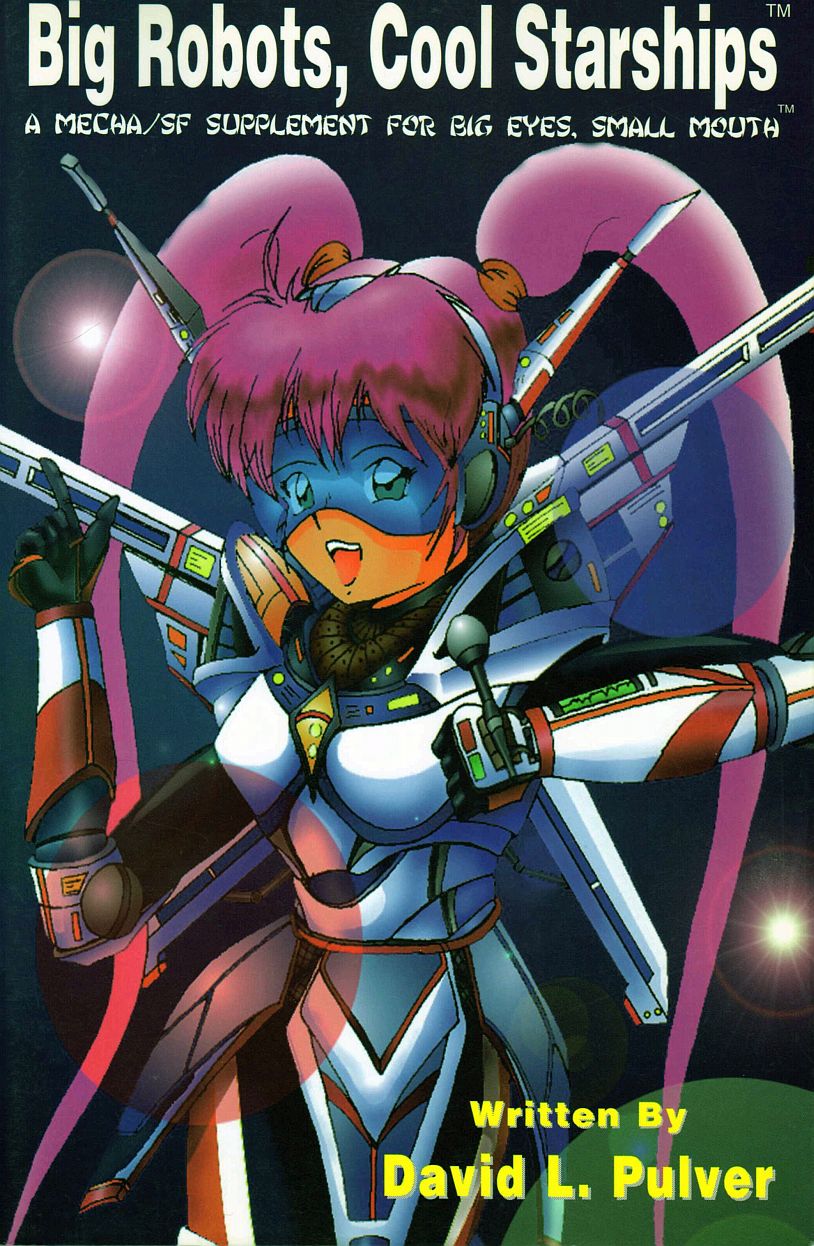
     The only supplement I purchased for BESM was Big Robots, Cool Starships (1999).  It functions much like the original, giving ideas for how to build mecha (or giant robots), cyborgs, androids, spaceships, or even magical armor with the same level of vagueness.  BESM was focused on the idea that the players and GM could operate in a cooperative manner and agree upon how the rules should be interpreted.  Because of the level of sparsity in regards to all-around detail, I think it works.  There isn't much of a way to win at BESM (though the Extra Attacks attribute introduced in BESM becomes abusive when combined with Multiple Mecha Attacks in BRCS, because the amount of attacks multiply with each other...and that means that one character may have one attack action each round and another could have 20) because the game is clearly meant to focus on story.
     In that regard, neither MacKinnon nor David L. Pulver (author of BRCS) manage to create a sense that they have a launching pad to steer players and GMs in what they assume to be the right direction.  This may be because MacKinnon originally had no intention of getting in the way of the players' good time.  There is also the issue that Pulver's suggested adventure is too bare bones to help a new RPG player, but too scripted in its expected outcomes to make experienced GMs and players happy. 
     Still, I was pretty shocked that it has only been 14 years (almost 15) since MacKinnon first wrote BESM.  He wrote in a pre-3E D&D world, where game companies did not have the luxury of writing for an OGL (Open Game License) system and making your own system almost always meant having a distinctive setting.  Sure, Fudge showed up in 1995, but it required a lot of work in terms of figuring out how much of the rules were needed for a setting or story, and in my extremely limited experience, players and GM often had difficulty deciding on how to play with the less than concrete Fudge rules.  GURPs had been around much longer, debuting in 1986, but it relied on concrete rules that were specific in terms of what applied to what setting.  There was room for GM fiat in decided for exceptions, but the supplemental material became canon unto the type of setting people played (not always, of course, but far more often than I would have expected).
     There is a danger when it comes to mixing hard defined rules with whatever the group agrees upon.  Indeed, I never had a good experience running (GMing) or playing White Wolf's Mage: The Ascension (I played with groups that used the 1996 2nd Edition) because it did exactly this.  There is no easy way to define how magic is supposed to work unless one resorts to a set of spells, and Mage didn't want to do that.  The problem became that players would attempt to do insanely powerful things (like create a living creature out of the aether) while having very little power as defined by the game mechanics.  It invariably turned into an argument and at least one player would pout because they couldn't do whatever they wanted to do.  BESM seemingly overcomes this because everyone has to agree as to what the rules mean, because the book doesn't define them to any kind of absolute or concrete terms.  Everyone would know what the rules allow for because they are the people who set the limits, and that seems both audacious and inspired.  It should even work.
     However, if my past decade of gaming has taught me anything, it is that players seem to crave system.  Story has become much less important.  Maybe it is the MMO effect, where how one makes a character has more impact than the story for him or her.  D&D 3E was a huge offender in terms on needing to have everything fit the rule.  Gone was the simplicity of giving the baddies an AC (Armor Class, or what level of skill+luck is needed to hit the creature or character) and HP (Hit Points, gamerese for how much damage a creature or character can take before it dies) and running a combat on the fly.  Gone was giving certain creatures the abilities necessary for the scene to look and feel right.  Everything became defined, and people who played the d20 system (RPGs that ran under the OGL system) got sucked into this trap.  I know because I am one of them.
     I don't know if I could take people whose experience came from that d20 mindset and expect them to get the much more free-form BESM.  I am certain that there are old-school gamers who prefer the fits the rules mindset that has fallen upon us.  I miss the story being king.  I miss the rules always being made to fit the story, and not vice versa.  BESM requires a certain level of maturity that may be best suited for the RPG player who has learned how to play but not yet settled into a rut of comfortable systems.  I do know that it would be a disaster for an Organized Play campaign, and that is where I see most my RP action these days.  OP play is an entirely different animal from home play, the kind of RPG experience that used to be the norm.  It is as different as being friendly with the people with whom one plays and playing a game with well-established friends.  OP requires a commitment to the rules because that is the consistent element.  It is rules over story, even when the story is very good.
The in-book example of a BESM character.  Simple, at least by RPG standards.  It is clear the focus was not on tricky out the character as much as it was making one that would be fun to play.  That is what I miss in RPG systems.
     And that is sad, because MacKinnon was on to something.  He was effectively giving the gaming experience back to the players and freeing them up from having to be slaves to the on-going products and endless releases of crunch (gamerese for game mechanics and rules) that allow for better, faster, newer, etc., characters.  It was an anarchist-light idea that worked for a brief while.  I would have been curious to see what Guardians of Order would have done with George R.R. Martin's Song of Ice and Fire setting, since they had the rights before collapsing because of debt.  What could have been.

Tuesday, January 31, 2012

Adventures of Huckleberry Finn (1885)

     I want to go on the record and state that Adventures of Huckleberry Finn (1885) is nowhere near as well crafted, compelling, or meaningful as The Adventures of Tom Sawyer (1876).  I am wholly aware that I am committing some form of literary heresy with that statement.  The latter is widely viewed as a children's story, but it contains more truth about the struggle to be an adventuresome boy while still growing into a man.  It deals with young (and honest) love, financial inequities, and life on what was essentially the frontier.
     In contrast, Huck Finn abandons its deeper truths after the first third of the story, first in favor of a comical take on Americana con-artistry, then in destroying the virtue built into the Tom Sawyer character nine years earlier.  Maybe it was how disrespectful Twain was to his own creation that soured me most on this book, but I think it also had something to do with the easy realization that there is no adequate ending to the tale.  Instead, Twain places Jim back in shackles and cannot seem to return Huck to the realization that a slave is also a person and should be respected as one.
     If the second half of Huck Finn had been as well written as the first half (or the first third, especially), it would be the American masterpiece it is celebrated to be.  Instead, the book gets bogged down with the idea that young women (especially) are creatures to be marveled at (and perhaps politely lusted after), that men are essentially creatures looking to take advantage of others, and that the injustice in slavery is largely based in the separation of families – a huge step back from the early revelations at which Huck grasps to understand.
     The absolute worst part of the story is the handling of the revelation of what happened to Huck's father (even worse than Tom's appearance).  It feels cheap, and it is quite obviously a cheat.  As a frustrated writer, I know the temptation to wrap up unattended – and sometimes forgotten – elements with a wave of the hand and a simple statement that voids any concern for them.  I was hoping for something much better from a book as well regarded as this one is.
     Now, all of this is not to say that I am not happy that I read the book.  There is enough good material to make the less than good sufferable.  But it doesn't end up being the story it starts out to be (yes, I have been insanely guilty of that myself) and seems to wander away from having a point or even a consistent point of view.