Wednesday, January 4, 2012

TV Shows That Didn't Change the World

      There is a lot of pretension that comes when people evaluate the TV shows and movies they like.  Many insist that their favorite shows somehow changed the world. Some people have (quite incredibly) made that claim about Firefly (2002), a show that was entertaining but flawed enough that FOX couldn't attract any viewers even with constant promotion (fans who discovered the show on DVD make the claim that FOX killed the show by airing episodes out of order or insisting on a pilot episode that would entice people to want to see more of the show, but as they didn't watch it when it was on I ignore their ill-informed repetitions of other people's opinions).  Likewise, people have made the claim about The Cosby Show (1984-1992) – a show that may have changed Middle America's attitude about black families – but seeing as how I watched about 80% of the first four seasons and all I can remember is that Theo tried listening to MacBeth on a record and Ridy had a friend named Bud, I am not going to treat it as a game changer.
      I would dare say that most of the shows that I spent my time watching were so much fluff that I couldn't ask anyone to believe that they have had any kind of lasting impact or deeper meaning.  Such is the fate of anyone who has dedicated entirely too much time plopped in front of the tube, effectively doing nothing.  But there are some shows of which I am quite fond that never really seemed to get their due.  None of them were high art, ratings darlings, or critically acclaimed.  Still, these shows – all of which aired at some point in the 1990s – that didn't change the world deserve a few words. 

5) Tour of Duty (1987-1990)
     No doubt put on television in an attempt to cash in on the success of Oliver Stone's Platoon (1986), Tour of Duty (1987-1990) started off as a promising in the bush combat show, one that would allow for something beyond the allegory Stone employed.  Unfortunately, cast changes – some due to character death – and altering the tone to allow for soapy romantic interplays (not really necessary in a TV show about how the men of Bravo Company endure the war) robbed the show of its distinctive feel.  Moving the filming location from Hawaii to a Hollywood backlot also made it feel less authentic.
     Still, there is something raw (for the era) about Tour of Duty.  It addresses racial inequity and tension, and not in some kind of enlightened way.  Lt. Goldman (Stephen Caffrey) and SSgt. Anderson (Terrence Knox) may have great affection for their black soldiers, but they take almost no action to limit the racism of the white soldiers; it is the late 1960s and they don't have the answers.  This is a show that aired before "nigger" became the n-word, as is evidenced by it being used on multiple occasions (including in the pilot).
     Sadly, for all the good of Tour of Duty – it has good production values for its era, the action (especially in the first season) is compelling, the characters feel real – it simply feels lifeless once the period appropriate music is removed from it.  So much of the mood is killed that it makes the show seem second rate.  That, and the knowledge that the producers felt a need to compete with ABC's China Beach (1988-1991) for female viewers (not a battle they were going to win) by making it less of a combat-focused show keep it from being an all-time favorite.  But there are more than enough great episodes (mostly from Season One) to keep this show in mind when it comes to thinking about a time when the networks didn't have cable competition and were still willing to take chances.
     I have actually met and had brief conversations with series regular Miguel A. Nuñez, Jr. and guest star Tim Thomerson ("They Good, the Bad, and the Dead", 1987). Both felt that Tour of Duty never got its proper due from critics but that fans – especially those who have served in the military – have continued to be enthusiastic about it even 20 years after its cancellation.  I cannot speak for the critics of the era, but I do know that Tour of Duty started off as a show that was willing to let the soldiers be afraid of the threat of combat and desiring little more than making it through the day in one piece.  It wasn't the rah-rah piece that Combat (1962-67) or Baa Baa Black Sheep (1976-78) were, but it fell short of giving the audience a real feel of the dangers of war (I blame the era) while striving to be more realistic.
     I say give Season One a chance.  Forget that it doesn't have the period music and concentrate on the relationships between the characters or how nothing is ever as simple as a TV show of the time should have had it.

4) The Adventures of Brisco County, Jr. (1993-94)
     Back before Bruce Campbell got fat or producer Carlton Cuse found success with Nash Bridges (1996-2001) and Lost (2004-10), there was a show on FOX with cowboys, rockets, and prostitutes.  And it wasn't Firefly.  Sure, The Adventures of Brisco County Jr. (1993-94) had some issues balancing the campy humor with western action, but Campbell was perfect as the Harvard educated lawyer who turned bounty hunter to avenge his murdered father.  There were elements of the supernatural and science fiction, but the show mostly existed to give a humorous take on the dime novel stories of cowboys and villains.
     The cast – limited as it was – could not have been better.  Campbell knows how to play charming, bordering on (but stopping short of becoming) smarmy.  Fit and young, he plays the role like a Han Solo in the fading days of the Wild West who is unburdened by a Luke Skywalker.  Filling in the Chewbacca role was Julius Carry's Lord Bowler, though Bowler begins the series as a friendly adversary of Brisco.  Christian Clemenson rounded out the regulars as the uptight lawyer for the Westerfield Club, Socrates Poole.  All seemed to luxuriate in their roles without crossing the line into self-involvement.  Recurring characters like Dixie Cousins (Kelly Rutherford), Professor Wiskwire (John Astin), Whip Morgan (Jeff Philips), Pete Hutter (John Pyper-Ferguson, perhaps the ultimate TV guest star of the 1990s-present), and John Bly (Billy Drago) provided a sense of continuity and always matched the main cast in terms of tenor and tone.
     Brisco County was like the Deadlands RPG without the need for giant monsters or a Southerner's fantasy about the CSA enduring. It debuted in the same season as The X-Files (1993-2002) – and served as the latter's lead-in – and was actually the more enjoyable show of the two.  What The X-Files had was a monster-of-the-week formula it could through in to break up the alien mythology episodes, and that was wholly lacking on television at the time.  Brisco County had the additional burden of people thinking that it was a Western – a genre that draws less interest on television than mild sci-fi – and that kept some people at bay.  I would assume that anyone looking for a traditional Western would have been downright angry at the mix that Brisco County offered.
     I think there are only three or four dud episodes in the single season of Brisco County.  It was on its way to building a much more accessible and compelling mythology than The X-Files or Lost (2004-2010) with the "device" that set most of the events in motion, but Cuse has made public comments about how he imagined a second season of Brisco County would have moved in a different direction, so maybe it is for the best that it is all contained in the 27 episodes.  I only wish that TNT had produced a TV movie for the last adventure of Brisco and Bowler.

3) Hercules: The Legendary Journeys (1995-99)
     I remember when I was watching the first run of Hercules: The Legendary Journeys (1995-99) that it was rather silly stuff.  And it still is.  But Hercules is much more fun and consistent than its spawn, Xena: Warrior Princess (1996-2000).  Kevin Sorbo was a more likeable lead than Lucy Lawless (at least at that point in her career) and his Hercules didn't need to spend endless episodes making up for his past misdeeds. One can argue that the Action Pack telefilms and Season One offer little reason to invest in Hercules.  Maybe.  But the show does go on to get better.
     It is never high art.  I don't think anyone ever had any illusions that it was supposed to be.  Sorbo and semi-regular Michael Hurst (as Iolaus) do their best to not let the humor undercut the dramatic tension.  Both managed to make the choreographed combats look interesting (if not realistic in any way).  Recurring guests Robert Trebor (as Salmoneus), Bruce Campbell (as Autolycus, King of Thieves), Alexandra Tydings (as Aphrodite), and the late Kevin Smith (as Ares) managed to match the energy and tone of the regulars in such a way that it was surprising to think that they were not always present.
     Given the limited production budget – somewhat maximized from shooting in New Zealand – it is amazing how good most of the episodes look.  Okay, maybe not some of the costuming, and definitely not the wigs and beards that look like they came out of a high school drama department's stash, but the overall photography and set design are well above average.
     Sorbo went on the make the vastly inferior Gene Roddenberry's Andromeda (2000-2005) and is apparently in the process of making a television show that seems eerily similar to My Name is Bruce (2007).  However, he will likely forever be thought of as Hercules.  And with good reason.  It was a fun show that relied almost entirely on the charisma of its star, and to good effect. 

2) Farscape (1999-2003)
     Nobody makes a soft Southern accent in space sexier than Ben Browder, and not in any intentional way.  Browder's John Crichton character is an RPG player's wet dream – the guy who gets to live the adventure and make constant pop-culture references and in-jokes during the action without breaking the mood.  He is the All-American hero, a Ph.D. and Astronaut who is good looking and (on Earth, at least) suave.
     Sure, Farscape (1999-2003) could have used a much larger production budget and less puppetry, but it endures as a quality show nonetheless. Creator Rockne S. O'Bannon and producers Richard Manning, David Kemper, and Robert Halmi, Jr. were never afraid to throw some darkness into the adventures of the earthling cast out amongst an alien universe.  At the same time, there was always a fair amount of humor to be found.
     The only bad things I have to say about Farscape are that there are four or five episodes that do nothing to drive the story forward or develop the characters and that the wrap-up film, Farscape: The Peacekeeper Wars (2004) is too compressed to allow for the character interplay that made the show one of the best programs on during its run.  Browder, Claudia Black, Anthony Simcoe, Gigi Edgely, Virginia Hey, Lani John Tupu, Tammy McIntosh, Raelee Hill, Jonathan Hardy (voice), and Wayne Pygram all seem to find something deeper in the characters than what is on the page. 
     I have never been happier to own a series on DVD than I am with Farscape.  I cannot figure out how it was not picked up for a fifth season (the show's producers and the Sci-Fi Channel – now SyFy – could not come to terms on the production costs), yet Stargate SG-1 (1997-2007) ran for ten seasons.  Maybe having a movie tie-in and an established TV star like Richard Dean Anderson makes all the difference in the world.  But Farscape remains one of the better shows that cable television had to offer at the time, and it didn't need to use frequent swearing or gratuitous nudity and sex scenes to impress critics.
1) Friday the 13th: The Series (1987-1990)
     Sure, there is a pale imitation of Friday the 13th: The Series (1987-1990) on the SyFy channel called Warehouse 13 (2009-present), but the latter has a much lighter, comedic tone.  This is not to say that there wasn't humor in the old Friday the 13th: The Series, but not all of it was intentional.  No, Friday the 13th: The Series was about as close to a horror film as one could sell on American television in the late 1980s.
     The set-up is wholly implausible in every regard.  Antique shop owner Louis Vendredi (R.G. Armstrong) makes a deal with the Devil to sell cursed objects that both wreak havoc in the world and deliver the souls of those who use them to, you guessed it, the Devil.  For some reason, Louis decides he doesn't want to do this anymore and that doesn't want sit well wit Satan.  That sets it up for his distant relatives – this is never clearly established and how they are related changes over the course of the series – Micki (Louise Robey) and Ryan (John D. LeMay) to inherit his shop.  They meet former magician/item procurer/WWII hero Jack Marshak (Chris Wiggins) and find out that they have just unleashed a flood of cursed items into the market.
     The rest of the series is supposed to be an effort to limit the damage these relics can cause, recover them and lock them away.  Louis reappears from beyond the grave a few times to menace the trio, but the show focuses much more frequently on the discovery of one of the items sold well before Micki and Ryan took over the shop.  Ryan exits after a two-part episode that is much more evocative of The Omen (1976) than slasher horror, making room for Johnny Ventura (Steven Monarque).
     While Ryan was really the heart of the series, Season Three has some of the best written episodes and the Johnny character may have developed into a compelling one given more time.  Instead, Paramount shut down production when they had enough material to sell the show in half hour installments overseas (under the name "Friday's Curse").  It would have been nice for Friday the 13th: The Series to have come to a proper conclusion, but that wouldn't be fitting for the horror genre.
     The effects may be cheesy.  The stories may use too many shortcuts that seemed obvious even in the era.  But there is something compelling and fun in the show.  It is one that could use a revisit, provided the right casting and respect of the characters as originally written.  Until then, we are left with the homage on SyFy.

Tuesday, January 3, 2012

The A-Team (2010)


B.A. Baracus, the New Hercules?
by Silence Do_nothing


     I'm curious if ancient Greeks moaned that their dramatists' penchant for adapting previously told tales of the gods reflected a lack of creativity, in the same way that modern audiences complain that all the film industry's remakes points to a Hollywood devoid of ideas. Which isn't to say that I didn't also roll my eyes at The Smurfs (2011) live action trailer, but that was from a strong sense that its only purpose could be as parody fuel for Robot Chicken or Family Guy, not a particular disdain for television-to-movie adaptations. I imagine the Athenians also made their share of stupid garbage. It's just that these would be far less likely to make it through the millennia than the classics which have survived to modern times.
     Falling somewhere between The Smurfs and Aeschylus' Prometheus Bound in the quality of adaptations spectrum is The A-Team (2010) (in fairness, I haven't experienced either of the two I have selected for the extremes, so I can't know for a fact that The Smurfs isn't a work of unparalleled genius which single-handedly vindicates Western culture or that Prometheus Bound couldn't have benefited from the Titans employing a speech pattern which substitutes derivations of the word "Titan" for half of their vocabulary).
     Having only caught bits of the TV series while visiting relatives as a kid, most of my knowledge about the original comes from spoofs. Besides the famous theme song, the only things I directly remembered were that there was an old man with a cigar, a crazy guy, Mr. T, and a black van. I'm as susceptible to 80s nostalgia as the next guy who spent many of his childhood days entranced at the Toys R' Us G.I. Joe section, internally debating for a good hour which figures to spend his saved allowances on (the lineup for 1986 was so strong that I am only half-joking when I state that their cardbacks were works of unparalleled genius which single-handedly vindicate Western culture. But I've also argued that Halloween 3 (1982) was better than the John Carpenter original, so this may merely confirm that I have no shame. Or maybe taste. Or maybe both. I think someone yelled "Or talent." That's hitting below the belt), but this particular title didn't harken back to any warm and fuzzy memories for me. It would have to stand on its own merits.
     Whatever the medium, the plot for an A-Team adventure is never the most important thing in the world, but neither is the excessive amount of snarky fluff I type out, so fairness demands that I give at least passing mention of it. A mission for the Alpha Team, a close knit band of elite soldiers stationed in Iraq, gets them caught between competing conspiracies of rogue CIA agents and private military contracting company Blackforest. Wrongfully convicted of stealing U.S. mint plates, they must use every ounce of daring and skill to clear their names and regain their honor. The story could have worked just as well if it had the A-Team falsely accused of illegally downloading thousands of mp3s, so long as it put them in plenty of precarious situations that allowed each to display his particular talents before Hannibal broke out his victory cigar and catchphrase of "I love it when a plan comes together."
     Fairly inventive set-pieces allow The A-Team to avoid that fun-sapping staleness of many other offerings in the genre which feel like the action has been done a thousand times before. I can't recall the last time I've seen a plummeting tank harness the recoil of its cannon to safely steer its descent or port shipping containers serving as props in a giant shell game to set up an ambush. Team leader Hannibal's (Liam Neeson) intricate planning is intercut with the mission itself, making it easier to follow. None of it was a Matrix sized leap forward, but they were cool twists executed well. Given the relative scarcity of good action movies compared to good dramatic films, I maintain that action is harder to create and, therefore, more impressive (I realize this probably qualifies me for nothing more than curator of a hypothetical Michael Bay Museum of Cultural Artifacts).
     The sense of camaraderie and the casting for the team made them a fun bunch of characters to get behind. Never-mind that Liam Neeson is the only native English-speaking actor who can't do a convincing American accent. He still maintains a commanding presence which fits Hannibal. Lady's-man Face (Bradley Cooper) redeems his narcissistic arrogance through an almost religious faith in his compatriots ability to rescue him from certain doom. Oddly enough, an actor with the nickname of Rampage, the professional MMA fighter Quinton Jackson, produces a more congenial version of a character whose initials are supposed to double for Bad Attitude. This relatively quick to smile or chuckle B.A. Baracus is actually somewhat easy going when you consider how much grief he puts up with. I actually preferred Jackson's take on the character, as his is less cartoonish than having him perpetually scowling and looking for an opening to tell someone to "Shut up, fool!" The one thing that truly scares the brave men of the A-Team isn't the enemy, but what insane and insanely talented pilot Murdock (Sharlto Copley of "District 9" fame) might do. He is the wild card in Hannibal's meticulous plans. Even beneath all the crazy is a deep loyalty to the team and the possibility that he consciously exaggerates his nutso persona to gain an advantage. In contrast to the typical lone wolf action hero, they're all well aware they need each other.
     Going a more lighthearted route for the villainous PMC Pike was a good call. More times than not, these types of films seek too heavy a mood for the bad guy. It ends up clashing with the fun of over-the-top action or falls flat and ends up seeming cheesy. Actor Brian Bloom is good at playing up the humor without turning the character into a joke. Pike isn't shy about his disdain for incompetence and lets it out at inopportune times, like when he scolds and lectures a would be executioner about the proper terminology for the suppressor (definitely not silencer) and instructs the bumbling adversary how to attach it to the gun meant for his head.
     The end result of the movie is something better than just a guilty pleasure for people wanting to re-live childhood memories. It would be nice if all adaptations could be as good as Christopher Nolan's "Batman" movies, but even if they just reach The A-Team level consistently, moviegoers wouldn't be so suspicious of Hollywood's cinematic recycling.
     I think there are many creative works which were failures, but still had potential in more skilled hands. Junk culture is long on cool ideas, but short on talent. It's like inventors requiring engineers and technicians to bring their ideas to fruition.
     The A-Team was closer to what I imagine to be the quality of Prometheus Bound than what I assume to be that of The Smurfs. Whether A-Team characters will be part of the lexicon thousands of years from now is another matter. Maybe if a renowned writer pens an epic poem about B.A. Baracus venturing forth on a perilous quest to rescue his beloved black GMC van from an automotive graveyard.
     One more thing. I was completely joking about only half-joking about the cardbacks from the 1986 G.I. Joe action figures being works of unparalleled genius which single-handedly vindicate Western culture. Of course I wouldn't place them in the same league as Beethoven's "Ode to Joy" or Michelangelo's Sistine Chapel. I just thought it might be a more entertaining way of getting across that I thought they were awesome than simply writing "the 1986 G.I. Joe action figure cardbacks were awesome." I can only hope that I'm not thought less than serious about completely joking about half-joking.

Monday, January 2, 2012

Mission: Impossible - Ghost Protocol (2011)

     Maybe I just want to like Tom Cruise.  I was never a huge fan.  My favorite characters in Top Gun (1986) was Goose, followed by Wolfman (the latter because I like his cal sign).  There are several of his films that I have seen and wondered aloud during them, why was this made? – Far and Away (1992) immediately comes to mind.  But Cruise does have a lot of charisma, and he has built enough good will with me from Taps (1981), The Outsiders (1983), Rain Man (1988), A Few Good Men (1992), and The Firm (1993) for me to give some of his films a chance.  While I am sometimes extremely disappointed in a Cruise movie – see Vanilla Sky (2001) – I am usually satisfied with his performance.
     That brings me to Mission: Impossible - Ghost Protocol (2011).  I know I saw the first Mission: Impossible (1996) movie in the theater and found it to be entertaining, though not especially kind to those who were fans of either TV show (I missed the 1966-1973 one, but was on-board for the 1988-1990 reboot) as it made a villain out of the iconic hero Jim Phelps.  I am sure I saw Mission: Impossible II (2000), but I could not relay any information about it.  That led me to avoid Mission: Impossible III (2006), but having seen most of it on cable TV, I kind of wish that I could erase any memory of the whole thing. 
     So why give the new movie a chance?  In part because in not calling it "Mission: Impossible IV", I was confident that there wouldn't be any assumption on behalf of the film-makers that the audience would be heavily invested in the history of the franchise.  Sure, Ghost Protocol doesn't run away from that which went before, but it is largely a self-contained story that does its best to allow the viewer to learn all the necessary information from a handful of dialogue exchanges.  There are plenty of nods to the previous films and on-going story of the many travails of Cruise's Ethan Hunt (and familiar faces popping up), but Ghost Protocol is really just an excuse for lots of death-defying stunts, earth-shattering explosions, and chase after chase after chase.  But no masks, and in that regard, it was a bit of a disappointment as a Mission: Impossible film.
     The plot?  The IMF team has to stop the end of the world; apparently no other agencies needed to be brought in on the matter.  Still, I don't think anyone goes to a Mission: Impossible for the story.  There is one (sort of).  An IMF agent on the run gets killed, and only one man can get back the sensitive information he was carrying – Ethan Hunt.  But Hunt managed to get himself put in a Russian prison and an IMF team has to break him out.  Cue a very large, extended fight scene lots of effects.  The ad hoc team has to get some information out of the Kremlin, but – oops! – somebody beats them too it and decides the best way to hide the fact that the information has been stolen is to blow up the Kremlin and blame the U.S.A. (and nobody even mentions that Chechen rebels would be more likely culprits).  This causes problems and the IMF effectively gets shut down, leaving Hunt and his team to climb skyscrapers with special gloves, run through sandstorms, and be general menaces in India before letting the villain coordinate a nuclear strike against San Francisco.
     The IMF – at least in the movie franchise – always has the best intelligence available, but puts its agents into severely dangerous situations without much hope of things working out correctly.  That continues here, but it seems that the writers cannot think of another reason for the over-the-top and repetitive action sequences.  However, Ghost Protocol has a good sense of humor about how ridiculous most of it is.  It isn't laughing at itself, but it doesn't pretend that any of it is plausible.  The only problematic part of Ghost Protocol involves an interminable sequence in an automated parking garage where director Brad Bird seems to not realize how ridiculous the whole thing is.  Super badass agent Hunt somehow cannot overcome the strength of good Swedish genes with his fantastic skills and years of training (never mind that nobody else can stop him...ever).
     As a big screen actioner that doesn't ask the audience to do too much thinking, Ghost Protocol succeeds.  It is a fun movie, and Cruise is likable throughout.  His supporting cast largely defers to him – Jeremy Renner seems more than happy to let the big dog eat up the screen time and dominate the scenes – but he is giving enough to allow them to flesh out their characters even in the Ethan heavy scenes.  I don't think Cruise is that invested in the character (it felt like a well-acted paycheck), not when compared with some of his much earlier roles.  But he was in need of a box office success, and like Eastwood used to go back to Dirty Harry, Cruise returned to Ethan Hunt.
     Ghost Protocol is not cerebral fare, but there is something to be said for reliable, predicted action movies.  In that regards, it is a rousing success.  And it sets up for continued entries in the franchise that are not the missteps that Mission: Impossible III was.  I was not disappointed with Ghost Protocol, but I didn't expect more from it than it was going to give.  It looks good on the big screen, and that is where it should be seen.

Friday, December 30, 2011

The 2011-2012 Reading Project to Date (August - December)

     I thought I would give a visual recap of titles covered to date as part of the 2011-2012 Reading Project.  Sure, it is much less loaded with serious titles than the 2010-2011 Reading Project, but it already has more non-fiction titles in the first five months so I have not abandoned hope.  There are quite a few types of fiction covered, too, so I don't feel as though I have locked into just reading types of books.  Sure, there are five Dover Thrift Edition titles in the mix (one quarter of the books read), but they are just so damned affordable.
     Anyway, feel free to comment on any of the titles you may have read and enjoyed (or hated). I feel rather confident that most people will have read at least three of these books.  Or just take note that this would only be six rows of books if I yanked the comic books and graphic novels out.  I would like to say that fourteen of the titles pictured were courtesy of the Forest Park Public Library and another four were borrowed from family members, so the 2011-2012 Reading Project has been quite economical to date.

The Imperial Cruise by James Bradley, Walking the Tightrope of Reason by Robert Foegelin, Great Short Short Stories edited by Paul Negri, and What Jesus Meant by Garry Wills

Conan the Barbarian Michael A. Stackpole, Seinfeld and Philosophy edited by William Irwin, The Memoirs of Sherlock Holmes by Sir Arthur Conan Doyle, and Naked Heat by Richard Castle

Kremin issues 1-4 by Charles Moissant

A Study in Scarlet by Sir Arthur Conan Doyle, Ian Edginton, and I.J.N. Culbard, The Beast of Chicago by Rick Geary, and School issues 1-4 by Brian Defferding

Wrath issues 1-7, written by Mike W. Barr, mostly drawn by David Ammerman (Malibu Comics)

The Night Man issues 1-15 (Malibu Comics)

Rousseau's Dog by David Edmonds and John Eidinow, "Cat Calls" by Cynthia Leitich Smith, The Adventures of Tom Sawyer by Mark Twain, "Rogue Hunter #1 – Gaia: Into the Abyss" by Kevis Hendrickson, and Herland by Charlotte Perkins Gilman

Arcadia by Tom Stoppard, The Power and the Glory by Graham Greene, Richard Castle's Deadly Storm by Brian Bendis, Kelly Sue Deconnick, and Lan Medina, Lord of the Flies by William Golding, and The Penguin Historical Atlas of Ancient Greece by Robert Morkot

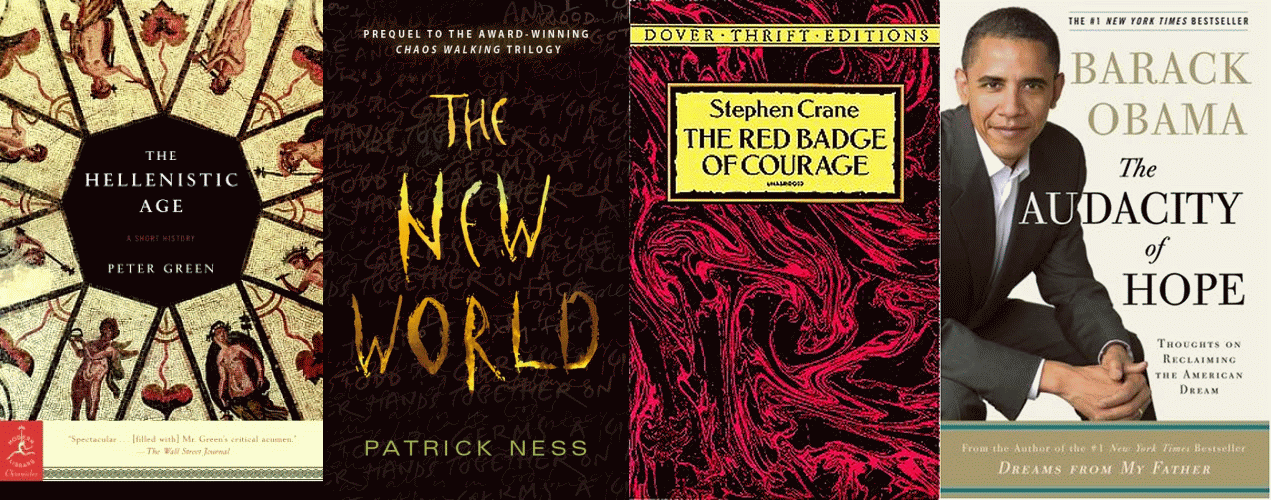
The Hellenistic Age by Peter Green, "The New World" by Patrick Ness, The Red Badge of Courage by Stephen Crane, and The Audacity of Hope by Barack Obama

The Dead that Walk edited by Stephen Jones, "They" by Vincent Hobbes, The Time Machine by H.G. Wells, The Zombie Survival Guide: Recorded Attacks by Max Brooks, and Blockade Billy by Steven King

Thursday, December 29, 2011

Dreamers (Original Text - Part Nine) (1997)

     I am pretty sure my intention was always to go back an develop the mini-scenes at the beginning of this section into full blown chapters.  I never did.  As a matter of fact, this is the last section where I tried to force to original concept of the story into what was developing.  It doesn't mesh well.  There is some decent dialogue, though.  Not great descriptive text, but I think I was trying to be very minimalistic with that.
If you are at all curious as to what page Nancy opens the Social Psychology book to, it would look very much like this.

IX

     It was a rule of life that could be depended upon.  Dave Burke didn't remember his dreams.  Technically, that was still true.  When he woke up, at five fifteen Saturday morning, he had known it was because of something in a dream.  It didn't feel scary, just something sudden.  Like a quick muscle movement in response to some imagined stimuli.  But he knew it was something in a dream.
     The day would be like this.  Burke didn't regret agreeing to work today.  First of all, overtime at eight and a quarter an hour was a healthy wage, and money was money.  More importantly, the shift he was taking belonged to Anika Lang, a young blonde who Burke desperately wanted to be better acquainted with.  A relationship can only go so far at the workplace, and Anika had always been friendly there.  She was going to a cousin's wedding or some such.
     Work.  Work on a Saturday.  No time for the band.  But people work on Saturday, one way or the other.

     Not more than an hour and half later, Larry Pudenski and Mike Carver were back at the warehouse setting up for the whole fleet of company vehicles.  An electrical explosion at one of the job sites set up for an emergency work day.  All other jobs, both company and side, would wait.  Mr. Pudenski and Don were already at the site.  It was just a matter, now, of getting the appropriate supplies and manpower there to fix what went wrong.  Or, more likely, to get the damage repaired and restore power; sometimes the source of the problems couldn't be addressed right away.
     For Mike Carver, it would be another day of lecturing.  He could tune it out easily enough.  The job was demanding; it would be the priority.  Neither Mr. Pudenski or Larry would have time, early on, to go off on a tangent.  For better or worse, the day would end at a bar or pizzeria with pitchers of beer.  Things could get worse than that.
    
     "I can't believe I agreed to do this."
     "You don't have anything else to do, and I could use the help.  Besides, you wanted some answers, right?"
     "The anger?"
     "Exactly.  Tit for tat."
     Nancy let a small laugh escape and turned back to the pile of books Jason had put in front of her.  "And you want to know what got me over J.B.?"
     "It wasn't sex.  He would have said something.  My guess is that you met somebody."
     "No.  I think its more that I've finally not needed someone."
     "Page two fifty eight, Social Psych."  This was met by only a blank look on Nancy's face.  "They gray book with the ferris wheel on the cover."
      Nancy opend the book.  Beneath a bar graph and a paragraph or two filled with green highlighted text was the sub-chapter heading in boldface: The Market Value of Physical Attractiveness.
     "That's not what I had in mind."
     "I need you to retype that entire sub-chapter so it can be photocopied."
     "Again, not what I had in mind."
     "I am paying you for this.  And you'll get your answers."
     She began to type the text into the computer, but not so carefully that spellchecker wouldn't be necessary.  Jason would be reading over other subjects in other books and typing them into another of his computers.
     "How does a poor boy like you afford three computers?"
     "I never throw anything away."  Jason gestured to an older model that sat in the corner of his bedroom collecting dust.  "That's from the late eighties.  It will serve to do this, but not much else.  No good for games."  He thumped the one he was working on.  "This is about three years old.  Its almost as bad as the first.  The beauty you are working with is the best prize I've ever won.  A three and a half thousand dollar computer, over five thousand dollars worth of programs and accessories."
     "That's a lot of luck.  Like with the stereo."
     "You're taking your luck from somebody."
     "Karma?"
     "That would imply you deserve it.  You cruise through school.  Don't give me that look, Jason.  You might bust your ass but you got all the breaks.  You have the school supporting you best it can.  You got Melissa the second you lost Stacy.  Somebody is on the downside of all that."
     "Good things happen to good people."
     "Attractive people are better liars than ugly ones."
     "That's not what it says, Nancy.  People are more likely to believe the lies of attractive people than they are the lies of those they find unattractive.  The funny thing is knowing that doesn't help much.  It doesn't say that they lie more, and it doesn't help to be suspicious of those to whom you are attracted."
     Nancy began typing again.  She would have just assumed to have asked how one could tell when wariness became suspicion.  When did it go beyond concern?  When did it stop being self-protecting and turn self-destructive?  That was what Jason was studying.  Sort of.
     Instead, she asked, "Why wouldn't you want to be with Melissa?"
     "I want to marry Melissa."
     That was more than Nancy expected.  She sat silent.
     "You're asking about last Sunday?"  She responded to Jason's question with a nod.  "It's a bit of a story.  You may know some of it already.  Okay, let's get a few beers and move to someplace more comfortable."
     "Your bed?"
     "The living room."
     Nancy found herself sprawled out across Jason's couch.  She had half a bottle of Rolling Rock in her left hand.  An empty bottle was on the floor next to the couch.  She had finished it before Jason had sat down in the chair opposite her.  He held a can of Schlitz  in his right hand and wore an odd grin on his face.
     "You are aware that I don't get to see Melissa much.  Not given how close we live to one another at any rate.  There is the assumption that I love her, that I am in love with her.  I won't dismiss those notions.  There are few times that I can find reason to not want to be with her.  Then there are my friends.
     "I need to spend time with my friends.  I know a lot of them from high school, or college.  They aren't like my colleagues.  God, I have colleagues.  But it isn't the same thing.  These friends of mine are slipping away.  Maybe that's natural, but it doesn't sit well with me.  If you didn't have the luxury of being able to take the time, you wouldn't be here today.  If you were Larry or J.B., or even Vicki, you wouldn't have that luxury.  And I wouldn't have the luxury to accommodate your free time if it weren't for your willingness to help me get some work done.
     "I spent a night with my friends.  Melissa would have spent it with hers up at Northwestern if you hadn't dragged her down to your parents' house."
     "I still qualify as one of Melissa's friends."
     "Yes, you do.  And she has a batch of friends from school.  Just like you and I did in Ann Arbor."
     "But you were a frat-boy."
     "I got better.  And I even found a better school without having to leave the Midwest.  Where was I?"
     "Friends.  Hers and yours."
     "I'll skip that.  Nancy, it was like you wanted me gone, wanted me trapped with Melissa.  Not a bad place to be trapped, but I don't want to have to give up the people who have meant so much to me for so long.  I don't want to be told that I have to be with 'the woman'.  Didn't it used to be okay for me to drop by unannounced and pick up some people to do something?  It was as though you wanted to expedite my exodus."
     "The anger?"
     "Sometimes its fun to be angry."
     "Therapeutic?"
     "No.  Probably a little harmful in the long run.  But it can be fun."
     Nancy finished off her second beer.  Jason wasn't done with his can of Schlitz.
     "Ready to go back to work, Miss Klein?"
     She smiled, although it was a bit forced.  Jason hadn't really said much.  There had to be more to it than Jason's lack of faith in the durability of his friendships.
     "You have another thing to answer."
     "What?"
     "It's about you and Melissa and a woman's needs."
     Jason blushed, but more than that, he dropped his beer.
     "Well?"
     "Off limits."
     "No, Jason.  You gave me bullshit about the anger.  I want an answer to this one."
     "It's about sex.  I can't imagine that there is anything I can say about the topic that would be unknown to you."
     "I don't know much about the sex between you and Melissa."
     "Thankfully."  He couldn't look her in the eye.  "What has Melissa told you?"
     She only smiled coyly.  It was most definitely not forced.
     "The woman's needs phrase refers to the fact that Melissa wants more physical contact."
     "You mean sex."
     "Not necessarily one in the same."
     This time it was Nancy who turned red.  She couldn't help but give a nervous laugh.  "Phone sex?  You talked Melissa into having phone sex with you?  And I'm guessing this is one a regular basis."
     "Well, I'm glad I told you.  Now."
     "Isn't that some sort of perversion?  Or sexual deviance?  Do you prefer it to real sex?"
     "Because this isn't where I wanted this conversation to go."
     "I'm serious."
     "No, I prefer real sex.  Very much so.  But there are time constraints, and it's still with her..."
     "It's twisted."
     "That's why we don't talk about, Nancy."
     "Does it mean a lot that it is with her?"  He nodded.  "Then it's sweet." 
     "I've gone from perverted and deviant to twisted in sweet in less than a minute."
     "Quick recovery, Dr. MacLeod."
     She was laughing and Jason was about to continue the banter, but he noticed something about her eyes.  It was actually in her eyes.  There was a flash of light, and he had no idea what it meant.  There was no reason for him to have known as not many people had experienced it themselves.  Nancy had.  It was something spectacular.
     Then she was on the floor, almost unconscious.  He was over like a shot.
     "Bad acid flashback?"
     "Something just happened – to someone."
     "Are you okay?  You look dazed."
     "I don't know who..."
     He helped her onto the couch.  She was going on about some sort of psychic event.  He didn't bother to try to explain that psychologists used psychic in a different context than laypersons.  She calmed down a bit, more to ease Jason's mind than because of any direct influence he may have had.
     "So, you're psychic?  Why aren't I analyzing your dreams, then?"
     Nancy gave him the bird.
     "Then what was it."
     "Someone we know, and something bad."
     "Do you like deluding yourself like this?"
     She propped herself up on an elbow.  "Would you rather talk about your twisted virtual sex life?"
     "Just the sweet part."
     "I know what I'm talking about."
     "You sound like J.B.  Did he ever tell you about when the werewolf stole him out of his bed?  I think he was five.  It just snatched him up in his blanket and ran off with him.  But something was chasing the werewolf.  Like a white knight.  The creature threw him under the stairs and escaped out the front door."
     "That's just a story."
     "A dream.  But he woke up under the stairs wrapped in the same blanket.  He thought he had a demon after him.  He might still; it isn't something we talk about, he and I.  There is too much there for me to read into."
     She almost forget that Jason was mocking her sixth sense.  She didn't believe in it, not very often at least.  Then there were times it couldn't be defined.  It was more than coincidence.  Maybe J.B.'s dream was like that.  It was a definite insight into his make-up as a person.
     "Should we call it quits for the night?  You're still shaken.  I'm going to call Melissa—"
     "From a different room, please.  I don't want to watch that."
     He had no immediate response.  It was too well timed.  Like the time his Chemistry T.A. had added "-less" to a girl's statement about how much she was worth.  He should have laughed.  He wanted to.  Unfortunately, he was beginning to feel some sickness in his stomach.  Like he had just lost his best friend.  Or someone had walked on his grave.  He sat down on the couch and quietly told Nancy as much.  He didn't like to think that perception could exist beyond the perceivable.  Her state had now affected him.
     "I am going to get Melissa here."
     "I should go, then."
     "No."
     "She and I are friends, but not even for you, Jason."
     "I'm touched, but I would rather stay working.  If you're right about this, maybe I could do a research paper on this para-psychological event into something publishable.  I could be the next Peter Venkman."  He didn't wait for her to ask who that was.  "Bill Murray in Ghostbusters."
     "No thanks."
     "Then I'm a concerned friend who want to take care of you, and wants his girlfriend to help out."
     "On one condition."
     He said he was open to suggestions.  He said he wanted a list of options to choose from.  He used a lot of words to say so.
     "Tell Melissa you want to marry her."
     "Eventually."
     "Because that's all that makes it sweet."  She could tell Jason wasn't listening.  "The only thing that makes any of this perversion at all acceptable is that it is very important that it is Melissa, and not someone else."
     "I don't want a lecture."
     "But I know sex.  You have to let her know how much you care.  Let her know that its about love, not your getting your rocks off."
     "When she gets here."
     "Because I'm scared to be here with you until then."  She drew him in with her eyes.  "Were you angry because you thought I was going to wreck your perfect little system?  You call her when you need her, and then you are done.  She's a fun little tool, and real sex is great, but since time matters a phone call will do it?"
     "She and I worked this out, Nancy.  It doesn't sound romantic, and it probably isn't.  It is part of the system.  You want me to throw that away for love."
     "You love her!"
     "I've never told any woman that I love her."
     Nancy wanted to say something meaningful.  "Not even your mother?  Or your sisters?  No one?"
     "Not since I turned twenty one.  Not even my Gramma.  Nancy, I consider you a good friend, but I'm not real comfortable talking about all of this.  I've told Pudenski I love him, because he's like the brother I never had.  I told Lew Pittman, too.  I haven't gotten beyond that."
     It gave Nancy a huge insight into Jason MacLeod.  He and Larry had been friends since they were five.  Llewellyn Pittman was a friend to both of them, but he died when they were all in high school.  Nancy guessed that it was just as likely that Jason told Lew how much he cared for him at the funeral as it was that he said it when he was alive.  Then in college he decided he wasn't going to tell anyone he loved them?  That would have coincided with Stacy Andrews.
     "Is this all about St. Andrews?"
     "I always hated that you called her that."
     "Your Catholic princess.  The light of your life.  Wasn't she still a virgin when you two started dating?"
     "At least we are beyond the idea that you're a psychic."
     "I still want to talk about that."
     "You're just better at talking about sex."
     "I believe I can paraphrase it by saying 'you preach what you know.'"  She was starting to feel better.  "I want another beer.  And I want to talk about St. Andrews.  And it would be nice it you would believe me about this feeling.  Iwas right about Lynn leaving Larry."
     "Nice alliteration.  And all you said was that Lynn was going to go back to New York."
     "She did!"
     "Four weeks later.  Then they didn't break up for another month."  He sighed.  "You know if I don't call Melissa now, I won;t be able to get her here."  Jason walked over toward the kitchen, looking for the phone.  "And no more beer for you."


Wednesday, December 28, 2011

Blockade Billy (2010)

     Impressed with Steven King's ability to inject an interesting character study into his zombie story "Home Delivery", I decided to give him another chance.  However, Blockade Billy (2010) was probably the wrong choice if I wanted to be impressed.  It is unbelievably short – a short story claiming novella status by virtue of font size and spacing – and the version I checked out from the library did not have the bonus story "Morality". 
     King relates the improbable story of a baseball player removed from the game and record books after one month in the 1957 season.  The player, the titular Blockade Billy Blakely, is called up to play for the fictional Newark Titans (there are Newark Titans at the Ohio State University and the New Jersey Titans are a Women's Spring Football team).  He is an odd duck but one hell of a baseball player.  The entirety of the tale is told as though it is being related to King by the retired Third Base Coach from that team.
     There isn't much in the story.  It is breezy, maybe a little too much so.  King doesn't quite know what kind of story he wants to tell and is quick to go back to peppering in plenty of curse words to fill out the dialogue (something I first noticed when reading his short stories over 20 years ago).  It appears as though King had an idea for a story – and didn't want it to be any kind of horror – but couldn't quite find the human angle.  The reflective observations about what may have been the motivation for Blockade Billy to do what he did felt forced, as though King wanted to have a moral to the story.  I don't think it needed one, not if he had committed to developing it in a manner that would have engaged the reader in the strange month long odyssey of the team.
     I am glad I didn't invest 1,000 pages in a King book to get something like this, but as it was an insanely quick read I am not complaining.  I do think that this story could have been left to sit and be revisited when King had a better idea of what he wanted to do with it; he certainly doesn't need to put out books to put food on the table these days.  There are a couple of King stories I do want to read, and I hope they are betting than Blockade Billy, but I have read worse from established authors.  And much worse from people like myself who can only aspire to be authors.

Tuesday, December 27, 2011

The Zombie Survival Guide: Recorded Attacks (2009)

     Sure, I gave The Zombie Survival Guide (2003) as a Christmas present to a coworker many years ago – I want to say it was 2004 – but I never read it.  I glanced through it, but it didn't seem to hold much appeal for me.  For a book that was filed under humor, it seemed leaden.  Moreover, it felt lazy.  Now, I will own the fact that it irresponsible for me to come to those conclusions without actually reading at least one entire section of the book.  The person to whom I gave the book was happy with it, and author Max Brooks has gone on to have much success churning out more titles relating to the zombie apocalypse.  As I had an entire day free, I decided to give Brooks another shot – though this time in graphic novel form, as I was sure it would not take much time to get through it.
     That was an understatement.  The Zombie Survival Guide: Recorded Attacks (2009) features some compelling black and white artwork by Ibraim Roberson.  It is not expressive of action, but is detailed and moody.  Still, it cannot make up for the lack of anything resembling story in any of the vignettes Brooks half informs.  There isn't much in the way of connective material to link the stories, nor does Brooks do anything to make one believe he should be praised for his research in squaring his fantasies of sporadic outbreaks of the undead and actual history.
     The Zombie Survival Guide: Recorded Attacks feels more like an attempt to storyboard a mishmash of a film, where zombies could be incorporated into multiple eras.  Nothing in it is compelling on its own, and when taken together it just comes off as an attempt for Brooks to wring more money out of a genre that he doesn't seem to have added anything to.  Maybe I'm wrong.  Maybe in the full text of The Zombie Survival Guide and World War Z (2006), Brooks does make many and varied contributions to the genre beyond giving a name to the virus that creates his zombies.  But in my limited experience, Brooks offers nothing new and does so in an unimaginative manner.
     I cannot imagine that anyone would be satisfied with this product at its list price of $17.00 (though I doubt few buy their books at list price these days).  It is too short, too disjointed, and not distinctive enough to merit being necessary in any collection.  As a tie-in, it may satisfy a need for some fans to see Brooks' imagining of a world perpetually at risk of a zombie uprising play out over a 62,000 year span.  By itself, it only serves as a reminder of how many attempts to tell a zombie story with nothing behind it have plagued the foreign and direct-to-video film markets over the past decade.  I also think that Brooks did Roberson a disfavor by not listing the artist's name on the cover.
     Whether or not this completely turns me off to ever giving World War Z a chance – I think that most authors who are not graphic artists do not translate well into this medium – I know that I will continue to be leery of Brooks.  Having seen him on Deadliest Warrior (2009-present) and the Starz produced Zombie Mania (2008), I am filled with a sense that he is a man who is enamored with the idea of zombies but cannot find any voice to make the concept his own or structure the zombie apocalypse as to give it any kind of allegorical meaning.